
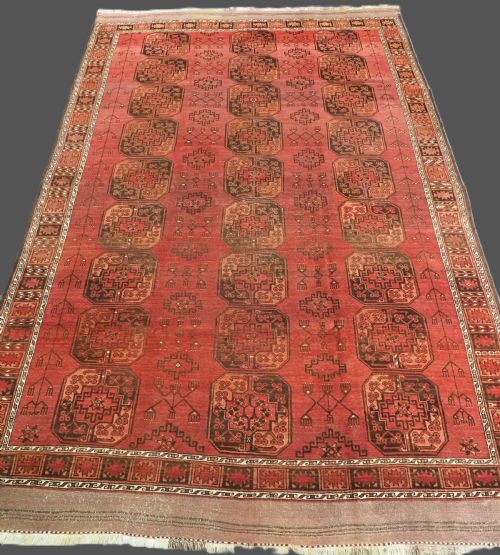
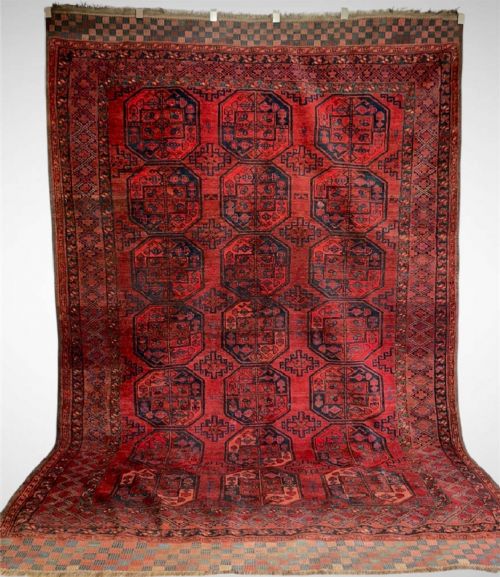
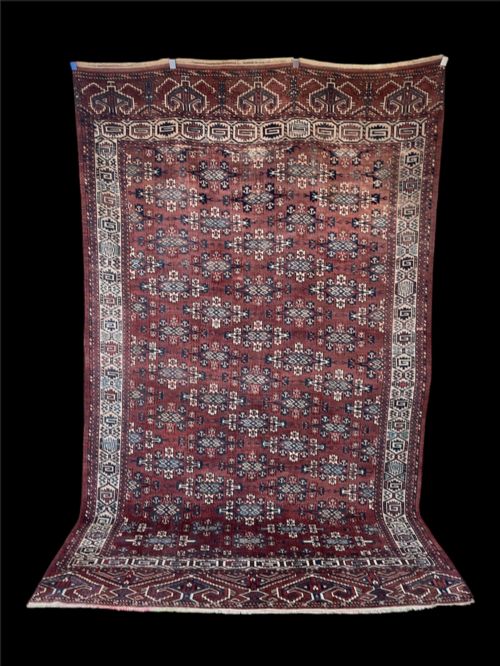


Turkmen Main Carpet
When you search for a turkmen main carpet, you are looking for a tribal floor covering defined by distinctive regional guls and deep red hues.
Turkmen Main Carpet
A turkmen main carpet represents the traditional weaving output of various Central Asian tribal groups originating from regions such as the Trans-Caspian steppes, the Akhal oasis, and the middle Amu Darya river valley. These large format floor coverings served important domestic and ceremonial functions within nomadic and settled communities.
Tribes including the Tekke, Ersari, Yomut, Chodor, and Kizil Ayak each developed distinct layout structures and secondary ornamentation that allow specialists to attribute provenance. Examples frequently surface in various sizes, ranging from small room formats down to compact tribal rugs.
The aesthetic centres on repeating geometric medallions known as guls, arranged in regimented rows across a field of madder-dyed red or pink wool. Border systems utilise intricate minor motifs such as curl leaves or hooked elements to frame the field.
Wool and Natural Dyes
Weavers constructed these pieces entirely from locally sourced wool, utilising durable pile knots secured onto woollen warp and weft foundations. This dense fibre construction provided the structural integrity required to withstand heavy daily use within tent or domestic dwellings.
Colour palettes rely on natural dye sources, yielding rich tones of madder red, warm pink, brown, and ivory. These organic colourants produce subtle tonal variations across the pile that deepen gracefully over time.
Turkmen Main Carpet Retail Price Guide 2026
Typical asking prices for turkmen main carpet among the pieces listed under this phrase on Sellingantiques today, from the lower quarter to the upper quarter. They describe what is for sale here now, not the wider market.
The inventory records pieces dated from the mid nineteenth century up to circa 1900, constructed entirely from wool and natural dyes.
Design Clarity and Pile Integrity
Quality separates on the precision of the drawing and the saturation of the natural dyes within the field. Finely rendered guls and crisp secondary motifs indicate superior weaving standards maintained by experienced artisans.
The condition of the wool pile and the survival of original elem ends at the top and bottom margins dictate the desirability of a specimen. Examples retaining full pile depth alongside balanced proportions command higher regard among collectors.
The Turkmen Main Carpet Glossary
- Gul
- A primary geometric medallion repeated across the field of a turkmen main carpet. Different tribes utilised specific gul variations to signal cultural identity.
- Elem
- The decorated end panel situated at either the top or bottom of a carpet beyond the main border. These sections often feature subsidiary shrub or tree motifs.
- Madder
- A natural red dye derived from the roots of the Rubia tinctorum plant. It forms the foundation of the characteristic red and pink palette seen in these textiles.
- Warp
- The vertical foundation threads stretched lengthwise on the loom before knotting begins. Wool warps provide the underlying tensile strength for the entire structure.
Turkmen Main Carpet: Frequently Asked Questions
What is a gul?
A gul is the repeating octagonal or geometric medallion that forms the primary decorative motif across the field of these Central Asian carpets.
Different tribes adapted these shapes into distinct variations such as the Tauk Nuska, Kepse, or Dyrnak designs, allowing modern observers to trace the origin of a specific textile.
Where were these carpets made?
These textiles originated across the Trans-Caspian steppes, the Akhal oasis, and the middle Amu Darya region in Central Asia. Nomadic and semi-nomadic groups including the Tekke, Ersari, and Yomut produced them in local encampments and settlements.
Production later expanded into surrounding areas such as Afghanistan, reflecting the migration and trade patterns of these distinct tribal populations.
How do I care for an antique rug?
Protect the wool pile by placing the textile in a low-traffic area away from direct sunlight to prevent fading. Vacuum gently using suction only without a rotating brush roll.
Rotate the textile periodically to ensure even wear patterns and consult a specialist textile conservator for professional cleaning when required.
How are different tribes identified?
Specialists identify tribal origin by examining the geometry of the primary guls, the structure of the border guards, and the secondary colours utilised in the field. Each group maintained strict traditions regarding their weaving layouts.
Minor design details and specific structural characteristics in the wool foundation provide further evidence for regional attribution.