
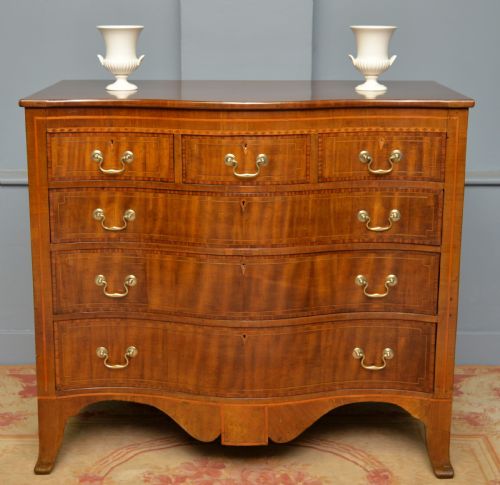


Serpentine Wooden Box
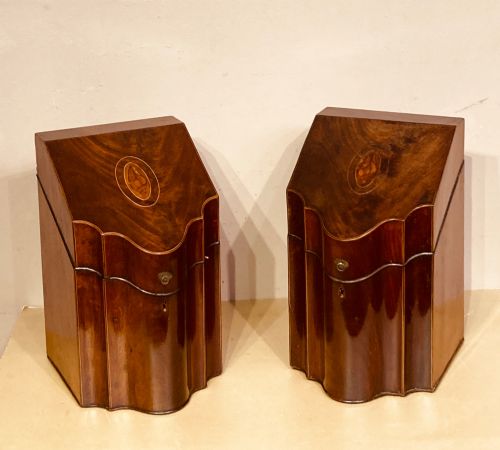
These serpentine wooden boxes bring fluid eighteenth and nineteenth century lines into any room, prized for their curved fronts and rich timber grains.
Serpentine Wooden Box
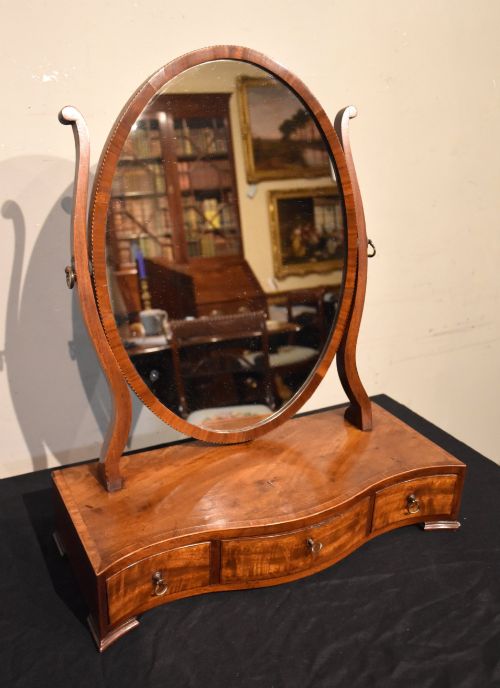
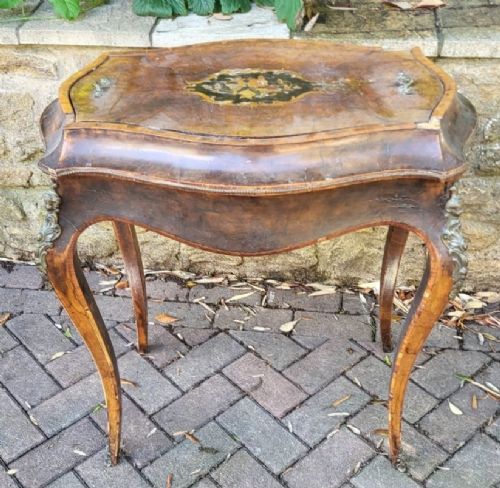
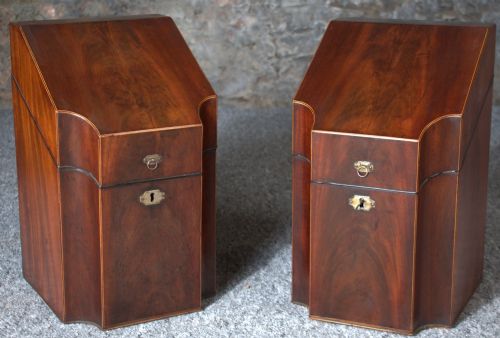
A serpentine wooden box is most frequently met on this page as an eighteenth century or Georgian knife box, often found in pairs, alongside dressing mirrors and tea caddies shaped with gentle undulating fronts. The selection also spans Victorian burr walnut planters, French thuya wood collectors pieces, and Italian lacquer keepsake cases.
Makers shaped these forms from mahogany, walnut, satinwood, and boxwood, applying brass fittings, bone details, and intricate string inlay to enhance the undulating profile. These objects served practical domestic roles, from holding cutlery and stationery to preserving personal valuables on dressing tables.
What varies in quality
Quality rests in the choice of timber grain, where highly figured fiddleback or burr mahogany elevates a piece far above plain stock. The precision of the serpentine curve and the crispness of the inlaid boxwood stringing dictate the maker's initial skill.
Hardware selection marks the difference between standard production and top tier work, evident in chased brass fittings and intact original interior partitions. The survival of polished surfaces and deep patination over centuries completes the hierarchy.
Listings feature mahogany, walnut, satinwood, and boxwood across eighteenth century Georgian and nineteenth century Victorian periods.
The Serpentine Wooden Box Glossary
- Serpentine
- A shape characterised by a central convex curve flanked by two concave curves, creating a fluid undulating front. This profile requires high carpentry skill to execute cleanly in solid timber.
- Stringing
- A narrow strip of contrasting wood inlaid into the surface to create delicate decorative borders. Boxwood is frequently used against darker mahogany for this linear contrast.
- Fiddleback
- A figure in mahogany exhibiting ripples that resemble the grain of maple used for violins. This pattern catches the light and denotes superior timber selection.
- Escutcheon
- A protective plate surrounding a keyhole, usually fashioned from brass in these pieces. It often mirrors the decorative style of the surrounding cabinet work.
Serpentine Wooden Box: Frequently Asked Questions
What were serpentine wooden boxes used for?
These boxes primarily functioned as knife boxes, cutlery storage, or stationery cabinets in dining rooms and studies. Dressing mirrors served similar domestic purposes on bedroom tables.
Over time, many knife boxes found new life holding letters or keepsakes, while smaller caddies and cases stored tea, jewellery, or collector items.
How do I date an antique wooden box?
Dating relies on timber species, construction methods, and stylistic markers such as inlay patterns and brass hardware shapes. Georgian pieces often feature solid mahogany with boxwood stringing.
Later Victorian examples introduce burr walnut and French veneers alongside different interior configurations. Comparing grain patination helps confirm age.
Are knife boxes found as pairs?
Yes, many eighteenth century knife boxes appear as matching pairs designed to sit symmetrically on sideboards. Surviving pairs retain identical dimensions and hardware.
Single boxes also appear frequently in the listings, having been separated over centuries of use in different households.
How should I care for a mahogany box?
Maintain the timber by keeping the box away from direct sunlight and sudden temperature changes that cause wood to crack. Dust gently with a dry cloth.
Apply a microcrystalline wax occasionally to nourish the polished surface without building up heavy residues. Avoid liquid polishes entirely.