
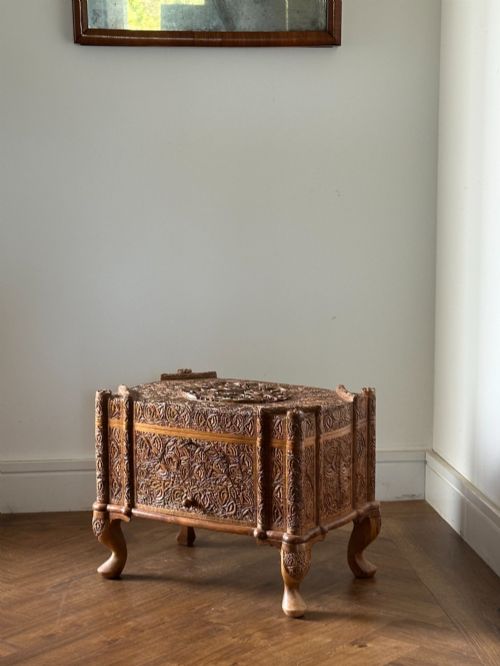
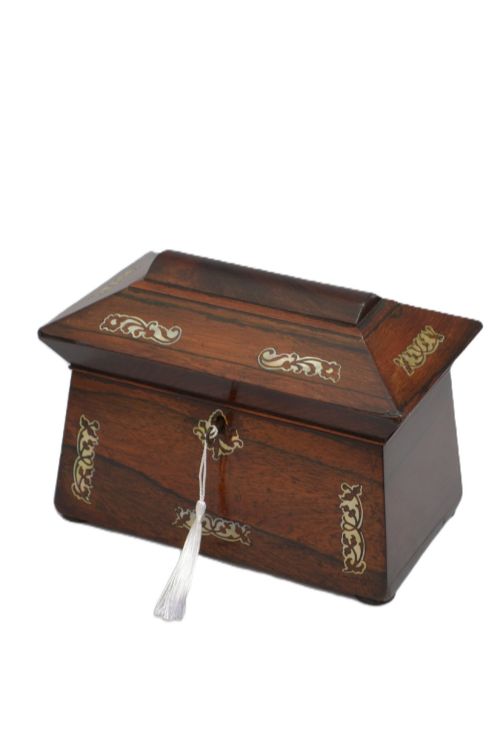


Sarcophagus Jewellery Casket
These sarcophagus jewellery casket pieces are architectural receptacles shaped like ancient tombs, designed to hold precious trinkets and prized keepsakes securely upon a table.
Sarcophagus Jewellery Casket
When you search for a sarcophagus jewellery casket, you encounter compact table cabinets and lidded boxes modeled on classical monument forms. These objects serve to store valuables while adding a formal architectural presence to domestic interiors.
The versions most frequently met on this page date from the Regency and Victorian periods, taking forms such as workboxes, sewing boxes and dedicated keepsake boxes. They emerge primarily in solid woods like rosewood and mahogany, often with leather bindings or exotic veneers.
Makers shaped these vessels with sloped lids and stepped profiles mirroring ancient stone tombs, sometimes mounting them upon small feet. Their interiors generally reveal fitted compartments for needlework implements, rings and loose ornaments.
How they were made
Cabinet makers constructed these boxes using dense timbers such as rosewood and satinwood, frequently applying decorative veneers over secondary woods. They integrated detailed inlays of mother-of-pearl, bone and contrasting woods into the surfaces to create geometric or floral patterns.
Metalwork played a structural and decorative role, with brass mounts, hinges and handles secured to the exterior. Interiors utilised silk linings, fitted wooden trays and leather tooling to organise the storage spaces neatly.
Some sewing boxes hid compartments secured by secret wooden latches, requiring a specific sequence of lifts to reveal the hidden stash.
What varies in quality
The standard of a piece depends heavily on the choice of timber and the precision of its veneers. Highly figured grains like burr yew and coromandel elevate the visual depth of the exterior significantly.
Craftsmanship is further judged by the execution of interior fittings and the complexity of mother-of-pearl inlay work. Integral brass mounts and stable, well-fitted lids demonstrate superior construction compared to simpler utilitarian boxes.
The Sarcophagus Jewellery Casket Glossary
- Sarcophagus
- A stone coffin used in ancient times, whose sloping lid profile inspired the distinctive shape of these nineteenth-century boxes.
- Regency
- An architectural and design period spanning the early nineteenth century, characterised by classical revival motifs and refined proportions.
- Mother-of-pearl
- The iridescent inner layer of mollusc shell, cut into thin plates and embedded into wooden surfaces for decoration.
- Rosewood
- A heavy, dark timber with distinct figuring, widely utilised by cabinet makers for luxury boxes during the Georgian and Victorian eras.
Sarcophagus Jewellery Casket: Frequently Asked Questions
What were these boxes used for?
These vessels were designed to safely store personal valuables, letters and delicate jewellery upon dressing tables or drawing-room surfaces.
Many examples also doubled as workboxes or sewing caskets, containing internal compartments for threads, needles and small tools.
How do I date a box?
Dating relies on observing the prevailing timber choices, hardware styles and construction methods typical of specific design eras.
For instance, brass paw feet and bold rosewood veneers point firmly toward Regency production, while later Victorian pieces often incorporate different inlay techniques.
Are the interiors usually original?
Many boxes retain their fitted wooden trays and partitioned compartments designed for specific domestic tasks.
Silk linings and fabric elements, however, frequently show signs of replacement due to natural degradation over the decades.
Where were these caskets made?
English workshops produced the majority of these pieces, drawing upon imported tropical timbers routed through expanding global trade networks.
Certain items reflect regional specialisms, including Anglo-Indian production utilising indigenous woods and traditional carving methods.