

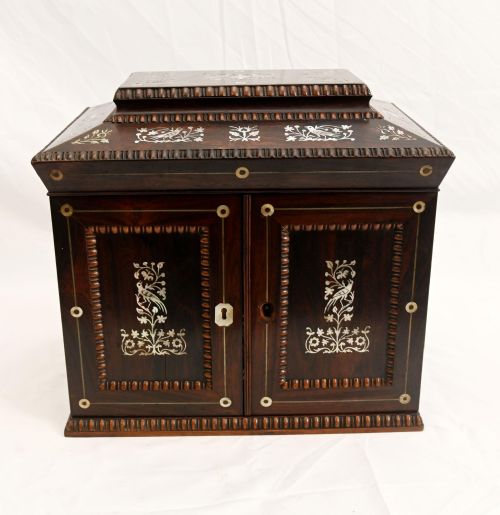


Sarcophagus Jewellery Box
These sarcophagus jewellery box pieces are architectural tabletop caskets built to hold trinkets, offering secure storage and period presence.
Sarcophagus Jewellery Box
A sarcophagus jewellery box takes the form of a classical sloping tomb, sitting on bracket feet or claw and ball supports. You will most frequently meet Regency and Victorian examples shaped from dense timbers, designed to house precious personal items and needlework tools.
The objects serve multiple purposes beyond simple storage, functioning as table cabinets, workboxes, and keepsake chests. Makers structured these caskets with compartmentalised trays and velvet or silk linings to organise rings, brooches, and sewing implements.
Originating largely from English workshops, these pieces span the Georgian, Regency, William IV, and Victorian periods. The forms range from modest table boxes to large cabinets adorned with brass mounts and intricate veneers.
Materials and construction
Cabinet makers utilised heavy hardwoods such as rosewood, coromandel, satinwood, and yew, often laid over a secondary wood carcass. These polished surfaces frequently received contrasting stringing or geometric inlays.
Decoration relied heavily on mother-of-pearl inlay, brass stringing, and cast brass mounts. Artisans also employed red Russia-leather and tooled leather bindings, alongside delicate bone details and silk or velvet interior linings.
Sarcophagus Jewellery Box Retail Price Guide 2026
Typical asking prices for sarcophagus jewellery box among the pieces listed under this phrase on Sellingantiques today, from the lower quarter to the upper quarter. They describe what is for sale here now, not the wider market.
One surviving leather-bound writing slope preserves an engraved initial "K", offering a quiet whisper of its original owner.
Variations in quality
Quality reveals itself in the choice of timber figure, such as burr yew or highly grained rosewood, and the precision of the mother-of-pearl or brass inlay. Superior examples display seamless mitre joints and carefully fitted internal trays lined in fine fabrics.
The sophistication of the hardware and feet distinguishes the output of standard workshops from finer commissions. Heavy cast brass mounts, engraved initial plates, and functioning locks with keys elevate a piece above simpler leather-bound or plain wooden variants.
The Sarcophagus Jewellery Box Glossary
- Sarcophagus form
- A sloping-lidded box shape reminiscent of an ancient monumental stone coffin. This profile defines the architectural silhouette of these caskets.
- Rosewood
- A dense, dark timber featuring distinct grain patterns, favoured for nineteenth-century luxury furniture and boxes. It takes a high polish.
- Mother-of-pearl
- The iridescent inner layer of mollusc shell, cut into thin geometric shapes and pressed into wood veneers. It provides bright contrast against dark timbers.
- Workbox
- A container fitted with compartments and trays for sewing tools, threads, and small crafts. Many sarcophagus designs doubled for this use.
- Table cabinet
- A larger tabletop storage chest featuring multiple drawers or doors. These pieces sit on furniture surfaces rather than the floor.
Sarcophagus Jewellery Box: Frequently Asked Questions
What fits inside a sarcophagus jewellery box?
These boxes accommodate rings, brooches, necklaces, and small keepsakes within their partitioned interior trays. Many examples also include specialised wells and velvet-lined sections originally intended for sewing tools and thimbles.
The deeper lower compartments allow for slightly bulkier trinkets and folded letters. Silk and velvet linings help cushion delicate items against the wooden structure.
How do I date a sarcophagus jewellery box?
Dating relies on identifying the primary wood species, decorative motifs, and hardware styles associated with specific eras. Regency pieces often feature brass inlay and claw feet, whereas Victorian examples frequently showcase extensive mother-of-pearl work.
Internal construction details, such as hand-cut dovetails and silk lining techniques, also offer clear clues to the period of manufacture. Surviving keys and engraved presentation plaques can further narrow down the timeline.
Were these boxes used only for jewellery?
Makers constructed these caskets to serve multiple domestic roles, including sewing, letter storage, and general keepsake organisation. Interior fitted trays with needle compartments demonstrate their frequent use as workboxes.
Larger variations functioned as gentleman's table cabinets or desktop stationery cases. Owners adapted the modular compartments to suit whatever valuable personal items they possessed.
How should I care for a wood box?
Keep the wood away from direct sunlight and extreme humidity fluctuations to prevent veneer splitting and warping. Occasional dusting with a soft, dry cloth maintains the polished finish without damaging delicate inlays.
Avoid using modern liquid polishes, which can build up in the carved details and soften old glue or fabric linings. Gentle handling of the original hinges and locks ensures the moving parts remain functional.