

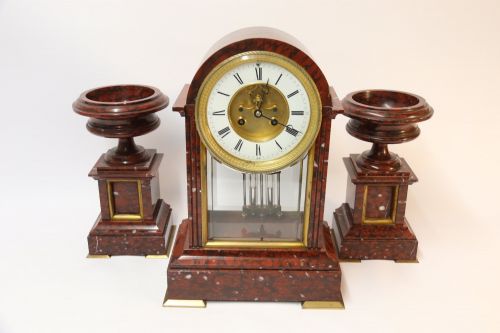


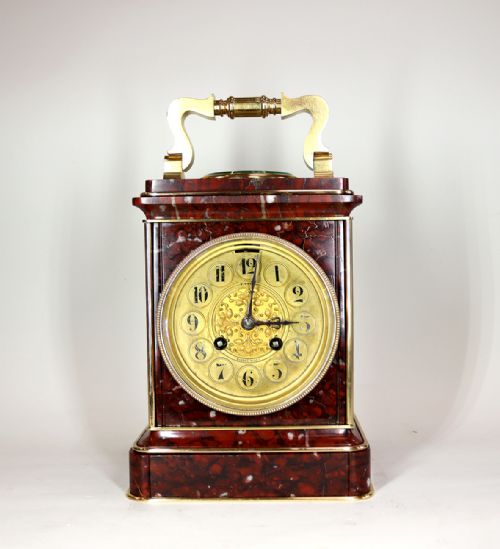


Rouge Marble Mantel Clock
These heavy rouge marble mantel clocks combine deep red stone with gilt bronze and enamel dials to anchor a room with architectural presence.
Rouge Marble Mantel Clock
A rouge marble mantel clock brings together the striking presence of red marble with traditional French horology, predominantly originating from the nineteenth century. Buyers searching for a rouge marble mantel clock will encounter pieces spanning the Victorian era and periods such as the Second Empire and Louis XVI style.
The forms range from single mantel clocks to substantial clock garnitures accompanied by side ornaments. Many of these pieces integrate bronze, ormolu, and brass mounts alongside the polished stone.
Originating largely from French workshops, these clocks utilise materials like red marble, glass, and enamel dials. The physical weight and the interplay of gilt metal against deep red stone define the visual character of the objects found in this category.
Materials and construction
The foundation of these pieces rests on heavy rouge marble, shaped into architectural cases and columns. Workshops combined this dense red stone with cast bronze or ormolu mounts, securing decorative elements to the marble body.
Clock faces typically feature enamel dials protected beneath glass bezels. Gilt bronze and brass details are fastened to the stone housing, completing the multi-material construction characteristic of nineteenth-century French clockmaking.
Rouge Marble Mantel Clock Retail Price Guide 2026
Typical asking prices for rouge marble mantel clock among the pieces listed under this phrase on Sellingantiques today, from the lower quarter to the upper quarter. They describe what is for sale here now, not the wider market.
Some carriage clocks grew ambitious enough to wear heavy red marble coats.
Distinctions in quality
Quality in these clocks emerges from the crispness of the bronze casting and the depth of the rouge marble figure. Finer examples display detailed chasing on the ormolu mounts and harmonious integration between the metalwork and the stone case.
The presence of matching garnitures and signed movements by known makers elevates the standing of a piece. Lesser examples rely on simpler marble forms with minimal or cast mounts that lack the sharpness of top-tier workshop output.
Samuel Marti·Le Roy Paris·Raingo Freres
The Rouge Marble Mantel Clock Glossary
- Rouge marble
- A rich red ornamental stone with white or grey veining, heavily utilised for nineteenth-century French clock cases and architectural ornaments.
- Ormolu
- A gilded bronze technique involving the application of a finely ground gold-mercury amalgam to cast bronze, giving a bright golden finish.
- Clock garniture
- A set comprising a central mantel clock accompanied by matching side ornaments such as urns or candelabra.
- Enamel dial
- A clock face made by fusing powdered glass to a metal base at high temperatures, often featuring painted Roman numerals.
- Second Empire
- A mid-nineteenth-century French design period known for eclectic revivals of historical styles and opulent decoration.
Rouge Marble Mantel Clock: Frequently Asked Questions
What periods do these clocks come from?
The pieces seen here belong predominantly to the nineteenth century, encompassing the Victorian era and French periods like the Second Empire and Louis XVI style.
Dates cluster around the mid to late nineteenth century, reflecting the height of French decorative clock production.
Are these clocks usually sold with garnitures?
Many listings include clock garnitures, which are matching sets featuring side ornaments alongside the main mantel clock.
Single mantel clocks also appear frequently, offering a more compact option for a fireplace mantel or shelf.
What metals are used alongside the marble?
Makers mounted these stone cases with bronze, ormolu, and brass decorative elements.
Gilt bronze and ormolu provide a bright contrast against the dark red figure of the rouge marble.
How do I identify the style?
Styles draw heavily on French design vocabulary, including Louis XVI Revival, Empire, and Renaissance Revival motifs.
Look for architectural columns, classical mounts, and symmetrical proportions characteristic of nineteenth-century French workshops.