


Rosewood Tapestry Screen
A rosewood tapestry screen brings warmth and texture to a room, offering both decorative needlework and protection from the hearth.
Rosewood Tapestry Screen
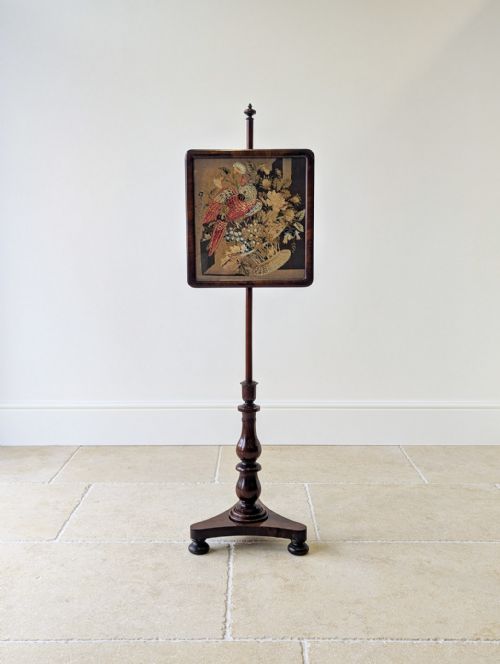
A rosewood tapestry screen typically takes the form of a pole screen, featuring an adjustable needlepoint or embroidered panel mounted on a slender upright stand with a tripod base. These furnishings served a practical purpose in period homes, standing before fireplaces to shield inhabitants from radiant heat.
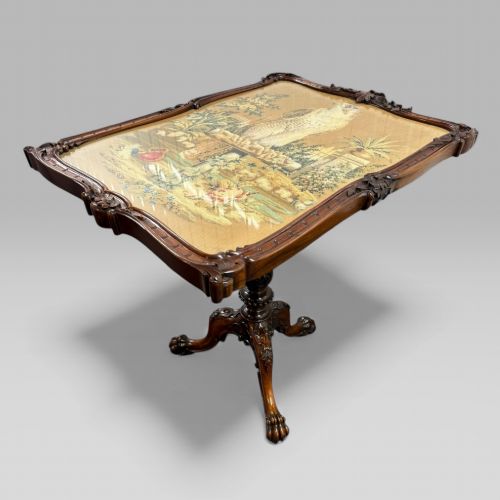
Most examples found here date from the nineteenth century, spanning the Regency, William IV, and Victorian eras. Alongside traditional pole screens, the selection occasionally includes cheval screens and table screens designed for placement on side tables or desks.
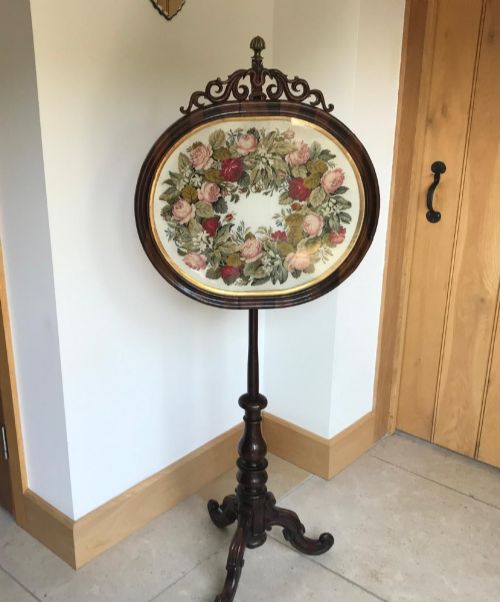
The panels themselves display hand-woven wool needlework, often depicting floral motifs or pastoral scenes. Makers combined dark timber with textile art to create items that functioned as both movable partitions and decorative focal points.
What varies in quality
Quality rests in the crispness of the timber carving on the base and the finesse of the needlework panel. Superior pieces feature finely turned columns, substantial tripod legs with detailed carving, and densely stitched pastoral or floral woolwork.
The sophistication of the mechanical adjustment mechanism also distinguishes better examples. Smooth movement in the brass fittings and secure placement of the panel indicate superior workshop production.
Listings span the Georgian, Regency, William IV, and Victorian periods, executed primarily in rosewood with wool needlepoint panels.
Gillows
The Rosewood Tapestry Screen Glossary
- Pole screen
- A vertical standing screen with an adjustable panel mounted on a central wooden pillar. This form allowed occupants to raise or lower the textile shield against the heat of an open fire.
- Cheval screen
- A self-standing floor screen supported by two sturdy side pillars rather than a central pole. These larger frames often accommodated wider needlework pictures.
- Needlepoint
- A type of counted thread embroidery stitched onto a stiff open-weave canvas. It forms the primary decorative element for the adjustable panels.
- Palisander
- A dense, heavily figured timber encompassing various rosewood species used by cabinetmakers. It provides the dark, richly grained background characteristic of these frames.
- Tripod base
- A three-legged support system providing stability for the upright pole. These bases frequently feature scroll or claw feet.
Rosewood Tapestry Screen: Frequently Asked Questions
What is a rosewood tapestry screen used for?
These furnishings originally stood near fireplaces to protect people from the intense heat of open fires. The adjustable panels shielded the face while allowing inhabitants to regulate the amount of warmth.
Today, they function primarily as decorative interior pieces. Placed in a corner or beside seating, they introduce historic textile art and warm timber tones to a room.
How do I adjust a pole screen?
Most pole screens utilise a small brass thumb screw or collar located behind the panel frame. Loosening this mechanism allows the panel to slide up and down the central wooden pole.
Tightening the screw secures the panel at the desired height. Care should be taken when adjusting older brass fittings to avoid straining the timber.
How do I tell Regency from Victorian screens?
Regency and William IV screens tend to feature cleaner architectural lines, restrained reeding, and precise brass mounts. The timber grain on earlier pieces often displays rich figuring.
Victorian examples frequently exhibit heavier carving, more elaborate foliate motifs on the tripod base, and busier floral needlework. The proportions on Victorian models can also be notably grander.
Can the tapestry panels be cleaned?
Needlework panels require gentle care due to the age of the wool and canvas. Surface dust can be removed very carefully using a soft brush or low-suction vacuum through a mesh guard.
Water and liquid cleaning agents should be avoided unless handled by a professional textile conservator. Direct sunlight can fade the wool over time, so placement away from harsh windows helps preserve the colours.