





Victorian Rosewood Pole Screen
A victorian rosewood pole screen is a slender fireside shield designed to protect a gentlewoman's face from the blistering heat of an open coal fire.
Victorian Rosewood Pole Screen
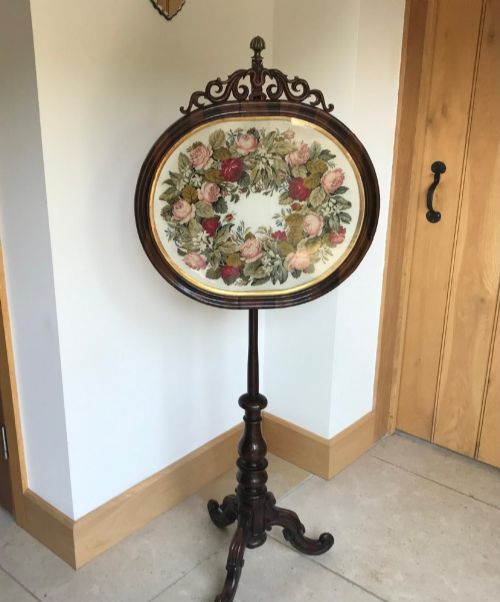
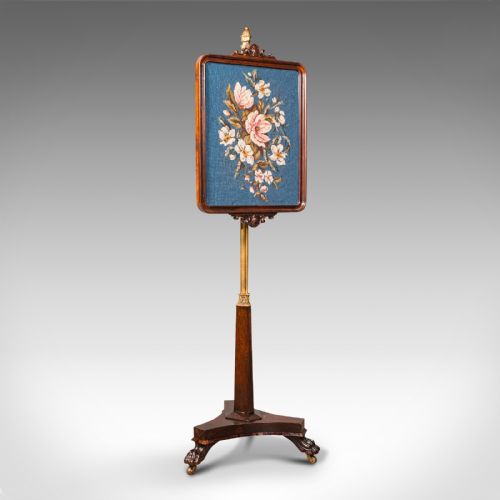
When you search for a victorian rosewood pole screen, you encounter a distinct nineteenth-century furnishing designed to be positioned before a hearth. These stands feature a vertical turned column mounted on a tripod base, carrying a sliding panel that adjusts to block the radiant heat.
The versions most commonly met on this page span the Regency, William IV, and Victorian eras, often displaying rich dark timbers and intricate carved details. They survive both as individual stands and occasionally as matching pairs intended for grander reception rooms.
How they were made
Cabinetmakers turned dense rosewood on a lathe to create the slender central columns and carved the tripod legs with scrolling foliage or claw motifs. The sliding mechanism relied on a small brass thumb screw or internal counterweight that permitted the screen to travel up and down the pole.
The protective panels themselves consist of textile work stretched over a wooden frame, utilising wool, silk, or Berlin woolwork. Skilled needlewomen stitched floral bouquets, pastoral scenes, or geometric motifs directly onto canvas mesh before mounting the tapestry into the frame.
Victorian Rosewood Pole Screen Retail Price Guide 2026
Typical asking prices for victorian rosewood pole screen among the pieces listed under this phrase on Sellingantiques today, from the lower quarter to the upper quarter. They describe what is for sale here now, not the wider market.
Listings for this phrase feature rosewood, mahogany, brass, and tapestry, spanning the Regency and Victorian periods.
What varies in quality
The distinction between standard examples and finer pieces rests primarily in the crispness of the timber carving and the sophistication of the needlework. Better workshops employed heavier rosewood stocks with deeper mouldings and more substantial tripod bases that prevented tipping.
Quality also shows in the complexity of the brass adjusting mechanism and the integrity of the textile panel. Original hand-stitched tapestries with well-preserved wool and silk threads elevate a piece considerably above those with later replacement upholstery.
The Victorian Rosewood Pole Screen Glossary
- Pole screen
- A vertical standing screen with an adjustable panel used to deflect fireplace heat. It typically stands beside the hearth in a parlour.
- Needlepoint
- A type of canvas work embroidery executed with wool or silk yarn. It forms the decorative and functional picture panel of the screen.
- Tripod base
- A three-legged support providing stability to the slender central column. These bases often terminate in scroll or paw feet.
- Berlin woolwork
- A style of charted needlework popular during the nineteenth century using brightly coloured wools. It yields a plush, textured surface.
- William IV
- A transitional design period spanning the 1830s bridging Regency lightness and heavy Victorian forms. Pieces from this era often display bold architectural carving.
Victorian Rosewood Pole Screen: Frequently Asked Questions
How did people use a pole screen?
These screens stood beside the fireplace to shield a person's face and complexion from the intense glare and heat of an open coal fire. Ladies sat behind them to protect cosmetics made from lead and wax from melting.
The height of the textile panel was adjusted up or down along the wooden pole depending on where the heat needed to be blocked. They were portable enough to be shifted around the room as seating arrangements changed.
Where should I place one at home?
A pole screen fits naturally beside a fireplace, reading chair, or sofa where its slender silhouette occupies minimal floor space. It functions well in corners or empty wall spaces that require vertical visual interest.
Keep the textile panel out of direct, blazing sunlight to prevent the historic wool and silk threads from fading over time.
How do I adjust the panel height?
Most screens feature a brass thumb screw set into the collar behind the frame which loosens to allow movement along the pole. Turning the screw counterclockwise releases the grip so you can slide the panel gently to the desired position.
Support the panel with one hand while loosening the screw with the other to avoid putting sudden strain on the historic timber and brass components.