

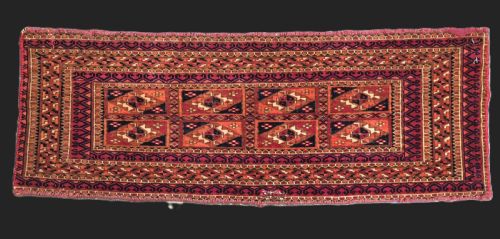
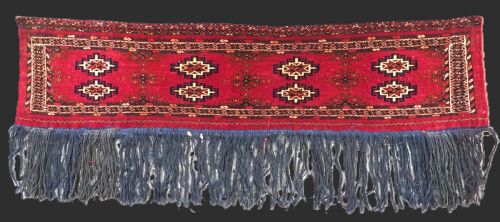


Red Wool Torba Face
When examining a red wool torba face, collectors find woven tribal bags from Central Asia shaped for tent storage and decorated with traditional motifs.
Red Wool Torba Face
The selections available here showcase various sub-tribal groups, most notably Tekke, Yomut, Saryk, and Ersari weavers, spanning periods from the mid-nineteenth century to the early twentieth century. Buyers encounter formats displaying specific tribal gull motifs, such as the Salor gul, kepse, or curled leaf patterns, often dominated by deep madder red grounds.
Many examples exist today as single bag faces separated from their original backings or lower compartments, adapted over time for display as wall hangings or collector textiles. The forms range from small square formats to elongated rectangles, preserving the intricate border designs and primary medallions created by tribal makers.
Materials and Construction
The foundation and pile of a red wool torba face rely on hand-spun wool, sometimes complemented by cotton structures or fine silk highlights used to accentuate specific details within the primary design. Weavers utilised natural dyes derived from local plants and minerals, achieving the rich madder reds, ivory grounds, and secondary dark tones characteristic of these regional textiles.
Weaving techniques involve dense knotting on wool foundations, yielding tight structures that vary from standard commercial density to exceptionally fine weaves found in certain nineteenth-century examples. Artisans completed the edges with sturdy overcast selvedges and occasional flatweave extensions to secure the perimeter before use in the nomadic tent.
Listings feature wool, natural dyes, silk, and cotton across periods spanning the nineteenth and early twentieth centuries.
Assessing Quality and Execution
The distinction between standard and superior pieces rests on the precision of the drawing, the crispness of the tribal guls, and the depth of the natural dyes. Master weavers achieved exceptional symmetry and proportion within complex medallion arrangements, whereas lesser pieces display compressed proportions or muddy colour saturation.
Another measure of quality involves the density of the knotting and the handling of the wool pile, with finer weaves allowing for intricate detail in secondary borders and motifs. The presence of silk highlights and well-preserved ivory grounds also elevates the visual impact of an individual bag face.
The Red Wool Torba Face Glossary
- Torba
- A small tent-storage bag produced by Turkmen and other Central Asian nomadic tribes, typically featuring a wide rectangular format designed to hang against the lattice wall of a yurt. These bags held small household possessions and bedding.
- Gul
- A primary medallion or repeating octagonal motif used in Turkmen rug and textile design to identify specific tribes or clans. Each tribal group utilised distinct variations such as the Tekke or Yomut guls.
- Madder
- A natural red dye derived from the root of the Rubia tinctorum plant, serving as the predominant colouring agent for the wool grounds of these tribal textiles. It produces deep, durable red hues that age gracefully.
- Mafrash
- A rectangular storage bag or hamper container used by nomadic groups for bedding and heavy items, possessing a box-like structure often represented in surviving face panels. These panels mirror the weaving techniques of torbas.
- Kedjebe
- A wedding camel-litter design depicted in tribal weaving, incorporating lattice patterns and triangular motifs associated with ceremonial processions. This design appears frequently on Saryk and Tekke bag faces.
Red Wool Torba Face: Frequently Asked Questions
How were these bags used?
Nomadic families hung these textile bags against the interior lattice walls of their tents to organise belongings and bedding.
The sturdy construction protected the contents from damp ground while adding decorative warmth to the dwelling.
How do I hang a bag face?
Many collectors mount these textile fragments onto neutral fabric backings or use specialist conservation grade clips for wall display.
This approach distributes the weight evenly and prevents strain on the historical wool foundation.
How are tribal designs identified?
Tribal attribution relies on the specific shape and arrangement of the primary guls, secondary motifs, and border structures.
Weavers from different groups like the Tekke or Yomut maintained distinct design traditions passed down through generations.