


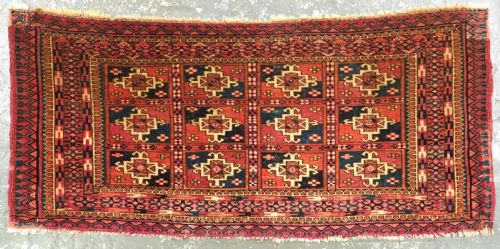
Tekke Rug Fragment
A tekke rug fragment brings the intricate tribal geometry and rich natural dyes of Central Asian weaving directly to your wall.
Tekke Rug Fragment
A tekke rug fragment represents the enduring textile artistry of Turkmen and Central Asian nomad weavers. These pieces originate primarily from nineteenth-century tribal weaving traditions, capturing the sophisticated patterns produced across the Merv Oasis and surrounding regions.
Buyers encounter specialised forms such as torba faces, chuval faces, and mafrash panels rather than full carpets. These surviving sections preserve specific traditional motifs, including Salor guls, curled leaf designs, and panel tree patterns.
The material takes the form of wool worked with natural dyes, often structured with fine weaves intended for dowry furnishings and tent storage bags. Each fragment demonstrates the practical durability transformed into tribal textile art.
Materials and construction
Weavers utilised natural dyes to colour the wool, producing deep, enduring shades that define the palette of these tribal textiles. This reliance on organic colour sources yields varied tones across ivory grounds and darker fields.
The construction relies on wool spun into fine weaves, particularly visible in torba and mafrash faces produced by Tekke tribes. This tight knotting allows complex geometric motifs to remain sharp and well-defined despite centuries of wear.
Listings feature nineteenth-century Turkmen tribal weavings executed in wool with natural dyes, centring on torba and mafrash fragments.
Determinants of quality
Quality rests upon the fineness of the weave and the clarity of the drawing within the design. Pieces exhibiting meticulous execution of motifs like the Salor gul or curled leaf pattern command attention through their precision.
The vibrancy and depth of the natural dyes significantly influence the visual impact of the textile. Superior examples retain rich, unmuddyed colour contrasts, particularly on ivory grounds, distinguishing accomplished tribal work from standard utilitarian output.
The Tekke Rug Fragment Glossary
- Torba
- A small storage bag face produced by Turkmen nomads, often hung inside a tent. These rectangular weavings typically display multiple guls.
- Chuval
- A large tent bag used for household storage by tribal groups. Surviving faces show detailed primary motifs.
- Gul
- A medallion or primary repeating design motif found in Turkmen rugs. Different tribal groups developed distinct variations of these octagonal forms.
- Mafrash
- A rectangular storage container or bedding bag woven by nomadic tribes. Fragments of these pieces preserve complex panel tree or geometric designs.
- Merv Oasis
- A historical region in Central Asia associated with the production of fine Turkmen tribal weaving. This location anchors the geographic origin of many traditional pieces.
Tekke Rug Fragment: Frequently Asked Questions
What is a tekke rug fragment?
A tekke rug fragment is a surviving section of a larger tribal textile, such as a tent bag face or storage panel, woven by the Tekke Turkmen.
These pieces preserve traditional motifs and fine wool construction from nineteenth-century Central Asian nomadic cultures.
How were these fragments used originally?
Nomadic families utilised these textiles primarily as functional storage bags inside traditional dwellings, such as torbas and mafrash containers.
They served both practical storage roles and as decorative dowry items representing the weaver's skill.
How do I display a textile fragment?
Many collectors mount these textile pieces as wall hangings to protect the fragile wool structure from floor traffic and heavy wear.
Proper mounting distributes the weight evenly across the backing material without damaging the historic fibres.
How can I tell the age of a piece?
Age is indicated by the use of natural dyes, the specific structure of the wool, and traditional tribal design elements.
Pieces dating to the nineteenth century or earlier show distinct material patination and hand-spun characteristics absent in later reproductions.