





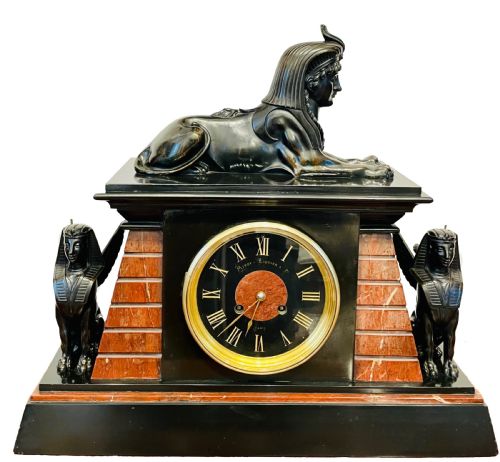
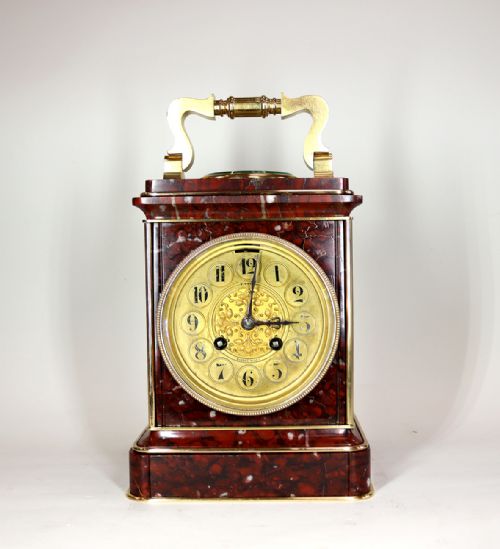

Red Marble Clock
A red marble clock brings substantial weight and deep crimson tone to a mantelpiece, combining mineral presence with precision movement.
Red Marble Clock
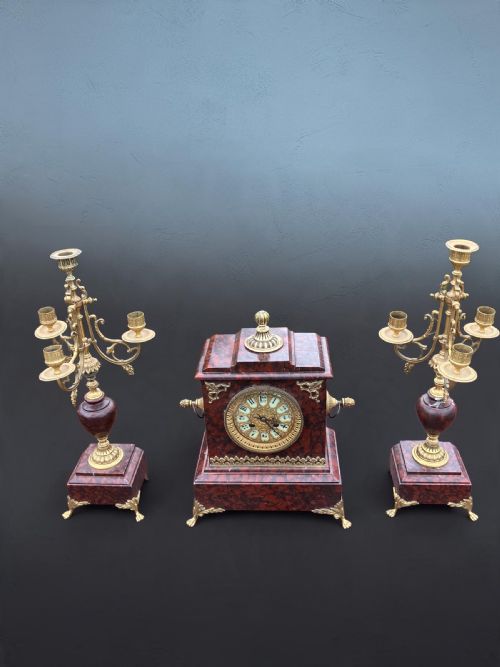
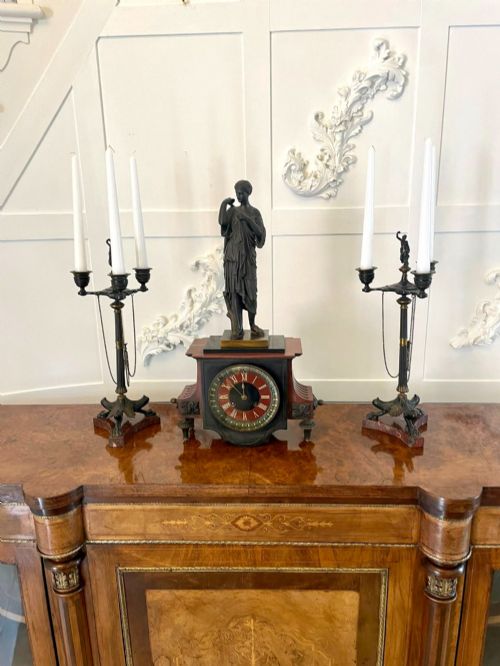
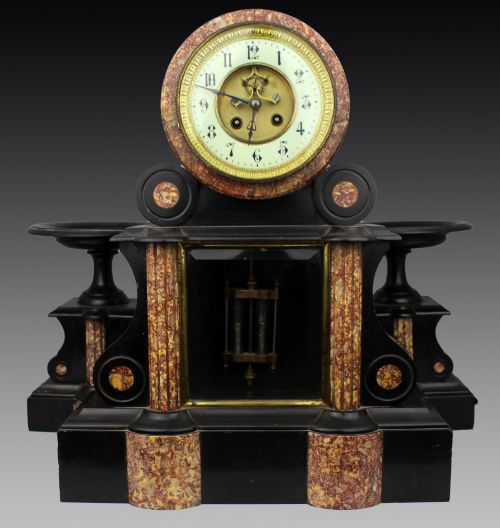
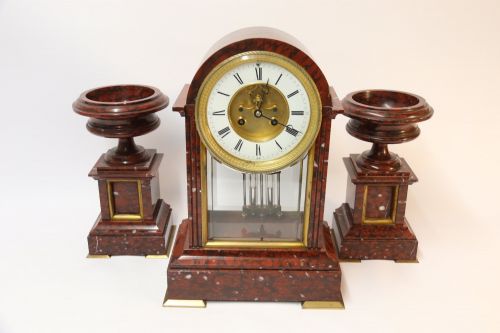
When you search for a red marble clock, you encounter substantial Victorian and nineteenth-century timepieces designed to command the mantelpiece. The pieces listed on this page encompass simple mantel clocks, grand clock garnitures complete with side urns or candelabra, and portico forms.
Most examples originate from nineteenth-century France, spanning the Victorian era and periods such as the Second Empire and Louis XVI Revival. You will find rouge marble frequently paired with bronze, gilt bronze, and ormolu mounts to create imposing architectural or figurative designs.
How They Were Made
Workshops shaped heavy natural stone, specifically rouge marble and specimen marble, into architectural cases and pedestals. Craftsmen then mounted these stone bodies with cast bronze, brass, or ormolu decorative elements, often adding enamel dials and protective glass bezels.
Movements relied on traditional mechanical engineering, utilising components such as silk suspension systems to regulate time. Makers integrated these delicate brass mechanisms directly into the dense stone housings alongside cast figures of bronze or gilded metal.
Red Marble Clock Retail Price Guide 2026
Typical asking prices for red marble clock among the pieces listed under this phrase on Sellingantiques today, from the lower quarter to the upper quarter. They describe what is for sale here now, not the wider market.
Materials span natural stones like rouge marble and black marble alongside metallic elements including gilt bronze, brass, chrome, and glass.
What Varies in Quality
The standard of the casting separates standard production from exceptional work, particularly in the crispness of the ormolu and bronze mounts. Finer pieces display deeply chased figures, cherubs, or architectural enrichment that integrate seamlessly with the polished stone body.
The selection and turning of the marble itself dictate the visual impact of the piece. Superior examples utilise rich rouge marble with varied veining, perfectly matched across clock garniture sets and paired with signed movements from established makers.
Japy Frères·Samuel Marti·Charles Hour of Paris·A. D. Mougin·Fritz Marti
The Red Marble Clock Glossary
- Rouge marble
- A striking red natural limestone with varied white and grey veining. It forms the primary dense stone body for many nineteenth-century French mantel clocks.
- Ormolu
- Gilded bronze produced by applying a mercury and gold amalgam to a cast bronze base. This technique creates a rich, durable golden finish found on clock mounts and garnitures.
- Clock garniture
- A set comprising a central clock accompanied by matching side ornaments such as urns or vases. These decorative sets created balanced symmetry on formal mantelpieces.
- Silk suspension
- An early method of hanging the pendulum from a fine silk thread inside the movement. It provides a delicate and traditional regulating mechanism for nineteenth-century clocks.
- Portico clock
- A distinct architectural clock style featuring a dial supported by four columns. This classical form often incorporates red marble bases and gilt bronze capitals.
Red Marble Clock: Frequently Asked Questions
How do I wind a mechanical marble clock?
Use the appropriate key on the winding arbors found on the enamel dial, turning gently until you feel resistance. Avoid over-winding to protect the internal brass springs.
Ensure the clock rests on a completely level surface so the pendulum beats evenly. Modern placement requires careful adjustment to keep the mechanical movement running accurately.
What is a clock garniture set?
A clock garniture pairs a central timepiece with matching decorative side pieces, such as urns or candelabra. These sets were designed to create a unified display across a mantelpiece.
Originating largely in nineteenth-century France, they share the same marble, bronze, and ormolu materials. This creates a cohesive aesthetic when arranged together in a formal room.
How do I identify a French nineteenth-century clock?
Examine the movement backplate and dial for maker stamps, casting numbers, or foundry marks. Names such as Samuel Marti or Japy Frères frequently appear on quality nineteenth-century mechanisms.
Look also for stylistic cues like Louis XVI Revival mounts, ormolu detailing, and visible silk suspension threads. The combination of heavy rouge marble and cast bronze points directly to this period.