
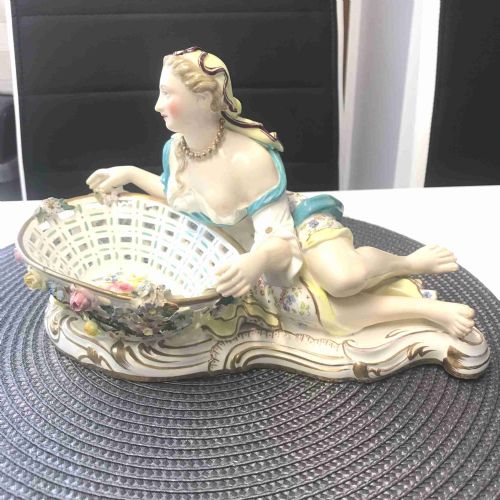


Porcelain Maiden Figurine
These porcelain maiden figurine examples capture classical forms and flowing lines, offering collectors sculptural elegance in ceramic.
Porcelain Maiden Figurine
A porcelain maiden figurine represents a female subject modelled in ceramic, often taking the form of classical figures, water carriers, or mythological maidens.
The pieces on this page span several periods, running from the 18th century through the Victorian era and into 20th-century Art Nouveau interpretations.
Common formats range from standalone statuettes and decorative centrepieces to spill vases and sweetmeat dishes featuring female subjects.
How these ceramic figures were produced
Makers utilised standard ceramic methods, shaping hard-paste porcelain, earthenware, or unglazed parian porcelain through intricate moulding and hand-finishing.
Surface decoration frequently involved applied glaze, enamel painting, and touches of gilt or gold leaf to highlight drapery and floral details.
Several maidens share their display space with small companions like lizards, doves, and wicker baskets.
What separates examples of porcelain maiden figurine works
Quality depends on the crispness of the modelling in the clay, where finer examples preserve delicate facial expressions and the fluid folds of garments.
The application of glaze, enamel, and gilding determines visual depth, with superior pieces showing precise hand-painting rather than flat colouration.
Meissen·Royal Dux Bohemia·Royal Worcester·Ernst Wahliss·Copeland
The Porcelain Maiden Figurine Glossary
- Parian porcelain
- A fine, unglazed biscuit porcelain resembling white marble, often used for nineteenth-century classical figures and portrait busts.
- Hard-paste porcelain
- A durable ceramic composition fired at high temperatures, producing a dense, vitreous body associated with European factories.
- Spill vase
- A small hollow vessel designed to hold taper spills for lighting candles or fires, frequently integrated into figural compositions.
- Sweetmeat dish
- An ornamental bowl or receptacle meant for small confectionery, sometimes supported by a figural ceramic base.
- Vide poche
- A small tray or dish intended for emptying pockets, often modelled with a draped female figure or shell motif.
Porcelain Maiden Figurine: Frequently Asked Questions
What materials are porcelain maiden figurine pieces made from?
The pieces are primarily shaped from porcelain, parian porcelain, or ceramic bodies. Many incorporate enamel, glaze, and gilt highlights to accentuate the sculptural details.
Certain items also utilise earthenware or hard-paste porcelain depending on the period and the producing workshop.
How do I identify Art Nouveau styles in these figures?
Art Nouveau examples display characteristic flowing organic lines, often depicting women with long hair, natural drapery, or water motifs. These designs frequently feature shell elements or stylized botanical accents.
Such pieces typically date from the late nineteenth century through the Edwardian period.
Were these figures purely decorative?
While many served as standalone decorative sculptures or statuettes, others had practical functions within the home. Examples include spill vases, sweetmeat dishes, and vide poche vide-poche receptacles.
These functional items integrated figurative sculpting with utilitarian design.
How do Victorian pieces differ from eighteenth-century versions?
Eighteenth-century examples often exhibit Rococo or Neoclassical styling, such as allegorical figures with floral baskets or elaborate bases. Victorian and later nineteenth-century pieces frequently embrace parian ware or classical revival themes.
The evolution reflects changing aesthetic preferences across European ceramic manufacturing.