
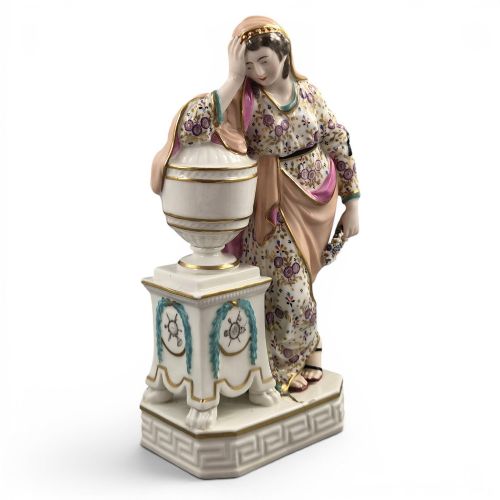


Polychrome Derby Porcelain Statuette
These polychrome derby porcelain statuette examples bring vibrant Georgian and 19th-century character to a room through finely modelled ceramic figures.
Polychrome Derby Porcelain Statuette
When you examine a polychrome derby porcelain statuette, you look at glazed ceramic figures representing classical deities, literary characters, and rustic pastoral subjects. The examples on this page span the 18th century, the Georgian era, and the 19th century, including periods like the patch period and the Bloor period.
Most pieces take the form of single figurines or matched pairs depicting mythological figures such as Diana, Minerva, and Andromache, alongside street vendors and musicians. You also encounter larger figure groups, including representations of Father Time and Pluto with Cerberus.
The selection includes pieces produced directly by the Derby factory alongside later Continental interpretations created in the 19th century in the Chelsea-Derby style or by makers such as Samson and Dresden.
How They Were Made
Potters shaped these objects using soft-paste porcelain during the 18th century, transitioning later to hard-paste porcelain formulations. Craftspeople built the forms in moulds, assembling complex multi-figure groups from separate cast components before firing.
Painters applied polychrome enamel colours by hand across the surface, supplemented by gilding and gold leaf highlights. The application of distinct glazes and enamel pigments defines the visual depth of each statuette.
Several figures portray historical actors like James Quin performing on stage alongside mythological deities and everyday bun sellers.
What Varies in Quality
Quality rests primarily in the crispness of the moulding and the precision of the hand-painted enamel work. Early pieces from the patch period typically display sharper details in facial expressions and drapery folds compared to later mass production.
The sophistication of the modeling separates standard decorative items from superior sculptural groups. Purity of the porcelain body and the careful application of gilding further distinguish the finest examples.
William Duesbury Co·Bloor Derby·Samson
The Polychrome Derby Porcelain Statuette Glossary
- Soft-paste porcelain
- An artificial porcelain composition fired at lower temperatures than hard-paste, common in early English factories. It produces a warm, slightly creamy body underneath the glaze.
- Patch mark
- A characteristic square or circular unglazed blemish on the base of an 18th-century figure. These marks result from the small clay supports used in the kiln.
- Bloor period
- The era of Derby production managed by Robert Bloor during the early 19th century. Pieces from this time often exhibit rich gilding and vibrant enamel palettes.
- Enamel
- Vitreous coloured glass fused to the porcelain surface through secondary firing. This technique provides the bright reds, blues, and greens found on these figures.
- Gilding
- The application of gold leaf or gold paint to highlight garment borders and bases. Master decorators used this method to add formal elegance to pastoral and classical subjects.
Polychrome Derby Porcelain Statuette: Frequently Asked Questions
How were these figures used originally?
Owners displayed these statuettes on mantelpieces, side tables, and dining room sideboard garnitures as decorative conversation pieces. They signaled cultural literacy and refinement to household guests.
Larger figure groups served as dramatic centerpieces, while pairs of figures provided symmetrical balance within period interior decoration schemes.
How do I identify an 18th-century piece?
Eighteenth-century examples often employ soft-paste porcelain bodies that show a warm translucency under strong light. Look for structural characteristics like patch marks on the unglazed bases.
The modeling on these early figures tends to display sharper anatomical definition and restrained, naturalistic enamel palettes compared to later 19th-century revivals.
How should I care for antique porcelain?
Keep these fragile figures away from direct sunlight and areas subject to sudden temperature fluctuations. Dust them gently using a soft, dry brush without applying liquid cleaners.
Display the statuettes on stable, level surfaces where accidental bumps or vibrations are minimised to protect delicate extremities like fingers and instrument parts.