




Ceramic Allegorical Statues
Ceramic allegorical statues embody abstract ideas like the seasons or continents in porcelain form, offering collectors tangible pieces of historical storytelling.

Ceramic Allegorical Statues
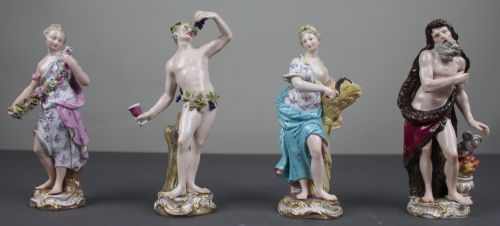
Ceramic allegorical statues represent abstract concepts such as the four seasons, the elements, or the continents through human or putti figures. These pieces frequently draw upon classical mythology and historical themes to personify intangible ideas in porcelain form.
Buyers on this page are most likely to encounter figures and statuettes originating from eighteenth-century English factories like Bow, Derby, and Chelsea, alongside nineteenth-century continental works from Meissen, Samson, and Volkstedt. These vary from single figures representing individual months or elements to complete sets depicting the four seasons.
The physical forms range from small decorative statuettes to substantial porcelain figure groups involving multiple subjects and elaborate bases. Many adopt styles spanning from Georgian Rococo to Victorian revivalism, reflecting the aesthetic preferences of their respective manufacturing periods.
How they were made
Factories utilised soft-paste and hard-paste porcelain body recipes, shaped in moulds or modelled by hand before undergoing high-temperature kiln firing. The resulting white ceramic bodies provided the base for detailed surface decoration.
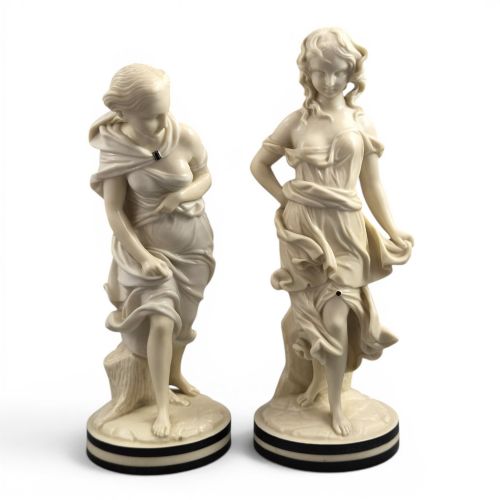
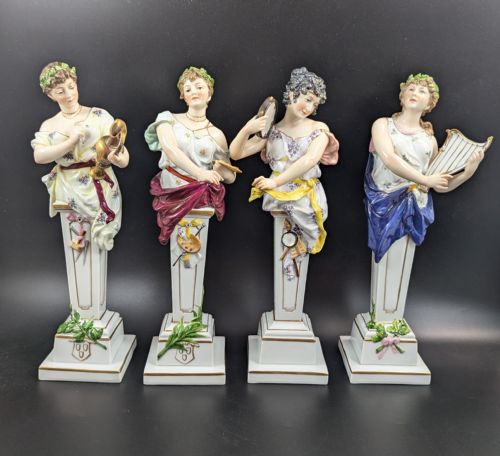
Makers applied enamel colours by hand and frequently incorporated gilding or gold leaf to highlight garment trims, bases, and symbolic attributes. Parian ware also appears as an unglazed alternative, prized for its resemblance to carved marble.
Specialised artists painted intricate facial expressions and naturalistic details onto the fired porcelain, while complex figure groups required individual components to be luted together prior to the final glaze firing.
The site records neoclassical and rococo revival styles across various forms, including single figures, pairs, and complete seasonal sets.
What varies in quality
Painting precision dictates visual success, with superior pieces displaying finely delineated eyes, delicate blush, and controlled application of enamel colours and gilding. Inferior examples suffer from heavy-handed brushwork and poorly registered colour transfers.
Completeness and historical integrity separate exceptional items from standard specimens, particularly in multi-figure sets where matching bases and original factory marks confirm authenticity. Later revival copies achieve technical competence but lack the artistic vitality of eighteenth-century originals.
Meissen·Royal Worcester·Bow Porcelain·Samson of Paris·Volkstedt·Derby Porcelain·Achille Mollica·Royal Berlin
The Ceramic Allegorical Statues Glossary
- Hard-paste porcelain
- A dense, vitrified ceramic composed of kaolin and petuntse that fires at very high temperatures. This material resists scratching and yields a bright, translucent white body.
- Soft-paste porcelain
- An artificial ceramic paste incorporating glass frits and white clays, fired at lower temperatures than hard-paste. It absorbs glaze differently and often presents a warmer, softer texture to the eye.
- Parian ware
- A fine-grained, unglazed porcelain developed in the nineteenth century to imitate carved marble. It is particularly suited to neoclassical figures and allegorical statuary.
- Enamel
- Vitrified metallic oxide colours applied over the glaze and fired again to fuse permanently with the porcelain. These pigments provide the vibrant palette seen on garments and natural bases.
- Gilding
- The application of gold leaf or powdered gold onto the ceramic surface to accent borders and details. This finish is often burnished to create a bright metallic shine.
Ceramic Allegorical Statues: Frequently Asked Questions
What do ceramic allegorical statues represent?
These figures personify abstract ideas, historical themes, or natural cycles such as the four seasons, the elements, and the continents. Artists used classical iconography and symbolic attributes to make complex philosophical concepts visible.
Collectors often seek out complete sets or specific figures that tell a broader allegorical story. Each piece acts as a physical embodiment of Enlightenment or Victorian intellectual pursuits.
How can I identify eighteenth-century pieces?
Eighteenth-century examples generally feature soft-paste porcelain bodies, hand-modelled details, and characteristic unglazed bases known as fire cracks or pinch marks. Early factories such as Bow and Derby employed specific paste compositions that feel distinct to the touch.
Examining the underside and the style of decoration helps distinguish genuine period works from nineteenth-century revivals. Pigments and glaze pooling offer further clues to the manufacturing era.
Where were these figures displayed?
In period interiors, allegorical statuettes occupied prominent positions on mantelpieces, side tables, and dining room dessert services. They served as conversation pieces that demonstrated the owner's classical education and refined taste.
Today, they suit enclosed cabinets or dedicated display shelves where their detailed modelling and delicate enamel work remain protected from accidental damage.
What is the difference between porcelain and parian figures?
Traditional porcelain figures feature glazed and enamelled surfaces with bright colours and gilded highlights. Parian ware, introduced in the Victorian era, is left unglazed to mimic the matte texture of carved marble.
While glazed porcelain relies on painted detail for expression, parian relies entirely on the crispness of the mould and the quality of the translucent body.
Why do some figures have missing attributes?
The delicate nature of porcelain extremities, such as fingers, floral garlands, and symbolic objects, makes them vulnerable to breakage over centuries of handling and relocation. Many figures hold removable accessories that easily separated from the main body.
Collectors accept minor losses or professional restorations depending on the overall rarity and historical significance of the piece.