
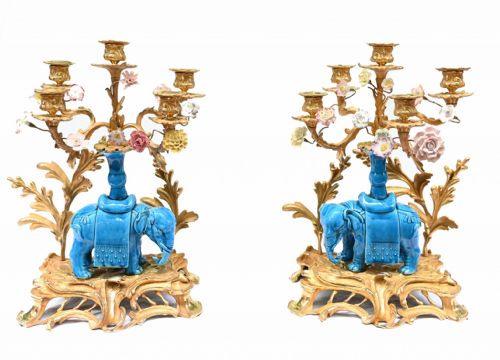


Pair Porcelain Candelabra
These pair porcelain candelabra bring together hand-modelled ceramic and gleaming metal mounts to light a room with eighteenth- or nineteenth-century presence.
Pair Porcelain Candelabra
When you search for pair porcelain candelabra, you encounter dual-branch lighting pieces that combine ceramic bodies with metal armatures. The selection here spans the Victorian era and the late nineteenth century, alongside earlier eighteenth-century examples.
Most pieces you meet on this page originate from European factories such as Meissen, Sevres style workshops, Royal Worcester Hadley, and Sitzendorf. They take various forms, from figural groups featuring gardeners and musicians to exotic animals and classical vases fitted with candle branches.
How they were made
The ceramic components rely on hard-paste porcelain, shaped by hand or moulded before receiving hand-painted enamel decoration and glazing. Factories employed skilled modellers to create figures of birds, musicians, and gardeners with delicate floral bases.
Metal mounts utilise ormolu, gilt bronze, and gold leaf to form intricate scrollwork arms and bases that support the candles. Artisans secured the porcelain bodies into these metal armatures with pins, screws, or specialised adhesives to create a stable two-material structure.
Listings feature hard-paste porcelain combined with ormolu, enamel, and gold leaf across Victorian and nineteenth-century forms.
What varies in quality
The distinction between standard production and the finest work lies in the crispness of the porcelain modelling and the depth of the hand-painting. Superior examples show finely rendered facial expressions on figures and meticulously applied enamel colours that withstand close inspection.
Metalwork quality separates average pieces from exceptional ones through the chiselling and gilding of the ormolu mounts. Heavier, more deeply chased bronze armatures that complement the porcelain curves rather than overpowering them indicate superior workshop output.
Royal Worcester Hadley·Meissen·Sitzendorf·Samson·Sevres
The Pair Porcelain Candelabra Glossary
- Ormolu
- Gilded bronze used for mounts and candle arms. This technique involves applying a mercury and gold amalgam to cast bronze before heating.
- Hard-paste porcelain
- A dense, durable ceramic composed of kaolin and petuntse fired at very high temperatures. It forms the crisp base for European figures and vases.
- Rococo Revival
- A nineteenth-century style mimicking eighteenth-century French design. It uses asymmetrical scrolls, C-scrolls, and naturalistic floral motifs.
- Enamel
- Coloured glass paste fused to porcelain surfaces through firing. It provides the vibrant palette seen on garments, birds, and floral bases.
- Bleu Celeste
- A bright turquoise blue ground colour used extensively on Sevres porcelain. It serves as a rich backdrop for gilded details and painted panels.
Pair Porcelain Candelabra: Frequently Asked Questions
How do I clean pair porcelain candelabra?
Dust the porcelain and ormolu gently with a soft, dry brush to prevent dirt accumulation in crevices and around delicate flower petals.
Avoid using water, liquid cleaners, or abrasive cloths, as moisture can damage the painted enamel or loosen historic adhesives.
Can I still use these for candles?
These pieces were designed to hold lit tapers, but modern use requires caution to protect the antique wax receptors and surrounding porcelain.
Many collectors prefer to display them unlit or use fitted faux candles to eliminate the risk of dripping wax and heat damage.
How do I tell Meissen from other factories?
Meissen pieces often feature distinctive hand-painted figures, birds, or musicians integrated with finely chased ormolu branches.
Examining the modelling quality and consulting factory marks hidden on the base helps confirm the origin of the porcelain.
Why do some have ormolu mounts?
Ormolu mounts were added to protect vulnerable porcelain edges and to provide sturdy structural support for the candle arms.
French and German workshops utilised gilt bronze to elevate decorative vases and figures into functional lighting fixtures for grand salons.