


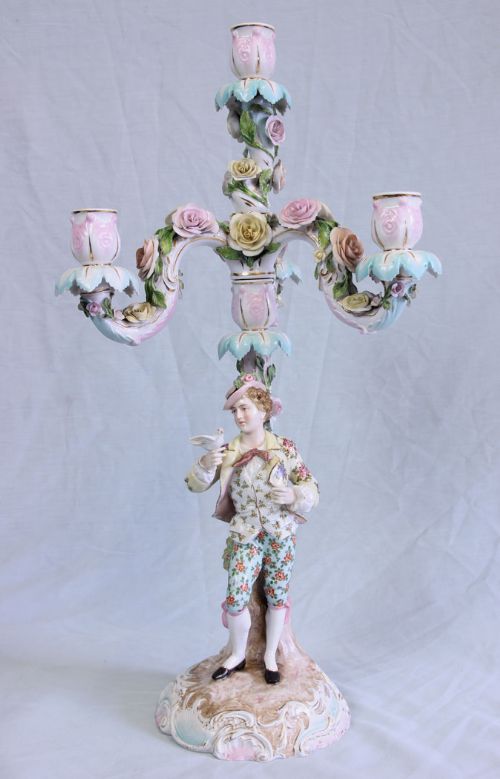


German Porcelain Candelabra
German porcelain candelabra bring elaborate figural modelling and painted floral detail straight to the dining table or mantelpiece.
German Porcelain Candelabra
German porcelain candelabra are decorative lighting pieces designed to hold multiple candles, often incorporating figural groups and elaborate floral bases. When searching for german porcelain candelabra, buyers encounter sculptural forms ranging from simple pairs of candlesticks to large four-arm figural candelabra and complete clock garnitures.
The surviving pieces on this page originate predominantly from the late nineteenth century, spanning the decades between eighteen eighty and nineteen hundred. Many of these items reflect the exuberant curves and organic motifs of the Rococo Revival style, translated into hard-paste porcelain.
Makers such as Meissen, Sitzendorf, Dresden and Saxony dominate the recorded output, bringing distinct regional traditions to the modelling and decoration. Buyers often find these pieces grouped in matching pairs, designed to sit symmetrically on a mantel or sideboard.
How they were made
These pieces rely on hard-paste porcelain fired at high temperatures, providing a durable and bright white body for subsequent decoration. Artisans then applied enamel paint by hand to render delicate facial expressions, clothing details and naturalistic floral bases.
Accents of gold leaf and gilt were frequently added to highlight the moulded contours of the porcelain branches and scrolling bases. Some designs also integrate gilt metal components to support the candle nozzles securely.
German Porcelain Candelabra Retail Price Guide 2026
Typical asking prices for german porcelain candelabra among the pieces listed under this phrase on Sellingantiques today, from the lower quarter to the upper quarter. They describe what is for sale here now, not the wider market.
Gardeners carrying porcelain baskets watch over the candles.
What varies in quality
Quality in these candelabra rests primarily on the crispness of the modelling and the finesse of the hand-painted enamel work. Pieces featuring complex figural groups, such as gardeners with baskets, demand greater sculptural skill than simpler floral designs.
The application of gold leaf and the integration of gilt metal elements also distinguish standard production from finer workshop outputs. Preservation of the delicate porcelain flowers and leaves heavily influences the overall character of each surviving piece.
Meissen·Sitzendorf·Dresden·Saxony
The German Porcelain Candelabra Glossary
- Hard-paste porcelain
- A dense, vitreous ceramic material fired at very high temperatures. It forms the robust foundation for traditional European decorative figures and lighting.
- Gilt
- A thin layer of gold or gold-coloured material applied to the surface of porcelain or metal. It provides reflective highlights along the moulded scrollwork.
- Rococo Revival
- A nineteenth-century design movement inspired by eighteenth-century asymmetry, C-scrolls and natural motifs. This aesthetic defines the curving forms of many nineteenth-century candelabra.
- Garniture
- A set of ornamental objects designed to be displayed together, typically comprising a central clock flanked by matching candelabra or vases.
German Porcelain Candelabra: Frequently Asked Questions
What periods do these pieces date from?
The available evidence spans the late nineteenth century, specifically between eighteen eighty and nineteen hundred.
These dates place the production firmly within the height of European revivalist manufacturing.
Are these candelabra sold as pairs?
Many listings feature matching pairs designed for symmetrical placement on mantelpieces or sideboards.
Single candelabra and larger clock garniture sets also appear in the records.
What materials are used in their construction?
The primary material is hard-paste porcelain, decorated with enamel paint and gold leaf or gilt.
Some examples incorporate gilt metal components to support the branching candle arms.
How do figural pieces differ from standard ones?
Figural designs incorporate sculpted human figures, such as gardeners with baskets, integrated directly into the floral bases.
These figurative elements require advanced modelling techniques compared to purely botanical or scrollwork designs.