


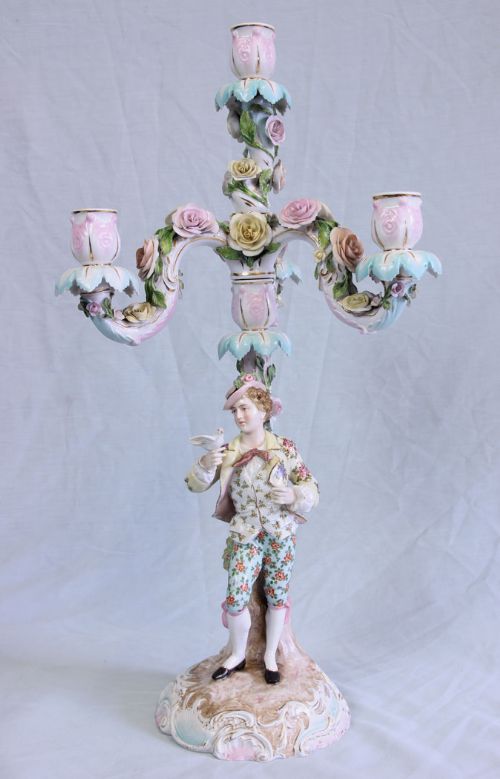


Floral Porcelain Candelabra
These floral porcelain candelabra bring elaborate 18th and 19th century European tablescapes to life with hand-modelled blossoms and gilt metal mounts.
Floral Porcelain Candelabra
When you search for floral porcelain candelabra, you encounter elaborate figural and branched lighting pieces from the 18th, 19th, and early 20th centuries. The selection here leans heavily towards 19th-century German production, particularly from Meissen, Sitzendorf, and Dresden.
Most examples take the form of paired candelabra or candlesticks featuring sculptural figures, birds, or allegorical scenes seated among applied porcelain flowers. Clock garnitures also appear, integrating matching candelabra into a unified mantel display.
The aesthetic is dominated by Rococo Revival and French Chateau styles, marked by scrolled bases, asymmetrical curves, and abundant floral encrustations. These pieces function as decorative centerpieces that combine sculptural ceramics with functional branched candle holders.
Materials and construction
The foundation of these pieces is hard-paste porcelain, shaped into figures, bases, and individual petals by skilled modellers. Artisans applied delicate porcelain flowers by hand, creating dense floral thickets that cover the bases and stems.
Listings feature 19th-century German factories including Meissen, Sitzendorf, and Dresden, alongside 18th-century pieces.
Assessing craftsmanship and condition
Quality separates in the precision of the hand-modelled flora and the crispness of the figure painting. Top-tier pieces exhibit finely detailed facial expressions and intricate, undamaged petals, whereas lesser examples show thicker, simplified flower applications.
The integration between the porcelain body and the gilt bronze or ormolu mounts dictates the overall harmony of the object. Heavier, more substantial metalwork and secure fixings distinguish the finest workshop output from standard commercial production.
Meissen·Sitzendorf·Dresden·Helena Wolfsohn
The Floral Porcelain Candelabra Glossary
- Hard-paste porcelain
- A durable ceramic material fired at high temperatures using kaolin and petuntse. It provides a crisp white body that holds sharp sculptural detail and vibrant enamel colours.
- Ormolu
- Gilt bronze created by applying a finely ground mercury and gold amalgam to a bronze object before heating. This technique produces a rich, durable golden surface finish.
- Rococo Revival
- A 19th-century design movement that revives the 18th-century French Rococo style. It is characterised by C-scrolls, asymmetric plant forms, and elaborate ornamentation.
- Clock garniture
- A set comprising a mantel clock flanked by matching decorative objects such as candelabra or vases. These suites create a balanced arrangement for a fireplace mantel.
- Figural candelabra
- Lighting pieces incorporating human figures, animals, or allegorical characters into the structural design. The figures often interact with the floral bases or hold the candle branches.
Floral Porcelain Candelabra: Frequently Asked Questions
Were these made as pairs?
Many surviving examples were produced as symmetrical pairs to adorn mantelpieces or large dining tables.
Single candelabra and larger clock garniture sets also appear within the 19th-century production.
How do I spot a Meissen piece?
Meissen pieces often feature distinct figural modelling and fine enamel painting characteristic of the renowned German factory.
They frequently date from the 19th century and appear alongside ormolu mounts or as part of garniture sets.
What is a clock garniture?
A clock garniture pairs a central mantel clock with matching side pieces, usually candelabra or urns.
This matched arrangement creates a cohesive decorative display for formal interiors.