
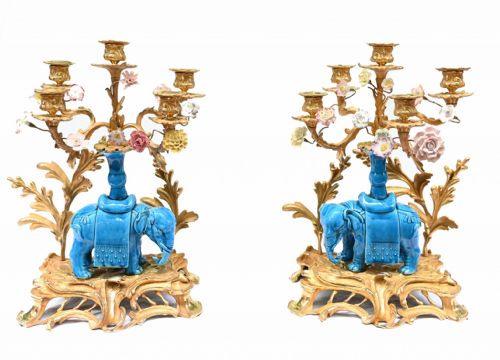


Victorian Ceramic Candelabra
These Victorian ceramic candelabra combine porcelain manufacture with branched candleholders for practical lighting and decorative presence.
Victorian Ceramic Candelabra
Victorian ceramic candelabra encompass porcelain and hard-paste porcelain branched candleholders produced across the nineteenth century and into the early twentieth century. Buyers seeking victorian ceramic candelabra will encounter pieces shaped with multiple arms for candles alongside figural and vase-form bodies.
The selection includes matched pairs and individual examples drawing on Rococo Revival, French Rococo Revival, and Neoclassical styles. Makers represented range from English factories such as Royal Worcester to continental European potteries.
Forms extend from standard multi-arm candelabra to candlesticks and table lamps mounted on china bases. Dating across the listings stretches from the mid nineteenth century through to the early twentieth century.
Materials and construction
Makers utilised porcelain and hard-paste porcelain as the primary body materials, shaping them through moulding and figural modelling. Surfaces received coloured glaze and enamel decoration applied by hand before firing.
Many examples incorporate metallic elements such as gilding, gold leaf, and gilt bronze mounts. These metal finishes complement the ceramic bodies and provide structural support for the candle-holding branches.
Listings feature porcelain and hard-paste porcelain combined with enamel, gilding, and gilt bronze across Victorian and early twentieth-century periods.
Assessing quality and manufacture
Quality separates through the crispness of the porcelain modelling and the detail in painted enamels. Finer examples display delicate figural work and precise hand-painting rather than heavier, generic decoration.
The integration of gilt bronze mounts and gold leaf highlights dictates the upper tier of the range. Superior pieces maintain harmonious balance between the ceramic body and the metal or porcelain arms.
Royal Worcester Hadley·Sitzendorf Porcelain·Meissen Porcelain·Dresden porcelain·Helena Wolfsohn
The Victorian Ceramic Candelabra Glossary
- Hard-paste porcelain
- A dense ceramic material fired at high temperatures using kaolin and petuntse. This composition yields a durable, vitrified body capable of holding sharp moulded details.
- Gilt bronze
- Copper alloy cast and finished with a gold layer or amalgam. It provides structural mounts and decorative accents on ceramic bases.
- Rococo Revival
- A nineteenth-century design movement reviving eighteenth-century asymmetrical scrollwork and natural motifs. Pieces in this style feature fluid, curving lines and organic ornamentation.
- Neoclassical
- A style drawing on classical Greek and Roman architecture and art. It relies on symmetry, restrained proportions, and formal decorative motifs.
Victorian Ceramic Candelabra: Frequently Asked Questions
What periods do these candelabra cover?
The pieces span the nineteenth century, including specific dates from the 1870s and 1880s, alongside early twentieth-century examples.
Production dates reflect both Victorian manufacture and later revivals spanning up to 1920.
Are these pieces sold as pairs?
Many listings feature matched pairs of candelabra or candlesticks designed for symmetrical mantelpiece or table placement.
Single examples and converted table lamps also appear within the selection.
What materials are used alongside porcelain?
Makers incorporated enamel, glaze, gold leaf, and gilding to enhance the ceramic surfaces.
Some examples integrate gilt bronze mounts to support the multi-arm candle branches.
Which styles influence these designs?
The aesthetic draws heavily on French Rococo Revival and broader Rococo Revival ornamentation, characterised by scrolls and asymmetry.
Neoclassical influences also appear in more formal, symmetrical compositions.