
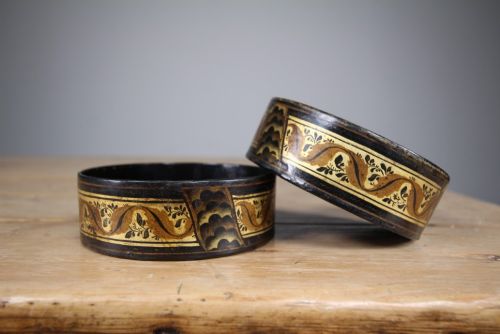


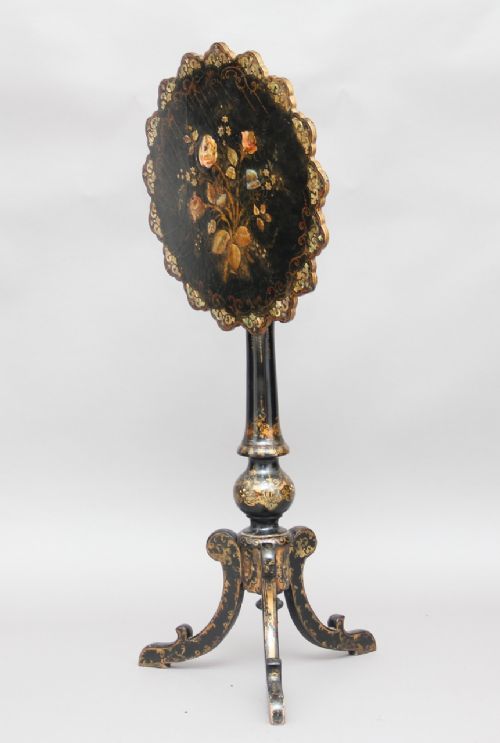


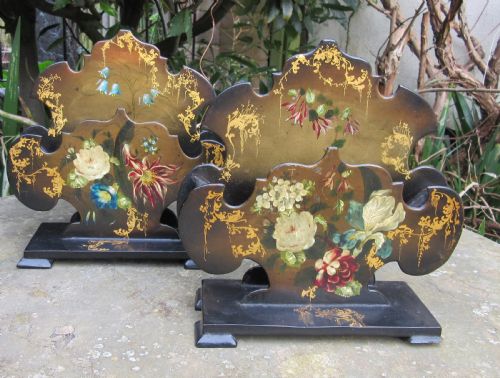

Painted Papier Mache Stand
These painted papier mache stand pieces bring tactile nineteenth-century craftsmanship and hand-decorated surfaces directly into daily domestic use.
Painted Papier Mache Stand
A painted papier mache stand groups functional nineteenth-century desk accessories, wine coasters, letter racks, and tray tables together under one decorative heading. Buyers seeking these items encounter diverse forms originating from the Regency period through the late Victorian era.
The pieces appearing on this page span several distinct forms, including occasional tables, bottle stands, and desk tidies. Many items take the form of trays mounted onto later or contemporary folding bases to create functional tray tables.
Geographic origins vary across the inventory, encompassing English workshops alongside Kashmiri productions and Welsh topographical pole-screens. Each variation reflects the global reach of nineteenth-century decorative arts and regional manufacturing traditions.
How they were made
Makers constructed the foundational body using layers of paper pulp or bonded paper sheets treated with size or glue, pressed into moulds, and dried to create a rigid, lightweight structure. Artisans then applied multiple coats of dark lacquer to seal the surface before embellishing the form.
Decoration relied on skilled hand painting augmented by gold leaf, gilt highlights, and occasional glass inlays. Painters built up detailed motifs, including Chinoiserie scenes and topographical landscapes, directly onto the dark lacquered ground.
Listings feature items spanning the Regency and Victorian periods, utilising papier-mache, lacquer, paint, gold leaf, and glass.
What varies in quality
The refinement of the hand-painted detail and the crispness of the gilt work dictate the standing of individual pieces. Superior examples display precise brushwork and well-preserved metallic leaf without heavy restoration.
Structural integrity also separates standard items from finer works, particularly where trays meet their stands or where lacquer surfaces remain unblemished by extensive craquelure.
Jenners & Bettridge
The Painted Papier Mache Stand Glossary
- Papier-mache
- A composite material made from paper pulp or layers of paper reinforced with glue, baked and shaped into rigid forms. It serves as the primary structural substrate for these decorative objects.
- Chinoiserie
- A European artistic style reflecting Chinese aesthetic motifs, commonly featuring figures, pavilions, and landscapes painted in gold on dark backgrounds. This style heavily influences nineteenth-century lacquered wares.
- Gilding
- The application of gold leaf or powdered gold onto a surface to create decorative highlights. It provides the brilliant contrast seen against black lacquered grounds.
- Coaster
- A small stand designed to hold wine bottles or decanters, protecting table surfaces from moisture and rings. These items often feature shaped rims and painted centres.
Painted Papier Mache Stand: Frequently Asked Questions
Are tray tables original or adapted?
Many papier mache trays from the nineteenth century were paired with folding or fixed stands decades after their initial creation to suit modern domestic living.
Examine the underside of the tray and the joint fixings to understand whether the base represents a period adaptation or a later addition.
How can I distinguish Regency from Victorian pieces?
Regency items typically display neoclassical motifs, cleaner geometric lines, and restrained classical gilding characteristic of the early nineteenth century.
Victorian examples often embrace busier ornamentation, including heavy Chinoiserie landscapes, mother-of-pearl inlays, and topographical scenes dating from the mid-century onwards.
Where were these items manufactured?
Production centred primarily in English workshops, particularly in Birmingham and London, alongside notable export hubs in Kashmir.
Regional British pieces also emerge, reflecting local landscapes and specific decorative commissions from Welsh and English provincial centres.