


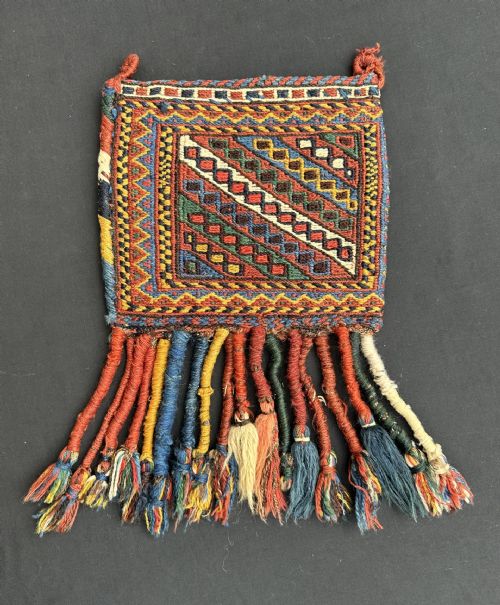


Oriental Rug Fragment Bag
An oriental rug fragment bag brings nomadic textile art into a modern interior, offering tribal patterns and rich wool pile in a compact form.
Oriental Rug Fragment Bag
When you search for an oriental rug fragment bag, you encounter utilitarian nomadic weavings created by tribal groups across Central Asia and Persia. These pieces originate as storage pouches, saddlebags, torbas, and chuvals utilised for domestic life and transport.
The selections available here span the nineteenth and early twentieth centuries, featuring distinct regional identities such as Turkmen, Baluch, Afshar, and Shahsavan groups. Most items survive as bag faces or fragments salvaged from larger utilitarian objects after heavy use.
How they were made
Nomadic weavers constructed these items using wool, hand-spun wool, and occasional cotton or silk elements for structural support and contrast. Artisans utilised vegetable dyes and natural dyes to achieve deep crimson, ivory, and earthy tones.
Techniques include hand-knotted pile alongside flatweave and soumak structures. These dense foundations ensured durability for daily nomadic use while displaying intricate tribal motifs.
Many pieces began life stuffed with blankets inside dusty tents before ending up framed on modern walls.
What varies in quality
Quality rests upon the precision of the drawing and the saturation of the natural dyes. Superior examples exhibit crisp tribal guls, balanced proportions, and fine knot density.
The integrity of the remaining wool pile and the clarity of design dictate the visual impact of each fragment. Pieces displaying sophisticated coloration and careful handling stand apart from simpler work.
Yomut Tribes·Baluch Salar Khani Tribe·Afshar Nomads·Tekke Turkmen·Ersari Turkmen
The Oriental Rug Fragment Bag Glossary
- Gul
- A primary medallion or repeating octagonal motif used extensively in Turkmen and Central Asian tribal weaving. It often denotes specific tribal lineages and family clans.
- Torba
- A small storage bag traditionally hung inside a nomad tent for domestic possessions. These rectangular pouches feature finely worked faces.
- Chuval
- A large tent bag utilised for bedding and household storage by nomadic tribes. They typically display multiple guls arranged in rows.
- Khorjin
- A traditional pair of saddlebags used for transport on animals during tribal migrations. Surviving examples frequently appear as single bag faces.
- Soumak
- A flatweave technique employing a wrapping method over vertical warps. This structure creates a durable textile with a textured surface.
Oriental Rug Fragment Bag: Frequently Asked Questions
What is an oriental rug fragment bag?
These items are surviving sections of utilitarian nomadic containers, such as saddlebags and storage pouches, woven by tribal groups in Persia and Central Asia.
Collectors prize them for their concentrated tribal designs and accessible scale compared to full-sized carpets.
How were these bags used?
Nomadic communities utilised these pouches inside tents for storing domestic goods, clothing, and bedding during migrations.
They hung from tent poles or loaded onto pack animals, serving practical storage functions before transitioning into decorative fragments.
How do I display a bag face?
Many collectors mount these textile fragments on fabric backings for wall display as miniature works of art.
Their compact dimensions allow placement in smaller spaces where a full carpet would overwhelm the room.
How do I identify different tribal designs?
Distinctive motifs such as guls, boteh patterns, and tile layouts point to specific regional weavers like the Turkmen, Baluch, or Afshar.
Colour palettes and weave structures further distinguish work originating from the Trans-Caspian steppes or South Persia.