
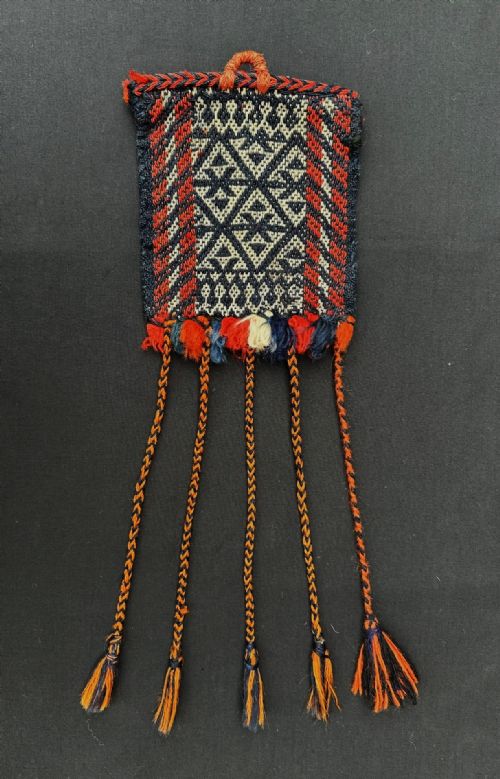
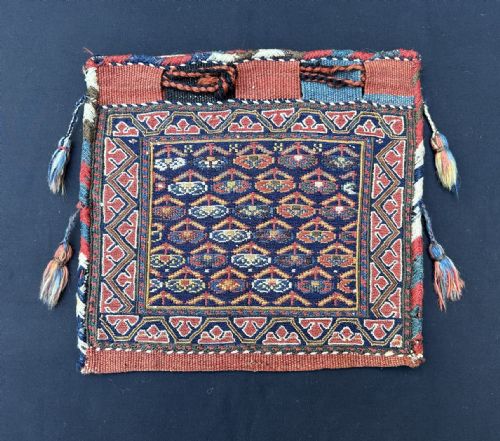


Navy Blue Woven Bag
These navy blue woven bag examples are nomadic tribal weavings created across Persia and Central Asia during the late nineteenth century.
Navy Blue Woven Bag
A navy blue woven bag on this page typically originates from nineteenth-century nomadic groups such as the Afshar, Qashqa'i, and Shahsavan tribes. These pieces manifest primarily as saddlebag faces or half-khorjin fragments woven for practical nomadic transport and storage.
The objects frequently display intricate tribal designs including boteh motifs, bird figures, and geometric patterns rooted in Persian and Central Asian textile traditions. Most specimens survive as single bag faces rather than complete dual-pouch saddlebags, retaining their original utilitarian character.
How they were made
The construction relies heavily on hand-spun wool manipulated through traditional knotting and flatweave soumak techniques. Artisans utilised natural dyes and vegetable dyes to achieve the deep indigo and navy blue ground colours characteristic of these tribal weavings.
Nomadic weavers worked within specific regional traditions, producing textiles structured for durability on horseback or camelback. The integration of lustrous wool fibres with durable cotton foundations ensures the structural integrity of each surviving piece.
Listings span the nineteenth century, focusing on nomadic textiles from West Persia, Fars Province, and Central Asia created using vegetable and natural dyes.
What varies in quality
Quality in these tribal weavings rests upon the handling of the wool and the depth of the natural dyes used to build the navy blue field. Lustrous, luminous wool demonstrates superior material selection by the weaver.
The precision of the tribal design and the complexity of techniques such as soumak work separate standard examples from finer tribal pieces. Intact structural elements like plain weave backs also influence the integrity of the surviving textile.
The Navy Blue Woven Bag Glossary
- Khorjin
- A traditional nomadic saddlebag designed for transport on pack animals. These dual-pouch containers are frequently divided into individual faces by collectors.
- Soumak
- A flatweave textile technique involving coloured weft threads wrapped over warp threads in a herringbone pattern. This method creates a durable surface with distinct structural ridges.
- Boteh
- A stylised floral or almond-shaped motif common in Persian textile art. The symbol represents fertility and life within traditional tribal designs.
- Okbash
- A specific type of Central Asian cylindrical bag used for storing tent poles or belongings. These Turkmen weavings feature distinctive elongated formats.
Navy Blue Woven Bag: Frequently Asked Questions
What is a navy blue woven bag used for originally?
Nomadic tribes utilised these wool containers as functional saddlebags for transporting personal possessions during seasonal migrations across Persia and Central Asia.
The sturdy flatweave and pile construction protected belongings from weather and rough travel while mounted on pack animals.
How do I care for a tribal bag face?
Protect antique textiles from direct sunlight to prevent natural dye fading and gentle vacuuming without a beater bar removes surface dust.
Professional textile conservation is recommended for any major cleaning to preserve the historical integrity of the wool.
How can I tell different tribal groups apart?
Different nomadic confederations employed distinct colour palettes, knotting densities, and iconographic motifs within their weaving traditions. Afshar and Qashqa'i pieces often reveal specific regional geometries and structural signatures unique to southern Persia.
Are these bag faces complete pieces?
Many examples survive as single bag faces rather than entire paired khorjin structures due to centuries of separation and daily wear.
Some specimens retain original plain weave backs or partial halves while others are mounted purely as decorative textile art.