
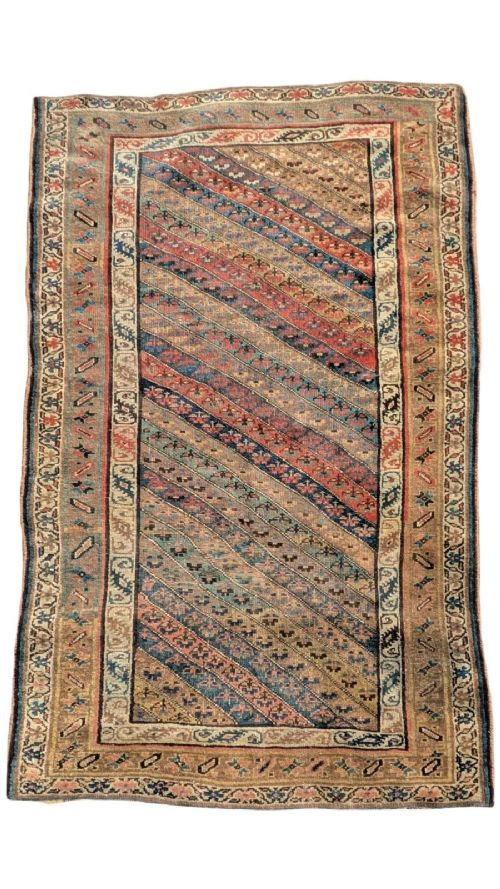


Multicolour Runner
A multicolour antique runner brings vibrant tribal geometry and rich regional hues into a long hallway, offering enduring floor art woven by hand generations ago.
Multicolour Runner
When searching for a multicolour antique runner, you encounter elongated tribal and village floor coverings originating from the nineteenth and early twentieth centuries. These textiles span Caucasian, Persian, Anatolian, and Central Asian traditions, showcasing narrow proportions designed specifically for corridors and narrow spaces.
The pieces most commonly met on this page include Caucasian narrow runners featuring repeat medallions and diagonal stripes, alongside Kurdish examples decorated with latch hook motifs. You also discover Central Asian kilims and Turkish half kilim kelim runners displaying bold graphic and banded patterns.
Originating from diverse tribal and regional groups such as the Luri, Qashqa'i, and Uzbek, these runners present a distinct narrative of traditional weaving. Each piece reflects the specific aesthetic vocabulary of its maker, translated through centuries-old regional designs.
How they were made
The construction of these runners relies fundamentally on natural materials, principally wool, cotton, and occasionally silk. Weavers utilised wool for the resilient pile and foundation, providing the durability necessary for heavy foot traffic in domestic settings.
Techniques varied between pile-woven rugs and flatwoven kilims, the latter created without a pile by tightly interweaving warp and weft threads. Certain pieces, such as the Persian Kashan, incorporate part-silk elements to introduce subtle sheen and finer detail into the woven surface.
Listings span nineteenth and early twentieth century production dates, ranging from eighteen-fifty through nineteen-thirty.
What varies in quality
Quality in these runners rests upon the crispness of the tribal design and the handling of the palette, distinguishing bold graphic execution from clumsy rendering. Finer knotting or tighter flatweaving creates structural integrity that preserves the intricate geometric motifs over generations.
The choice and saturation of dye colours dictate the visual depth of the piece, where harmonious chromatic balance elevates a standard village weaving into a striking work of textile art. Preservation of the original outer edges and proportional length further separates superior survivals from heavily altered examples.
The Multicolour Runner Glossary
- Kilim
- A flatwoven carpet or runner produced without a pile by tightly interweaving warp and weft threads. These textiles often display sharp geometric patterns resulting from the slit-weave technique.
- Runner
- A long, narrow carpet format traditionally utilised in hallways, corridors, and alongside furniture. Their elongated proportions display continuous repeat patterns down the length.
- Medallion
- A central ornamental motif set within the field of a rug or runner. Tribal weavers frequently repeated these geometric figures down the central axis of narrow corridor carpets.
- Latch hook
- A hooked geometric motif commonly found in tribal weaving traditions. This stepped outline decorates borders and central medallions across Caucasian and Kurdish pieces.
- Boteh
- An almond-shaped or paisley motif representing a floral shoot or cypress tree. This ancient symbol appears frequently in striped and field designs across regional carpets.
Multicolour Runner: Frequently Asked Questions
Where should I place a long runner?
These narrow floor coverings suit high-traffic corridors, hallways, and gallery spaces where their elongated format enhances the architecture. Their robust wool construction handles daily movement while introducing vibrant colour to transitional areas.
Ensure you utilise a quality underlay beneath the textile to prevent sliding on hard flooring and to reduce wear on the vintage foundation fibres.
How do I identify a tribal design?
Tribal designs typically feature geometric abstraction, including repeated medallions, latch hooks, and diagonal stripes woven from memory rather than precise architectural drafts. These patterns reflect the distinct cultural heritage of nomadic and village groups across the Caucasus, Persia, and Anatolia.
Examining the irregularities within the repeating motifs often reveals the hand of an individual weaver rather than a standardised factory output.
Are flatwoven runners durable enough?
Flatwoven kilims possess a sturdy structure achieved through tight interweaving of warp and weft threads without a raised pile. This construction offers remarkable resilience in domestic settings when paired with a supportive underlay.
Their flat surface makes them particularly practical for placement beneath interior doors that might otherwise catch on a thicker pile carpet.
How do I clean an antique textile?
Gentle surface care and regular light vacuuming without a rotating brush roll help maintain the wool and cotton fibres. Professional specialist cleaning remains essential for removing deep-seated dirt without damaging the natural dyes.
Avoid excessive moisture and harsh chemical treatments, as these can compromise the integrity of nineteenth-century foundation threads and alter the original multicolour palette.