

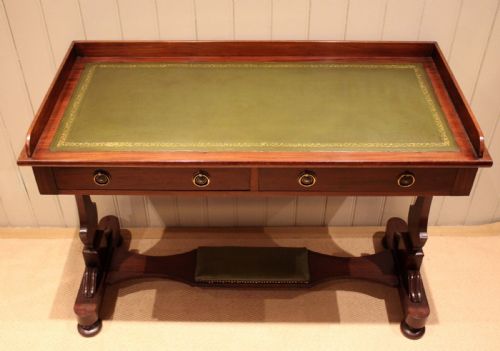


Large Mahogany Library Desk
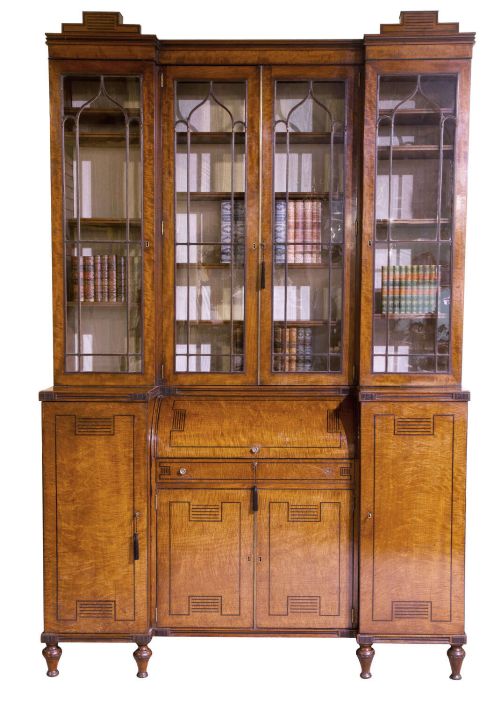
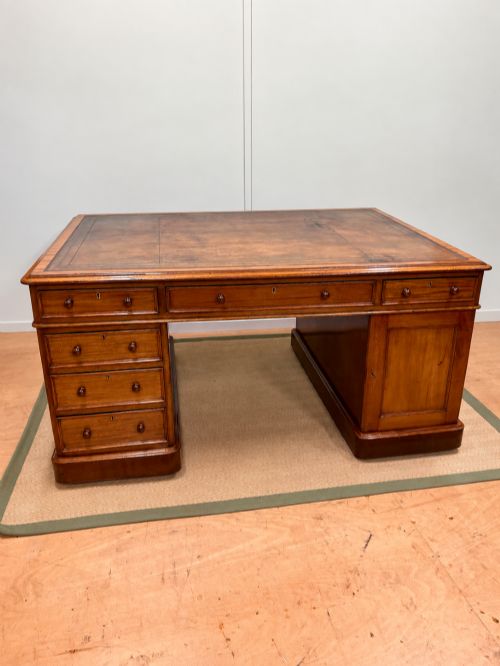
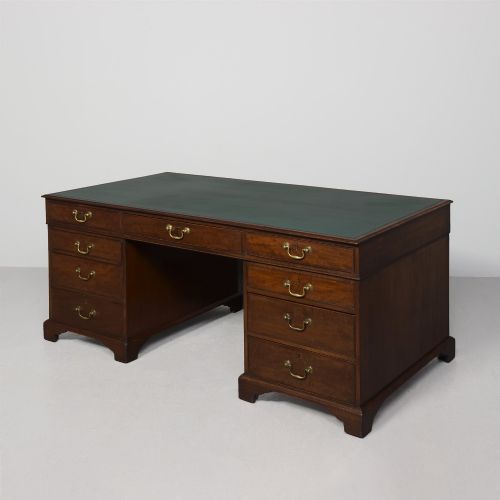
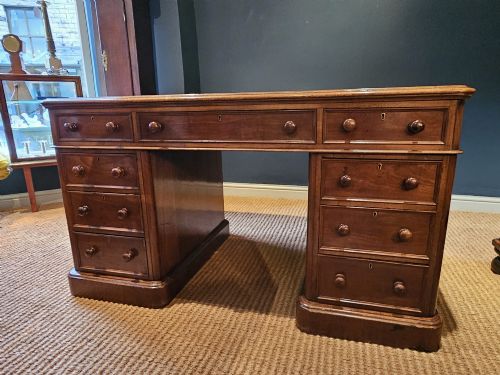
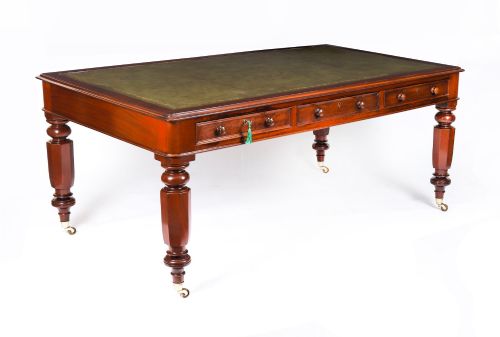
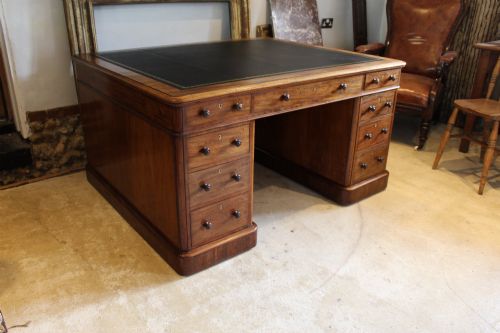
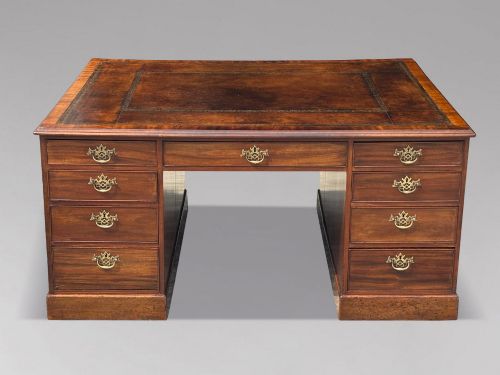
A large mahogany library desk brings double-sided utility and heavy timber presence into a study, most commonly seen as a pedestal partners desk from the Victorian and Georgian periods.
Large Mahogany Library Desk
A large mahogany library desk is designed for freestanding placement in a room, offering workspace from both sides through drawers or cupboards arranged back-to-back. The versions met most often on this page date from the Georgian and Victorian eras, often taking the form of substantial partners desks or writing tables.
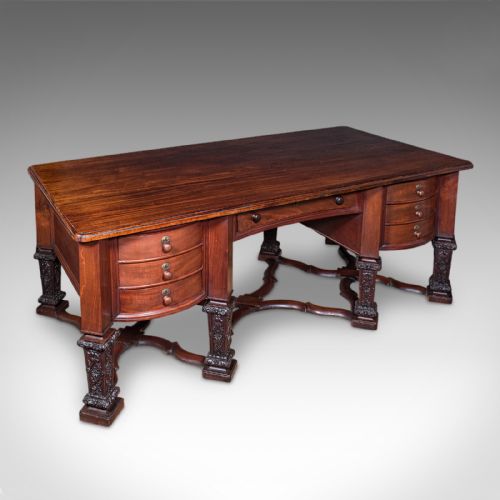
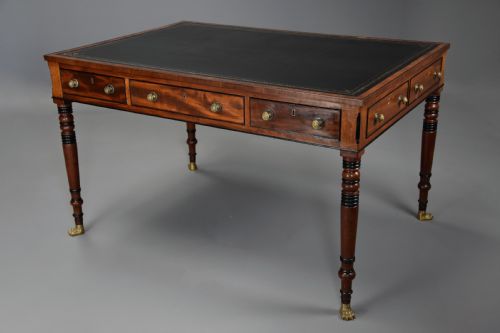
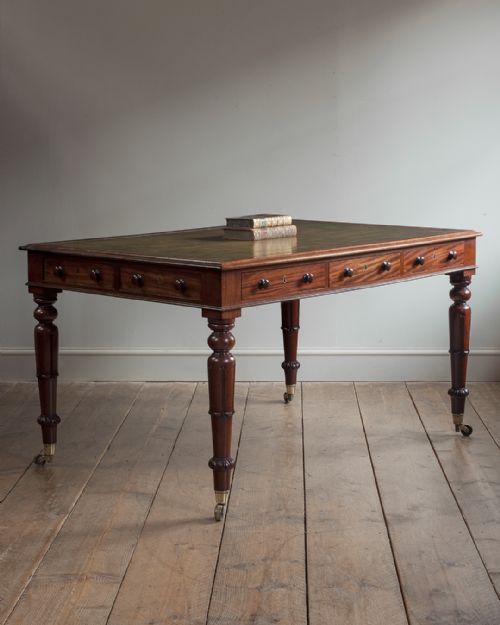
Makers constructed these pieces on a grand scale to serve administrative or scholarly use in large rooms. Alongside pedestals fitted with numerous drawers, the listings show library tables and sofa tables utilising the same timber.
The styles range from restrained George III designs to ornate Victorian revivals and Edwardian pieces. Buyers encounter both pedestal formats with banks of drawers and simpler writing tables supported on pillar ends.
Timber and Leather
Cabinet makers built the primary carcase and drawer linings from solid timber, applying figured mahogany veneers such as flame mahogany, curl mahogany, and burr walnut across the expansive flat surfaces. Boxwood inlay frequently frames drawer fronts or panel borders on finer examples.
The working surface inset utilises English hide leather, often hand-dyed and edged with blind-tooling. Brass handles, drawer pulls, and locks complete the heavy construction, providing secure and durable utility.
Periods span from the eighteenth century through the Georgian, Victorian, and Edwardian eras to the 1930s.
Gradation of Making
The distinction between ordinary utility items and superior library furniture rests in the choice of timber figure and the precision of the joinery. Mahogany selected for its vivid flame or curl grain elevates the visual weight of a large desk.
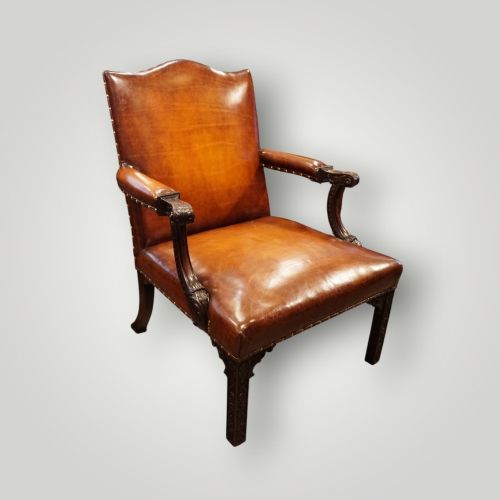
Subtle details such as boxwood stringing, blind-carved mouldings in the Chippendale manner, and secondary timbers used inside drawer construction reveal the original maker's hand. Even fading across the wood surfaces indicates balanced exposure over centuries rather than harsh chemical stripping.
Charles Andrea Nosotti·Cookes of Finsbury London·Howard & Son's·Whytock & Reid·W. Priest·Gillows
The Large Mahogany Library Desk Glossary
- Partners desk
- A large double-sided desk built with drawers and cupboards facing both directions so two people can work opposite each other. These pieces form the core of the library desk category.
- Flame mahogany
- A veneer cut from the fork of the mahogany tree where the grain twists to create flickering, flame-like patterns. Cabinet makers reserved this timber for prominent drawer fronts and tabletops.
- Kneehole
- The open space beneath the desktop where a person sits. In pedestal desks, this space sits flanked by vertical banks of drawers.
- Crossbanded
- A border technique where thin strips of veneer are laid around the perimeter of a tabletop so the grain runs perpendicular to the central panel. This provides a neat framing edge to mahogany surfaces.
- Leather top
- A writing surface inset made from animal hide. English hide leather provides a smooth, tactile plane for paperwork and protects the underlying wood.
Large Mahogany Library Desk: Frequently Asked Questions
What is a partners desk?
A partners desk is a large double-sided workstation built with drawers and cupboards accessible from both the front and the back. This layout allowed two people, such as business partners or scholars, to sit opposite each other.
These pieces typically feature wide pedestals and generous mahogany surfaces designed to anchor the middle of a large room rather than sit against a wall.
How do I care for a leather top?
The leather inset on a library desk requires gentle cleaning with a slightly damp cloth followed by occasional treatment with leather balms or waxes. Avoiding harsh chemicals preserves the hand-dyed finish and the blind-tooled borders.
Keep the desk away from direct heat sources and strong sunlight to prevent the hide from drying out or cracking over time.
How do I date a mahogany desk?
Dating relies on examining construction methods, timber choice, and stylistic cues such as drawer linings, handle styles, and leg shapes. Georgian pieces often display simpler, rigorous lines, while Victorian examples introduce heavier proportions and revival details.
Makers' stamps, trade labels, or signature brass locks also help pinpoint the workshop and era of manufacture.
Can these desks be disassembled?
Many large library and partners desks separate into modular components, typically dividing into two pedestals and a heavy top surface. This modular construction helped transport heavy furniture through narrow doorways during the nineteenth century.
Checking the interior construction reveals whether the pedestals lift away from the main top independently.