





Large Convex Mirror
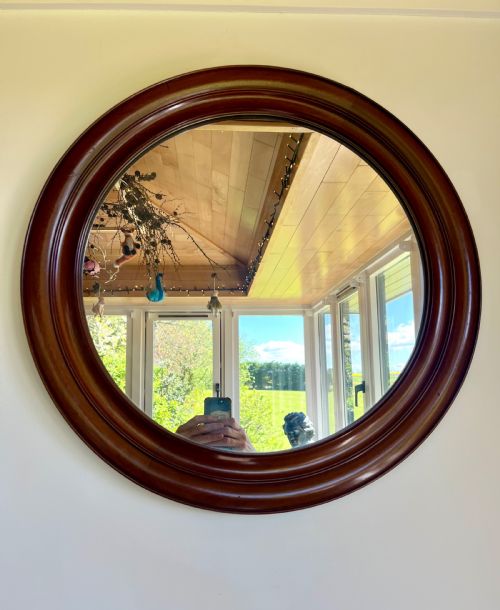
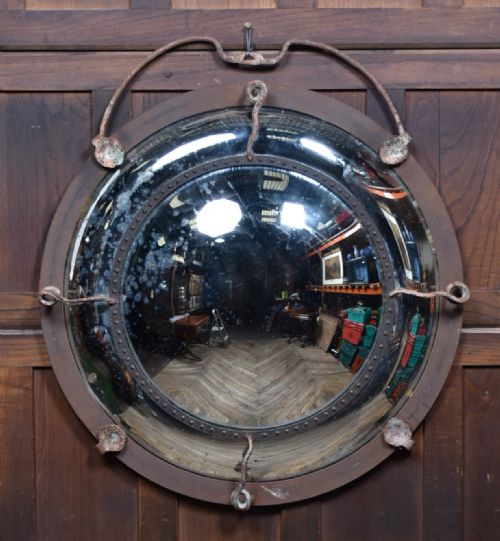
A large convex mirror draws the eye across a room, reflecting a wide, curved sweep of the interior.
Large Convex Mirror
When you search for a large convex mirror, you encounter circular wall plates designed to capture a panoramic reflection of the interior space. These pieces dominate a room through their scale, often measuring several feet across.
The pieces appearing on this page stem predominantly from the Regency period and the wider nineteenth century, alongside later revivals. Formats range from plain gilded frames to elaborate designs surmounted by carved eagles or fitted with candle sconces.
How they were made
Frames are constructed from timber, gesso and giltwood, utilising water gilding techniques to achieve a bright metallic finish. Ebonised slips often sit inside the main frame to provide a dark contrast against the gold leaf.
The glass plate itself is curved to throw back a fish-eye view of the room, held within a rebated groove behind the frame moulding.
Listings feature materials including giltwood, ebonised wood, gesso, brass, crystal, plaster, and wrought iron.
What varies in quality
The depth and crispness of the carved wood ornamentation dictate the upper tier of quality, particularly on pieces featuring detailed figures such as eagles or hippocampuses. Heavy, water-gilded frames show superior handling of gesso compared to later painted surfaces.
The integrity of the convex glass plate and the original construction of the timber backing boards establish the baseline for an authentic period example.
T. Fentham
The Large Convex Mirror Glossary
- Convex mirror
- A circular mirror with an outward-curving glass plate that produces a wide-angle reflection of the surrounding space.
- Giltwood
- Timber carved and coated with gold leaf, frequently seen on Regency wall mirrors.
- Ebonised slip
- A thin dark moulding placed immediately around the mirror glass to create visual depth within the frame.
- Girandole
- A wall mirror fitted with one or more candle branches or sconces attached to the frame.
- Gesso
- A plaster-like mixture applied to wooden frames as a smooth base for gilding.
Large Convex Mirror: Frequently Asked Questions
Why are convex mirrors called witch balls?
These mirrors earned alternative names like the witch's eye or sorcerer's mirror because their curved surface was historically believed to ward off evil spirits by trapping them in the reflection.
In domestic settings, they allowed servants to monitor activity across a large dining room from a single vantage point.
Where should I hang a large convex mirror?
A large convex mirror works best centred above a fireplace mantelpiece or on a prominent living room wall where the wide field of view can take in the entire space.
Because they concentrate light, placing them opposite a window helps brighten darker corners of a room.
How do I date a Regency convex mirror?
Dating relies on inspecting the construction of the timber frame, the composition of the gesso, and the presence of early mirror glass with characteristic distortions.
Regency pieces often feature specific decorative motifs like spread eagles or carved balls set around the outer rim of the frame.
Are these mirrors heavy?
These pieces carry substantial weight due to the solid timber frames, heavy gesso work, and thick curved glass plates.
Proper installation requires secure wall fixings anchored directly into masonry or solid studs to support the load safely.