


Antique Convex Mirror Sconces
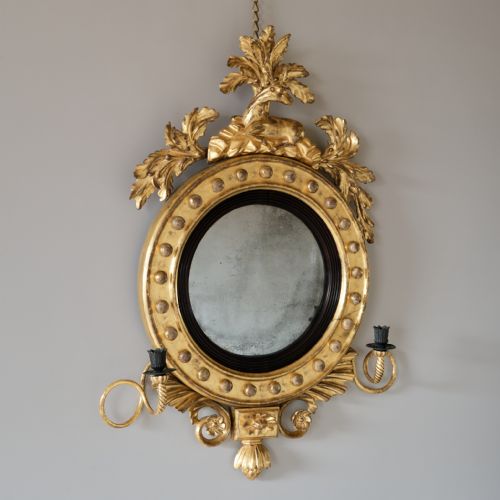
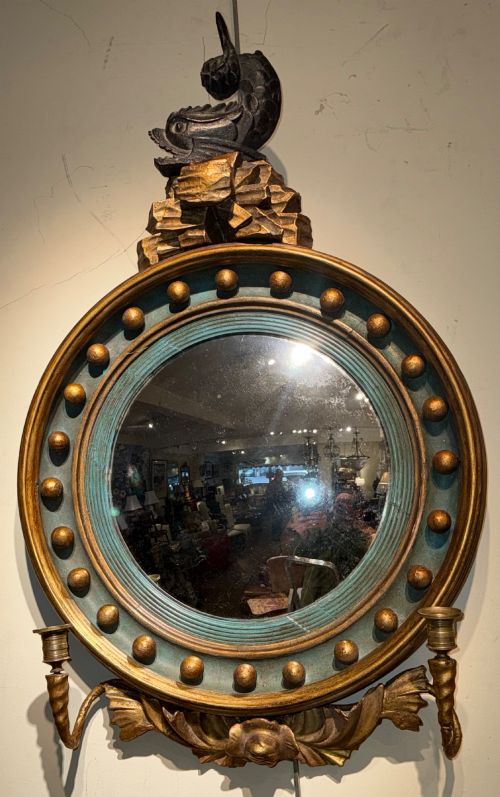
Antique convex mirror sconces bring depth and candlelight to a room, dominated here by Regency giltwood forms.
Antique Convex Mirror Sconces
When you search for antique convex mirror sconces, you look at circular wall glass designed to reflect a whole room in miniature. The examples on this page are wall mirrors and wall sconces spanning the Regency period, the nineteenth century, and nineteen twenty.
The Regency period provides the backbone of these listings, often appearing as giltwood convex mirrors or girandole mirrors with candle arms. Alongside these, later nineteenth-century pieces and nineteen-twenty mirror back wall sconces appear to complete the selection.
How they were made
Giltwood and brass form the structural framework for these pieces, shaping the circular frames and candle branches. Glass and mirror glass provide the reflective surfaces, often paired with ebonised wood or painted wood details.
Makers utilised wood and metal to build heavy wall mounts capable of holding projecting sconces. Gilding finished the primary surfaces, catching the light alongside the curved glass plates.
Listings span the Regency era, the nineteenth century, and nineteen twenty, utilising giltwood, brass, and ebonised wood.
What varies in quality
The richness of the gilding and the depth of the carved wood frame separate standard examples from finer works. Regency period pieces demonstrate precise craftsmanship in their giltwood frames and integrated candle arms.
Scale also divides the range, moving from compact wall sconces up to large circular mirrors spanning significant wall space. The integration of girandole branches alters the complexity and overall presence of the object.
The Antique Convex Mirror Sconces Glossary
- Convex mirror
- A circular glass plate curved outward to produce a wide-angle reflection of the interior. This form dominated Regency interior design schemes.
- Girandole
- A wall mirror featuring attached candle branches or sconces. These arms allow candlelight to reflect directly off the glass surface.
- Giltwood
- Timber coated with a thin layer of gold leaf or gesso and gold paint. It defines the bright surfaces of Regency frames.
- Ebonised wood
- Dark timber treated to imitate expensive ebony. It provides a stark contrast against gilt details.
- Regency
- An early nineteenth-century design period known for classical restraint and bold decorative forms. Pieces from this era frequently use convex glass.
Antique Convex Mirror Sconces: Frequently Asked Questions
Where should I hang a convex mirror?
These pieces work best on principal living room walls where they can capture light from windows and reflect the entire room.
Because the curved glass shrinks the field of view, hanging them at eye level maximises their decorative impact.
How do I identify a Regency piece?
Look for characteristic giltwood frames, classical motifs, and proportions typical of the early nineteenth century.
Evidence shows these often appear as girandole mirrors with integrated candle arms alongside standard convex wall glass.
Did these mirrors always have sconces?
Not all convex mirrors include candle arms, though many Regency examples incorporate girandole branches for lighting.
Pairs of mirror back wall sconces also appear in later twentieth-century forms designed specifically for candles.
What materials make up the frames?
Makers relied primarily on giltwood, brass, and painted or ebonised wood to construct the heavy circular surrounds.
These materials support the curved mirror glass while providing durable mounting points for wall display.