



Eagle Convex Mirror
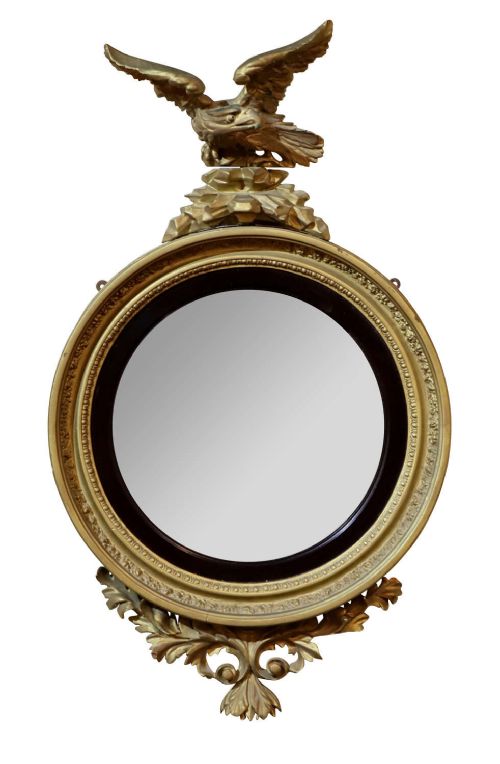
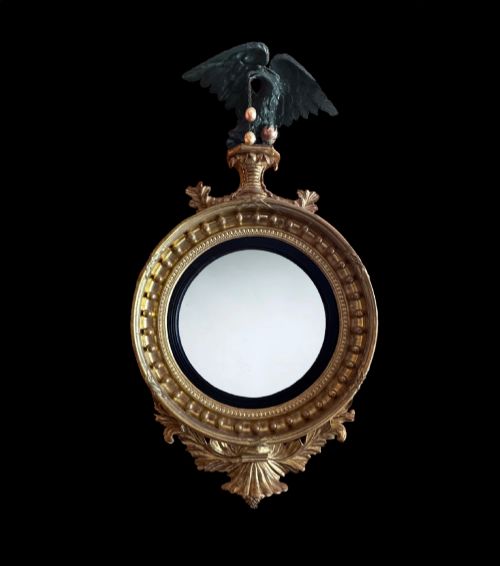
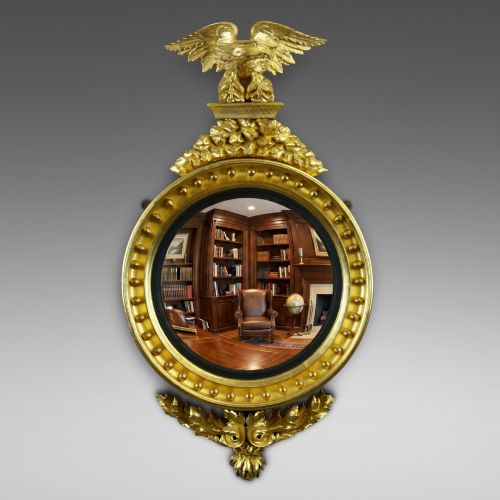
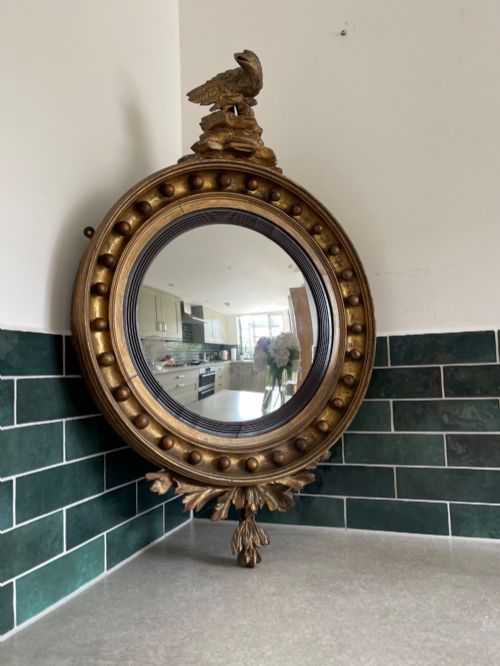
An eagle convex mirror commands attention in any room with its deep circular glass and powerful bird crest.
Eagle Convex Mirror
An eagle convex mirror is a distinctive circular wall glass featuring a curved plate that reflects a wide, distorted view of a room. These pieces most commonly date from the Regency period, though examples stretch across the nineteenth century and into the twentieth century.
The form typically combines a round wooden frame finished in bright giltwood with a carved eagle perched on top. Wall sconces and girandole variants also appear, adding candle arms that project from the sides of the circular frame.
Materials and Construction
Makers built the heavy circular frames from timber, applying layers of gesso to build up decorative mouldings and carved details. Giltwood finishes were then applied to give the frame its characteristic metallic sheen.
Mirrored glass plates were cast with a deliberate outward curve to capture a panoramic reflection. Secondary materials such as ebonised wood and brass occasionally accent the frame or provide contrast on the inner reeded borders.
The listings here feature pieces spanning the Regency era, Victorian period, and early twentieth century, constructed in giltwood, ebonised wood, and brass.
Assessing Quality
Quality rests heavily on the crispness of the wood carving, particularly the anatomy and posture of the eagle surmount. Bold, deeply undercut carving displays greater skill than softer, flatter execution.
The proportion between the circular frame and the crest dictates the visual balance of the piece. Superior examples maintain a harmonious scale where neither the bird nor the mirror dominates awkwardly.
The Eagle Convex Mirror Glossary
- Convex glass
- A curved glass plate that projects outward to create a fish-eye reflection of the interior. This optical effect allows the glass to capture a broad sweep of the surrounding space.
- Giltwood
- Timber coated with a thin layer of gold leaf over a prepared gesso ground. It provides a durable, reflective surface that catches natural light in a room.
- Girandole
- A wall mirror featuring attached candle branches or sconces. The arms extend forward to multiply the flickering light of candles.
- Surmount
- An ornamental feature placed at the very top of a frame. On these pieces, a carved eagle acts as the prominent crest.
- Ebonised wood
- Timber stained or treated to imitate dense, dark ebony. This dark finish often outlines the inner circle of the frame.
Eagle Convex Mirror: Frequently Asked Questions
What is the purpose of a convex mirror?
A convex mirror gathers light from a wide angle and compresses it into a single circular reflection. Historically, this allowed people to monitor activity across an entire room from a single vantage point.
Today, these pieces function primarily as striking decorative focal points. Their unique optics add depth and movement to traditional or modern interiors.
How do I date an eagle convex mirror?
Dating relies on examining the construction methods of the timber frame and the style of the gesso work. Regency pieces often feature specific carved motifs like reeded bezels and bold eagle crests.
Later Victorian and twentieth-century revivals tend to use different secondary woods and softer preparation layers. Comparing the wear on the gilt surface also helps establish age.
Where should I hang a convex mirror?
These mirrors demand a prominent wall where their curved reflection can be fully appreciated. Placing them opposite a window maximises the amount of light they pull into the space.
Because they project outward from the wall, ensure they hang at a secure height away from high-traffic areas. They anchor living rooms, hallways, and dining spaces effectively.
What does a girandole mirror feature?
A girandole incorporates attached candle sconces that project outward from the sides of the frame. These arms allowed the reflection to amplify the light of burning candles.
Many surviving examples retain their original sconces, while others show adaptations where candle arms were removed. The presence of these arms changes the overall silhouette against the wall.