

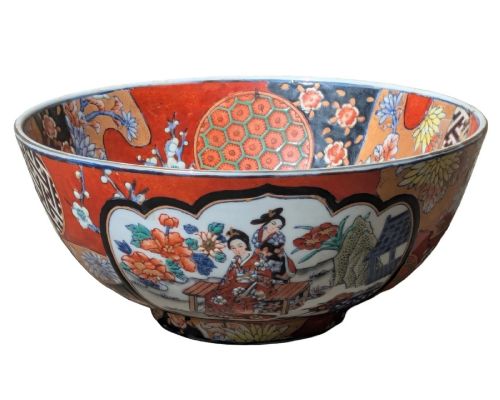


Japanese Decorative Basin
These japanese decorative basin examples bring hand-painted porcelain and rich bronze into a room, offering striking focal points for display.
Japanese Decorative Basin
When you search for a japanese decorative basin, you encounter a range of forms including large chargers, deep bowls, jardinieres, and planters. These pieces span the eighteenth, nineteenth, and early twentieth centuries, reflecting diverse periods of production from the Edo to the Showa eras.
The most common examples on this page are Japanese Imari porcelain bowls and Satsuma ceramic vessels, often dating from the Meiji period. Alongside ceramics, heavy bronze jardinieres and copper planters appear, showing the broad scope of decorative metalwork produced for export and domestic use.
Buyers also find specialised items such as cloisonne enamel bowls decorated with birds and peonies, as well as tripod vessels originating from Arita. Each form serves as a display piece, whether used as a standalone table centrepiece or a floor planter.
Materials and methods
Makers shaped porcelain and earthenware on the wheel or in moulds before firing the clay at high temperatures. Artisans then applied intricate hand-painted pigments, incorporating gold leaf and enamel details to achieve vibrant surface patterns.
Metal vessels rely on cast bronze and copper construction, sometimes enhanced with gilt or brass fittings. Cloisonne pieces utilise wire cells soldered to a metal base, which are then filled with coloured enamel pastes and fired repeatedly.
Several heavy bronze jardinieres double as antique censers, proving that nineteenth-century plants occasionally enjoyed a very smoky atmosphere.
Judging quality in these pieces
Quality rests on the crispness of the hand-painted decoration and the precision of the glaze work on porcelain vessels. Superior examples display fine brushwork, balanced compositions, and rich palettes of cobalt blue and iron red, particularly on Imari wares.
In metalwork and cloisonne, refinement shows in the weight of the bronze casting and the neatness of the wirework defining each enamel cell. Signed pieces and those bearing specific crests or attributed to known makers demonstrate higher levels of workshop execution.
Ryuzan·Nikko
The Japanese Decorative Basin Glossary
- Imari
- A style of Japanese porcelain featuring underglaze blue and overglaze red, gold, and green. This ware gained immense popularity in Europe through trade during the Edo period.
- Satsuma
- An earthenware type with a pale, crackle-glaze finish, typically decorated with elaborate polychrome enamels and gilding. These pieces frequently date from the Meiji period.
- Jardinieres
- Large decorative planters or basins designed to hold potted plants or floral arrangements. They appear in ceramic, bronze, and cloisonne enamel.
- Cloisonne
- A decorative metalwork technique where enamel is applied within compartments created by soldered wire. Pieces often showcase birds, flowers, and geometric borders.
- Meiji Period
- A historical era in Japan spanning from eighteen sixty-eight to nineteen twelve, characterised by a surge in decorative arts created for international export.
Japanese Decorative Basin: Frequently Asked Questions
What is a japanese decorative basin used for?
These vessels function primarily as decorative display items, serving as table centerpieces or striking room accents. Larger bronze and ceramic examples also act as jardinieres for holding potted plants.
Their varied forms allow them to sit on side tables, cabinets, or directly on the floor depending on their scale and weight.
How do I date a japanese decorative basin?
Dating relies on identifying stylistic markers associated with specific historical periods like the Edo or Meiji eras. Porcelain types, glaze characteristics, and signatures or crests provide further chronological clues.
Consulting the listed period details helps place each vessel within its historical window of manufacture.
Are these basins made of porcelain or metal?
The selection includes both ceramic and metal vessels depending on the specific type of basin. Porcelain and earthenware examples feature hand-painted glazes, while alternative pieces utilise cast bronze or copper.
Cloisonne enamel variations combine a metal body with vitreous glass pastes fixed in wire cells.
How do I care for antique ceramic bowls?
Dust ceramic and bronze surfaces gently with a soft, dry cloth to prevent the accumulation of dirt. Avoid using chemical cleaners or abrasive materials that could harm hand-painted enamel, gilding, or patinated metal.
Keep pieces away from direct sunlight and damp environments to protect the integrity of the glaze and metalwork over time.