




Inlaid Wooden Stationery Box
An inlaid wooden stationery box organises correspondence with fitted compartments, decorative veneers and brass details.
Inlaid Wooden Stationery Box
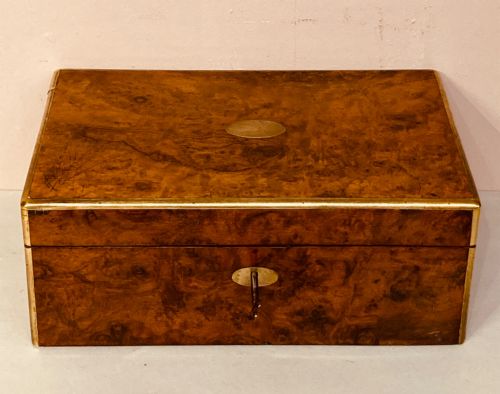
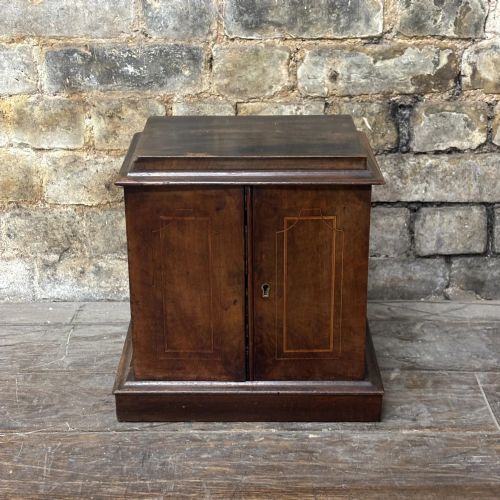
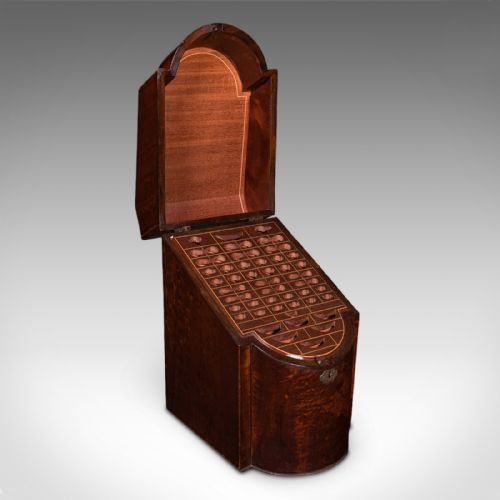
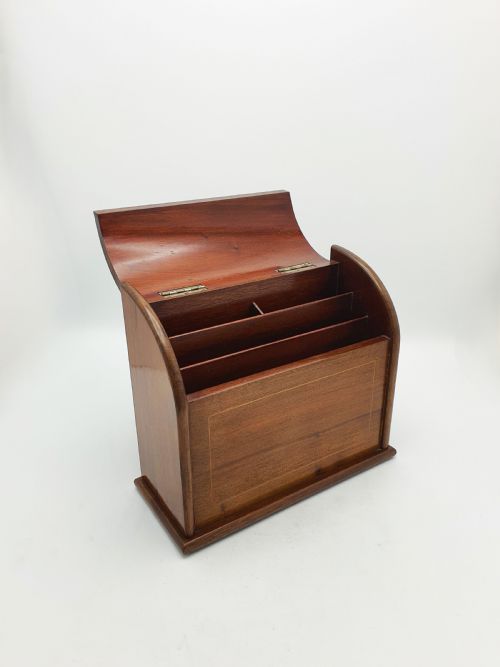
An inlaid wooden stationery box gathers desk accessories, writing slopes and correspondence cabinets from Georgian, Regency, Victorian and Edwardian periods. These table-top containers house letters, pens and paper behind hinged lids, sloping fronts and double doors.
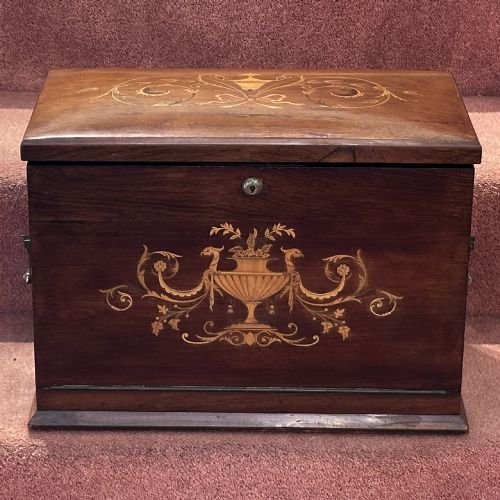
Rosewood, burr walnut and mahogany form the main bodies, embellished with satinwood, ebony, mother-of-pearl and bone inlay. Examples span standard slope forms to specialised stationery cabinets and document boxes.
How they were made
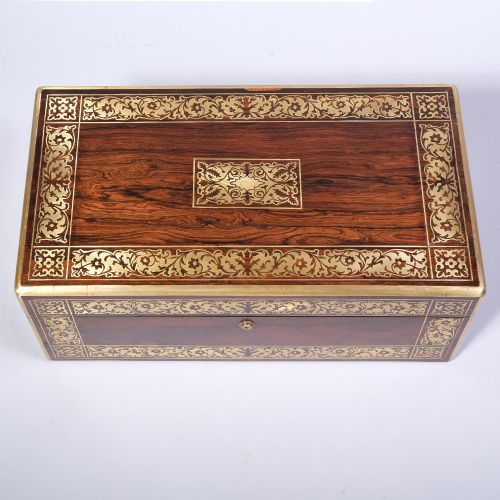
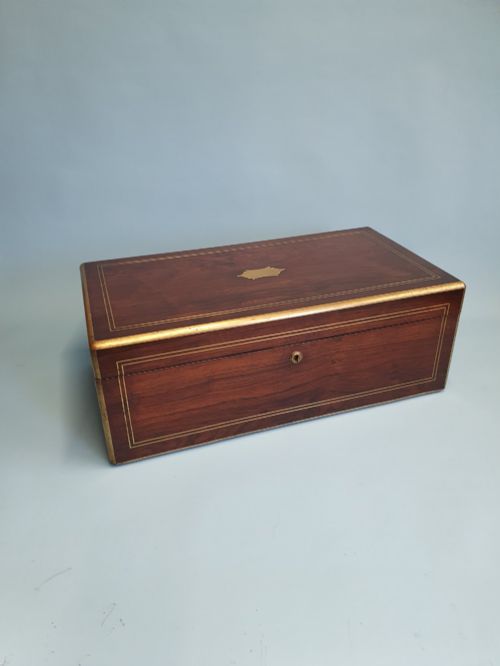
Carpenters constructed carcasses in dense hardwoods such as rosewood, walnut and mahogany, often applying burr veneers to display rich grain patterns. Inlays of satinwood, ebony and mother-of-pearl create geometric banding and floral motifs across lids and panels.
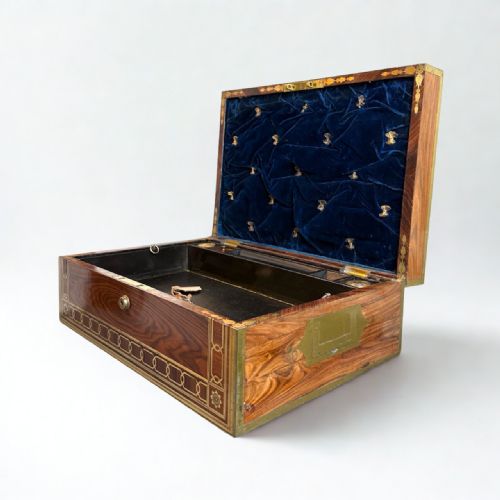
Brass banding, escutcheons and campaign-style corners reinforce edges and corners against travel wear. Interior fittings incorporate secret drawers, velvet-lined writing surfaces and compartments for inkwells and pens.
What varies in quality
Craftsmanship shows in the precision of the wood inlay and the selection of figured veneers like burr walnut or coromandel. Superior pieces feature integrated Bramah locks, complex secret drawer mechanisms and intact brass bound edges.
Specialised regional work, such as Tunbridge ware mosaic decoration or Irish Killarney woodwork, distinguishes finer decorative pieces from standard production boxes.
Edmund Nye
The Inlaid Wooden Stationery Box Glossary
- Writing slope
- A desktop box with a hinged sloping front that opens to reveal a velvet-lined writing surface and compartments for stationery. These boxes fold flat when closed to secure writing materials.
- Tunbridge ware
- Woodware decorated with mosaic patterns formed from thousands of tiny tinted wood prisms assembled to create pictorial or geometric designs. This technique originated in Kent during the nineteenth century.
- Bramah lock
- A high-security barrel lock patented by Joseph Bramah in the late eighteenth century, commonly found on better-quality campaign and writing boxes. Keys feature longitudinal slits that match internal sliders.
- Escutcheon
- A protective metal plate surrounding a keyhole, frequently cast in brass to match corner brackets and inlay accents. It prevents the wood around the lock from splitting during use.
- Killarney ware
- Irish decorative woodwork typically featuring inlaid marquetry motifs of shamrocks and local architectural ruins set into arbutus wood. These items date primarily from the nineteenth century.
Inlaid Wooden Stationery Box: Frequently Asked Questions
What is an inlaid wooden stationery box?
An inlaid wooden stationery box is a desktop container designed to hold letters, envelopes and writing tools. These pieces utilise decorative veneers and contrasting woods to adorn working spaces.
They appear in various forms, including correspondence boxes, sloping desks and partitioned cabinets. Each design provides dedicated compartments for organising paper goods.
How do you date an antique stationery box?
Dating relies on timber choices, construction techniques and stylistic periods such as Regency, Victorian or Edwardian. Earlier Georgian and Regency boxes often feature linear brass inlay and mahogany or rosewood.
Later Victorian pieces frequently employ burr walnut, coromandel, and mother-of-pearl embellishments. Lock types and interior fittings also offer clues to the manufacturing era.
Were these boxes used for travel?
Many writing boxes and slopes served as portable desks for travellers and military officers during the eighteenth and nineteenth centuries. Brass banding and robust corner brackets protected the timber during transit.
Stationery cabinets and larger correspondence boxes remained static on library tables and desks. Portable variants contained secure compartments to keep inkwells and documents safe on the move.
How do I care for a wooden stationery box?
Maintenance involves keeping wooden surfaces away from direct sunlight and extreme temperature fluctuations to prevent veneer cracking. Gentle dusting preserves the polished finish and delicate inlay.
Interior velvet or leather surfaces benefit from dry cleaning with soft brushes. Applying occasional suitable wax feeds the hardwood without harming historic polishes.