


Georgian Satinwood Box
A georgian satinwood box brings golden timber and fine neoclassical stringing straight into a room.
What they are
A georgian satinwood box is a small timber container made during the eighteenth and nineteenth centuries, often taking the form of a tea caddy, writing box, or watch box. These pieces range from compact oval shapes designed for loose leaf tea to larger storage and stationery boxes intended for a desk top.
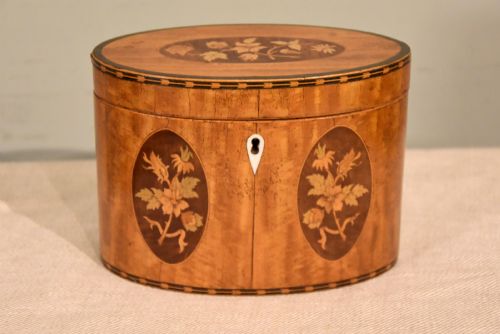
Buyers browsing this selection most frequently encounter tea caddies and writing boxes spanning the Georgian and Victorian periods. Oval tea caddies from around seventeen ninety appear alongside nineteenth-century writing boxes featuring contrasting timber stringing.
Originating in English workshops, these items served practical domestic purposes for wealthy households who needed secure storage for valuable commodities like tea, writing implements, or jewellery. Today, collectors value them for their warm timber tones and refined decorative inlays.
How they were made
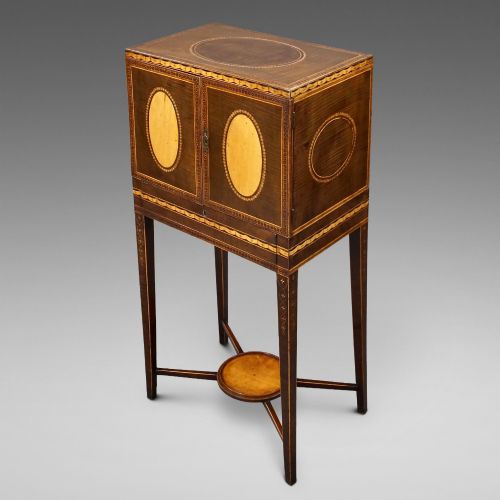
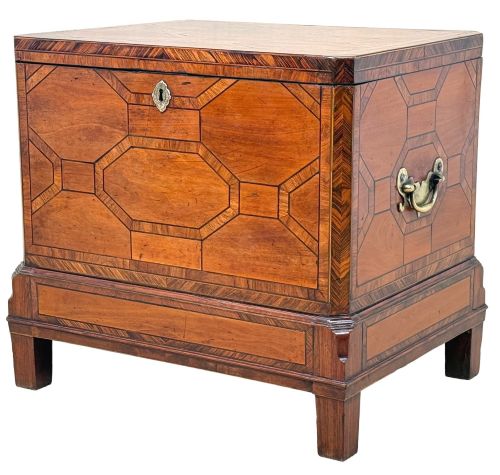
Cabinet makers built these boxes using dense primary timbers like satinwood, often applying crossbanding in darker woods such as rosewood or mahogany to frame the grain. Ebony and boxwood stringing lines create crisp geometric borders around lids and panels.
Surface decoration frequently relies on marquetry inlay, depicting motifs like conch shells using contrasting woods and engraved bone details. Metal hinges, locks, and escutcheons finish the construction, occasionally retaining internal fittings such as glass scent bottles.
Retail Price Guide 2026
Typical UK retail prices for georgian satinwood box, calculated from the Sellingantiques database of over a million retail prices indexed since 2003. This retail price guide relies exclusively on Sellingantiques data; no external sources or auction records are used, so the figures do not describe the wider market.
One surviving scent box thoughtfully keeps its four tiny glass bottles intact after two centuries.
What varies in quality
The distinction between ordinary utility items and exceptional pieces rests in the intricacy of the timber selection and the precision of the inlay work. Finer examples display highly figured satinwood matched symmetrically across the lid, complemented by delicate ebony and boxwood stringing rather than plain surfaces.
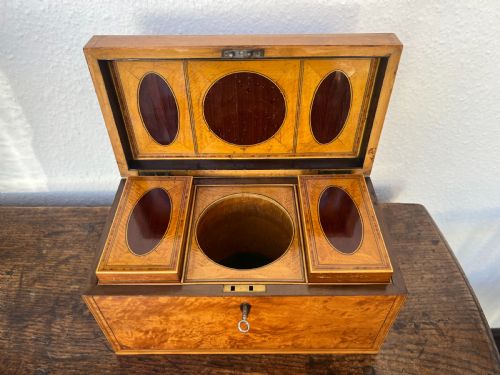
The presence of original internal components, such as glass bottles in scent boxes or fitted compartments in writing boxes, elevates a piece significantly. Superior construction shows in tight joints and crisp marquetry details like conch shell motifs that remain sharp and flush with the surrounding wood.
The Georgian Satinwood Box Glossary
- Satinwood
- A dense, lustrous timber with a characteristic golden sheen that forms the primary surface of these boxes.
- Stringing
- Thin inlaid lines of contrasting wood, such as boxwood or ebony, used to outline panels and borders.
- Crossbanding
- A strip of veneer laid across the grain of the primary wood around the edges of a box to create a framed effect.
- Marquetry
- Decorative patterns formed by fitting together small pieces of veneered wood and other materials like bone.
- Caddy
- A small container originally designed to store and preserve dry tea leaves securely.
Frequently Asked Questions
What is a georgian satinwood box used for?
These boxes served specific household functions, primarily holding tea leaves, writing materials, watches, or small jewellery items securely under lock and key.
Today, they function mainly as decorative accent pieces on tabletops, sideboards, or desks while continuing to store small personal items.
How do I date a satinwood box?
Dating relies on observing construction methods, timber choices, and decorative styles such as neoclassical stringing or conch shell inlay.
Pieces from the Georgian period typically exhibit hand-cut dovetails, specific hinge types, and restrained inlay patterns compared to later Victorian iterations.
Are original interiors common?
Original internal fittings vary, with some boxes retaining their glass scent bottles, tea compartments, or velvet linings while others are empty.
Surviving internal components add considerable interest for collectors who appreciate complete historical examples.
How should I care for satinwood?
Satinwood benefits from being kept away from direct sunlight and dramatic changes in temperature to prevent timber shrinkage and veneer lifting.
Routine maintenance requires only a soft, dry cloth to remove dust without applying modern chemical polishes.