
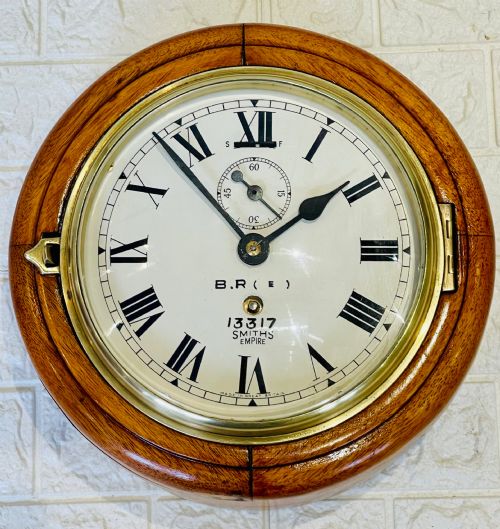


Industrial Brass Clock
An industrial brass clock brings robust utility and striking mechanical form to any room, combining heavy metals with precise timekeeping.

Industrial Brass Clock
An industrial brass clock combines heavy metal construction with functional engineering, drawing from railway, maritime, and utilitarian origins.
Buyers will encounter various forms on this page, including wall clocks, mantel clocks, desk clocks, and specialised station or signal box timepieces.
The periods represented span from the Victorian era and the nineteenth century through the Edwardian period and into the mid twentieth century.
Materials and Construction
These pieces utilise solid brass alongside supportive structural materials such as iron, slate, oak, mahogany, and marble to create sturdy housings.
Many examples incorporate glass faces to protect delicate dials and silvered metal components within heavy-duty industrial or railway casings.
Quality and Craftsmanship
Quality rests in the precision of the mechanical movement, the weight of the brass casing, and the authenticity of railway or industrial provenance.
Pieces bearing signed maker details or specific utilitarian deployment history distinguish themselves from standard commercial iterations.
Guilmet·John Walker·Smith·Gledhill Brook·Andre Guilmet·Armstrong of Manchester
The Industrial Brass Clock Glossary
- Fusee dial
- A clock movement driven by a fusee cone and chain or cord to maintain constant force as the mainspring unwinds.
- Bulkhead clock
- A heavy marine timepiece designed to be mounted directly to the interior wall of a ship.
- Compendium
- A multi-functional desk object that incorporates a timepiece alongside instruments such as barometers or thermometers.
Industrial Brass Clock: Frequently Asked Questions
Where were these clocks originally used?
Many of these timepieces served in utilitarian environments such as railway stations, signal boxes, post offices, and nautical vessels where precise timing was critical.
Others functioned in offices and workshops for time recording and daily operations.
How do I wind a fusee wall clock?
Fusee wall clocks require a specialised key inserted into the dial face to wind the mainspring via the chain or cord system.
Care must be taken not to overwind the mechanism to preserve the historical movement.
What is an industrial desk compendium?
A desk compendium is a decorative and practical desk piece modelled on industrial machinery, such as lighthouse structures or Davy lamps.
These pieces often house multiple meteorological or timekeeping instruments within a single brass housing.
How do I identify a railway clock?
Railway clocks typically feature clear dials bearing company initials or regional markings, alongside robust fusee movements designed for heavy public use.
Sturdy wooden or metal surrounds protected the mechanisms from dust and vibration in busy stations.