
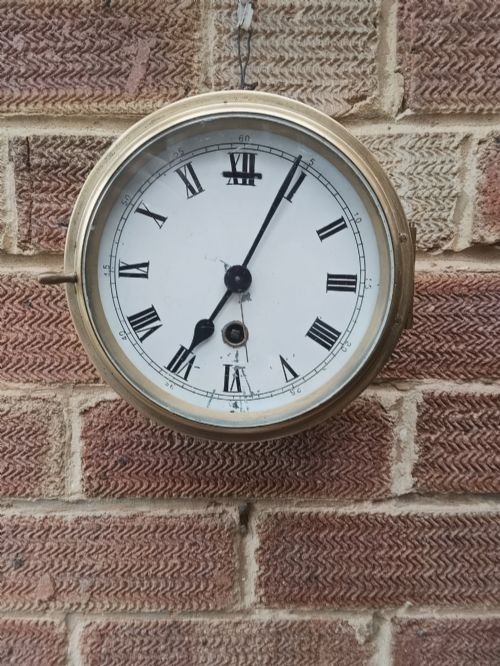

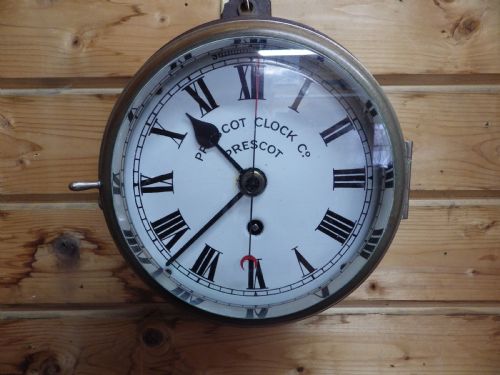


Maritime Wall Clock
These maritime wall clock pieces bring solid chronometry and naval heritage straight into the room, built to endure rough seas and look striking on dry land.

Maritime Wall Clock
A maritime wall clock serves as a sturdy timepiece rooted in nautical and industrial history, designed for functional service aboard ships. When searching for a maritime wall clock, buyers encounter heavy brass cases, enamel dials, and robust movements built to withstand damp and motion.
The pieces on offer span from Victorian and Edwardian examples to mid-century designs, featuring bulkhead formats, fusee movements, and radio room dials. Oak banjo barometers and engine room variants also appear, blending timekeeping with atmospheric pressure tracking.
Origins range from British workshops to German manufacturing, incorporating brass, nickel-plated metal, glass, and carved oak. These instruments suit studies, hallways, and living spaces where functional naval history adds distinct character.
Quality and Craftsmanship
Superior examples distinguish themselves through precision fusee movements and signed dials from established makers, ensuring reliable timekeeping and historical provenance. Heavy brass casting and undamaged enamel dials elevate the standing of a piece considerably.
Simpler bulkhead instruments or later mid-century models offer robust utility without the intricate hand-finishing found in earlier chain fusee mechanisms. The presence of matching barometers or specialised radio room colour segments adds complexity and desirability.
Maritime Wall Clock Retail Price Guide 2026
Typical asking prices for maritime wall clock among the pieces listed under this phrase on Sellingantiques today, from the lower quarter to the upper quarter. They describe what is for sale here now, not the wider market.
The selection includes specialised marine forms such as bulkhead timepieces, banjo barometers, engine room clocks, and radio room indicators.
Prescot Clock Co·Kelvin White And Hutton London·Schatz Of Germany·Smiths Empire·Sestrel
The Maritime Wall Clock Glossary
- Bulkhead clock
- A sturdy timepiece designed to mount directly onto the interior walls or bulkheads of a ship. These units feature secure bezel closures to protect the movement from moisture.
- Fusee movement
- A conical pulley mechanism connected to a chain or cord that equalises the variable pull of the mainspring as it unwinds. This system ensures consistent torque and accurate timekeeping.
- Enamel dial
- A metal face fused with powdered glass powder under high heat to create a hard, glossy finish. These dials resist yellowing and remain legible over decades of service.
- Banjo clock
- A wall clock featuring a round dial, a long narrow trunk, and a flared base, often mounted on carved wood. This American-origin form gained popularity in Victorian decorative interiors.
- Radio room clock
- A specialised timepiece featuring coloured segments on the face to indicate mandatory silence periods for listening to distress frequencies. They often highlight red and green intervals.
Maritime Wall Clock: Frequently Asked Questions
How do I wind a fusee ship clock?
A fusee clock requires a specialised winding key inserted into the dial aperture to tension the chain movement carefully. Turn the key smoothly until resistance signals the mainspring is fully wound.
Avoid overwinding older mechanisms, as this can strain the chain and delicate gear teeth. Regular servicing by a professional horologist keeps the movement running reliably.
Where should I hang a heavy bulkhead clock?
Mount heavy brass and metal clocks directly into wooden wall studs or masonry using appropriate wall anchors. The substantial weight of these pieces demands secure fixings to prevent slipping.
Position the clock at eye level in a room with stable temperature and humidity away from direct moisture sources. This protects the brass case and internal movement from unnecessary wear.
What do the coloured segments on radio room clocks mean?
The red and green sectors on radio room dials indicate international silent periods for maritime distress monitoring. Radio operators had to cease all normal transmissions during these minutes.
These coloured markings help date mid-century navigational instruments and add a distinct visual layer to the dial face. They reflect the strict safety protocols of historical marine communication.
How can I tell a Victorian ship clock from a mid-century piece?
Victorian and Edwardian examples frequently feature intricate chain fusee movements, hand-carved oak surrounds, and traditional brass bezels. They display the heavier craftsmanship typical of nineteenth-century naval standards.
Mid-century pieces often utilise simpler platforms, chrome finishes, or utilitarian government markings such as Air Ministry stamps. Examining the internal movement and case materials reveals the manufacturing era.