
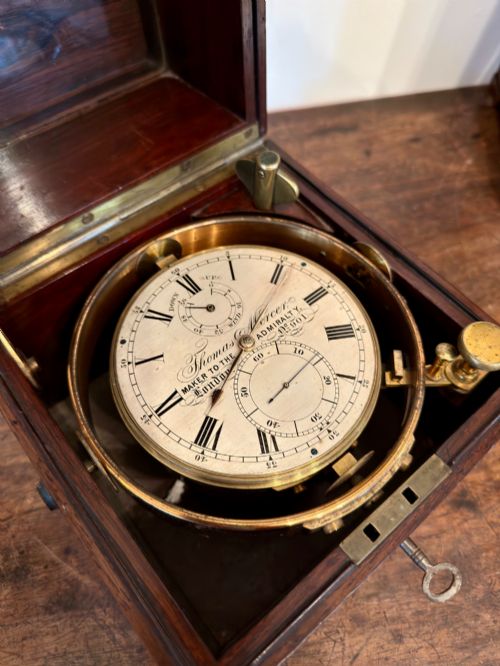
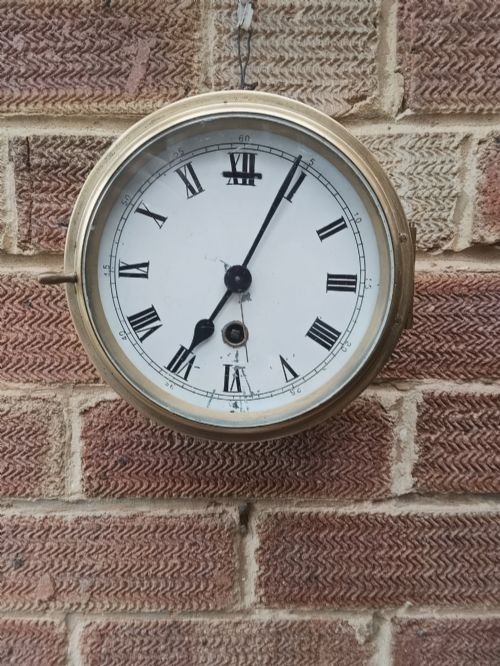
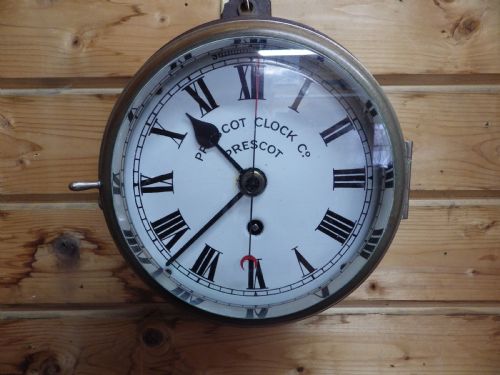
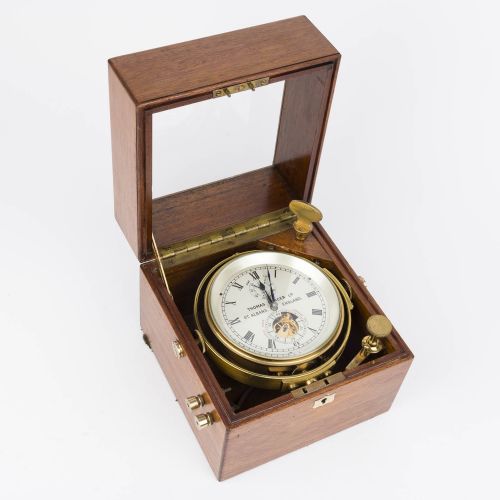


Brass Marine Clock
These brass marine clock examples bring functional maritime history into a room, offering the precision and heavy construction designed for life at sea.

What a brass marine clock is
A brass marine clock serves as a durable timepiece engineered to withstand the motion and damp conditions of a vessel. These objects range from heavy bulkhead clocks mounted on walls to precision chronometers housed in mahogany cases.
The pieces seen on this page span the Victorian era through the mid twentieth century, including examples from nineteen hundred, nineteen forty, nineteen thirty, nineteen fifty, eighteen sixty, and eighteen fifty. Wall clocks and mantel clocks appear alongside dedicated marine chronometers.
Buyers meet maritime and nautical styles most frequently, often featuring robust metal cases, glass viewing panels, and clear enamel dials designed for readability in difficult light. Certain pieces carry military or government markings such as Air Ministry or Admiralty patterns.
How they were made
Makers construct the primary housing of a brass marine clock from heavy cast brass, often paired with wooden surrounds in mahogany or general wood to secure the instrument against a bulkhead. Steel and metal components form the internal gear trains, while glass protects the dial face.
Movements utilise mechanical systems, including traditional fusee movements that maintain even tension as the mainspring unwinds. Enamel dials provide a crisp, durable surface for numerals, fired onto metal bases to resist cracking and tarnishing in salt air.
Retail Price Guide 2026
Typical UK retail prices for brass marine clock, calculated from the Sellingantiques database of over a million retail prices indexed since 2003. This retail price guide relies exclusively on Sellingantiques data; no external sources or auction records are used, so the figures do not describe the wider market.
What varies in quality
The calibre of the movement distinguishes standard timepieces from high grade chronometers, particularly those featuring Thomas Mercer mechanisms or fusee gear trains. Superior examples display meticulous hand assembly and heavier casting weights in the brass casing.
The legibility and preservation of the enamel dial heavily influence the character of the piece, alongside the presence of original mounting hardware and fitted wooden travel boxes. Makers' signatures and official government or Admiralty stamps add historical documentation that elevates the standing of the clock.
Thomas Mercer·Prescot·Smiths Astral·Lilley & Reynolds
The Brass Marine Clock Glossary
- Bulkhead
- A vertical partition dividing the compartments of a ship. Bulkhead clocks are bolted directly to these walls.
- Chronometer
- A highly accurate marine timekeeper used for determining longitude at sea. These mechanisms often feature two day power reserves.
- Fusee
- A conical pulley used in mechanical clocks to equalise the torque of the mainspring as it runs down. This ensures steady timekeeping.
- Enamel dial
- A face made by fusing powdered glass to a metal substrate at high heat. It provides a durable, bright white background for painted numerals.
Frequently Asked Questions
How do I mount a brass marine clock?
Most bulkhead clocks feature a hinged bezel or screw holes in the outer brass flange designed to secure the heavy body directly to a wall.
Ensure the fixings match the weight of the solid brass and glass construction to support the instrument safely.
What is a fusee movement?
A fusee movement uses a conical pulley and a chain or cord to regulate the force delivered from the mainspring to the gear train.
This mechanical refinement compensates for the decreasing power of the spring as it unwinds, resulting in more accurate timekeeping.
Are these clocks waterproof?
While built to endure damp marine environments and sea spray, vintage clocks are generally water resistant rather than fully waterproof.
Rubber gaskets on later models help keep moisture out, but older Victorian examples require dry placement.
How do I wind a marine clock?
Most models require a specialised winding key inserted through a small hole directly in the enamel dial face.
Turn the key gently until resistance indicates the mainspring is fully wound, taking care not to over tighten the mechanism.