
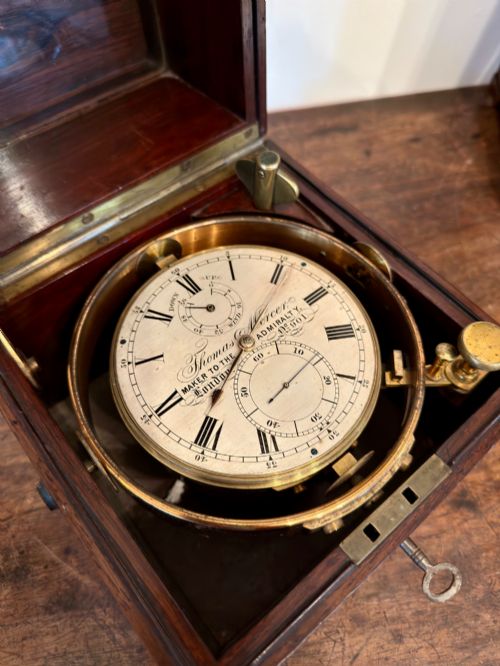
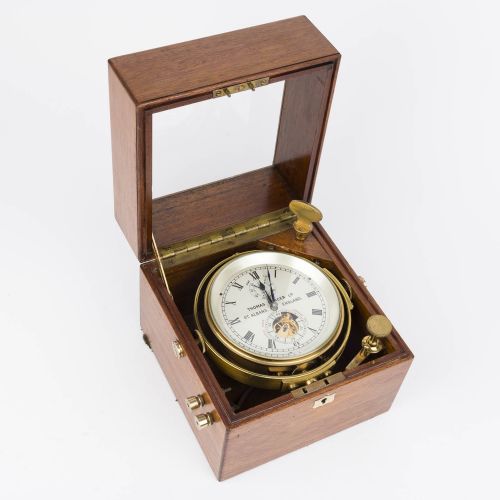


Mahogany Marine Chronometer
A mahogany marine chronometer is a precision timekeeper built for navigation at sea, housed in timber and brass.
What they are
A mahogany marine chronometer represents the pinnacle of historical timekeeping designed for navigation at sea. When you search for mahogany marine chronometer, you encounter instruments housed in sturdy timber boxes with brass fittings and glass viewing lids.
The pieces listed on this page span the nineteenth century, nineteen-forty, and nineteen-fifty. These chronometers take the form of specialised clocks built to maintain exact time aboard a vessel.
Makers such as Thomas Mercer, James McCabe, and Barraud of London appear in the records. Their work defines the maritime and regency styles characteristic of these precision instruments.
How they were made
These instruments combine dense timber construction with precision metalwork. Mahogany forms the outer protective case, often finished with brass corner mounts, drop handles, and glazed viewing lids.
Internal components utilise brass alongside delicate glass dials and lenses. The mechanical movements require intricate gearing and escapements designed to withstand the motion of a ship.
Listings span the nineteenth century, nineteen-forty, and nineteen-fifty, utilising mahogany, brass, and glass.
What varies in quality
Quality in these instruments rests upon the reputation of the maker and the precision of the movement. Signed works by notable London makers carry distinct mechanical refinement compared to unsigned examples.
The grade of the mahogany timber and the crispness of the brass fittings indicate the standard of production. Heavier brass mountings and finely figured wood distinguish the superior pieces in this category.
Thomas Mercer·James McCabe·Barraud Of London
The Mahogany Marine Chronometer Glossary
- Marine chronometer
- A highly accurate portable timekeeper used to determine longitude at sea by means of celestial navigation. These devices maintained strict time despite the roll and pitch of a ship.
- Two day
- A movement specification indicating the clock runs for forty-eight hours between windings. This duration was standard for operational navigation use.
- Gimbal
- A pivoted support ring that allows the chronometer case to remain level regardless of the vessel's motion. This mechanism neutralizes the effect of the ship listing.
- Regency
- An English design style spanning the late eighteenth and early nineteenth centuries. It emphasises clean architectural lines and classical restraint in timber furniture.
Frequently Asked Questions
What is a marine chronometer?
A marine chronometer is a specialised clock designed to keep accurate time at sea. This precision allowed navigators to calculate longitude.
These instruments sit inside fitted timber boxes to protect the delicate internal mechanism from moisture and shock.
How do you wind them?
Wind the movement using a dedicated key through the aperture in the dial or back plate. Care must be taken not to overwind the mainspring.
Most examples run for a specific duration, such as two days, before requiring another wind to maintain accuracy.
Why are they in mahogany cases?
Mahogany provides a stable, dense housing that resists warping in changing marine climates. The timber absorbs minor impacts and protects the precision movement.
Brass handles and corner brackets reinforce the timber box for handling aboard ship.
How do I date a chronometer?
Dating relies on maker signatures, serial numbers, and stylistic details of the timber case. Nineteenth-century examples show specific dial layouts and cabinetry.
Records of known makers help narrow the date of production to particular decades.