


Maritime Bulkhead Clock
A maritime bulkhead clock brings nautical utility and robust metal construction directly from ship cabins to domestic walls.

Maritime Bulkhead Clock
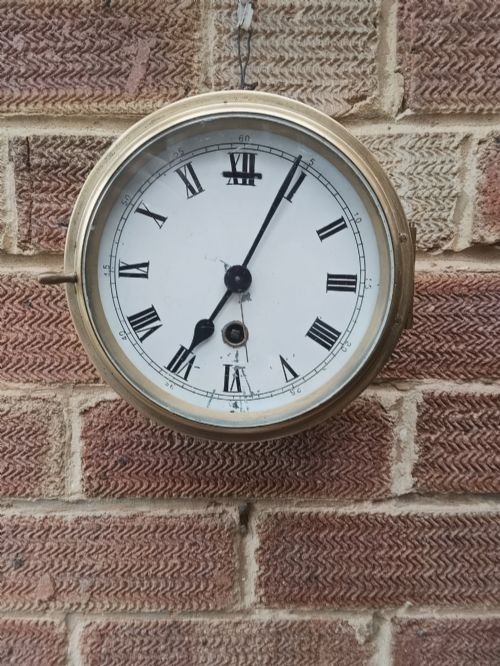
A maritime bulkhead clock is a heavy-duty timekeeper designed to be mounted securely on the walls of ship cabins and engine rooms, built to withstand constant motion and moisture. When you search for maritime bulkhead clock, you find timepieces spanning from the mid-nineteenth century through the mid-twentieth century, including Victorian examples and later mid-century iterations.
The most common forms on this page include brass-cased wall clocks featuring clear enamel dials, alongside specialised variations such as fusee movement models and radio room clocks with coloured segments. These pieces originate from distinct periods including Edwardian times and the decades spanning 1900 to 1960.
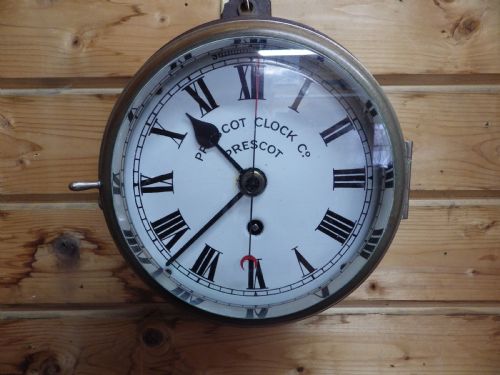
Makers and makers' marks on these dials point to established firms such as Prescot Clock Co, Kelvin White & Hutton London, and Smiths Empire, alongside military-issued pieces bearing Air Ministry markings. Styles range from strict industrial maritime designs to decorative Victorian marine iterations and Schatz German productions.
Materials and construction
These clocks rely heavily on robust brass cases, frequently cast with heavy bezels designed to seal tightly against salt air and damp environments. Nickel-plated brass and chrome finishes also appear alongside wooden mounts and steel components.
Dial construction typically involves white enamel with bold numerals for high legibility in dim ship interiors, protected by heavy glass covers secured by threaded bezels or hinges.
The internal mechanics range from standard movements to complex chain fusee movements designed to maintain even tension on the mainspring as it unwinds, ensuring accurate timekeeping despite the rolling of a vessel.
Factors of quality
Quality in these timepieces rests upon the precision and complexity of the internal movement, with chain fusee movements representing a higher tier of horological engineering than standard spring-driven mechanisms. The weight and casting quality of the brass case also dictate the overall standard of the piece.
The clarity and original condition of the enamel dial, along with legible maker signatures from firms like Prescot or Kelvin White & Hutton, elevate the standing of a clock. Industrial execution, heavy materials, and crisp dial typography distinguish superior examples from simpler utilitarian production.
Prescot Clock Co·Kelvin White and Hutton London·Smiths Empire·Schatz of Germany
The Maritime Bulkhead Clock Glossary
- Bulkhead
- The upright partition dividing compartments within a ship, providing the sturdy vertical mounting surface for these clocks.
- Fusee movement
- A conical pulley device connected to the mainspring by a chain, designed to equalise the torque as the spring unwinds.
- Enamel dial
- A metal face fused with powdered glass powder fired at high temperatures, creating a smooth, durable white surface for painted numerals.
- Bezel
- The metal ring that holds the protective glass cover in front of the clock dial, often hinged or threaded for access.
Maritime Bulkhead Clock: Frequently Asked Questions
Where were bulkhead clocks mounted?
These clocks were secured directly to the interior walls, known as bulkheads, of ships, cabins, and engine rooms where timekeeping was essential for navigation and shipboard duties.
Their heavy construction ensured they remained firmly attached and operational despite the constant vibration and rolling motion at sea.
What is a fusee movement?
A fusee movement uses a conical gear and a fine chain to regulate the power delivered from the mainspring to the gear train.
This mechanism ensures that the clock exerts uniform force whether the spring is fully wound or nearly run down, improving accuracy.
How do I clean a brass case?
Brass cases should be dusted gently with a soft cloth to remove surface particles without disturbing any aged patina that has developed over decades.
Harsh metal polishes should be avoided unless necessary, as they can wear away fine engraved details and maker inscriptions on the casing.
Are these clocks suitable for wall mounting?
These pieces are engineered specifically for wall hanging, featuring sturdy rear flanges or heavy cases designed to anchor securely into solid supports.
Due to their substantial metal weight, buyers must ensure fixings are robust enough to hold the clock safely in a domestic setting.