
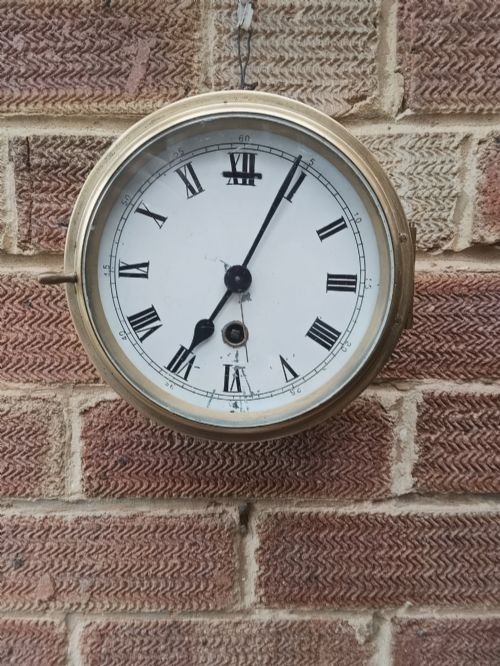
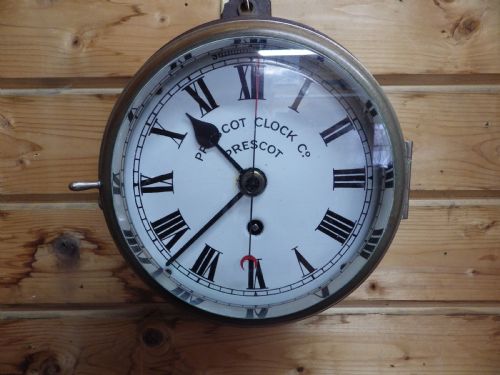


Marine Wall Clock
A marine wall clock brings naval timekeeping into a room, offering functional brass and glass dials from various decades.
Marine Wall Clock
A marine wall clock is a timepiece designed for use aboard a vessel, often taking the form of a bulkhead clock or a ships clock used to regulate maritime duties. When you search for a marine wall clock, you are looking at sturdy instruments that mounted to cabin walls to withstand damp and movement at sea.
The versions most commonly met on this page range from Victorian and Edwardian examples to mid-century pieces from the nineteen-thirties, nineteen-forties, and nineteen-fifties. These objects appear in styles such as maritime, industrial maritime, and mid-century maritime, reflecting shifts in naval and commercial shipping design.
Forms include standard wall clocks, engine room clocks, radio room clocks with red and green segments, and paired clock and barometer sets. Makers and marks associated with these pieces include Prescot Clock Co, Kelvin White & Hutton London, Air Ministry, Tempora, Smiths Empire, and Schatz of Germany.
What varies in quality
The clarity and legibility of the dial also dictate quality, with crisp enamel faces and specialised markings like radio room segments or eight-bell striking trains indicating higher manufacturing standards. Original components, including matching bezels and authentic maker signatures on the dial, preserve the integrity of the piece.
Prescot Clock Co·Kelvin White & Hutton London·Tempora·Smiths Empire·Schatz of Germany
The Marine Wall Clock Glossary
- Bulkhead clock
- A timepiece designed specifically to be mounted directly onto the structural partition of a ship. These sturdy clocks feature secure screw-down bezels and heavy cases.
- Fusee movement
- A conical pulley device connected to the mainspring by a chain, designed to maintain even tension and improve timekeeping accuracy. This mechanical feature appears in older models.
- Radio room clock
- A specialised dial featuring red and green sector markings indicating silent periods for listening to distress frequencies. These are found on mid-century marine clocks.
- Enamel dial
- A fused glass-on-metal face providing a smooth, durable, and wipe-clean surface that resists tarnishing in damp environments. They provide high contrast for reading time.
- Bezel
- The metal ring that holds the glass cover over the clock face, frequently hinged or screwed shut to seal the movement against moisture.
Marine Wall Clock: Frequently Asked Questions
What is a bulkhead clock?
A bulkhead clock is a heavy-duty timepiece built to mount securely to the interior walls of a ship. These clocks utilise robust metal cases and sealed bezels to protect the internal movement from moisture and vibration.
They were essential for keeping watch schedules and coordinating duties aboard naval and commercial vessels. Today, they bring a functional maritime aesthetic to domestic interiors.
How do fusee movements work?
A fusee movement uses a conical pulley and a fine chain to regulate the power delivered from the mainspring to the gear train. As the spring unwinds and loses strength, the chain pulls on a wider part of the cone to maintain consistent torque.
This mechanical refinement ensures greater accuracy over the duration of the clock run. It is a hallmark of traditional British horology found in older marine clocks.
What are radio room clocks?
Radio room clocks feature distinctive red and green pie-slice segments painted onto the dial face. These markings indicated mandatory silent periods when wireless operators had to listen exclusively for distress signals.
Originating in mid-century maritime communication, these specialised dials make these clocks particularly distinctive. They reflect the strict safety protocols of twentieth-century shipping.
How do I mount a marine clock?
Marine wall clocks typically feature screw holes drilled through the outer flange or a heavy mounting bracket designed for vertical surfaces. Because these clocks are often cast in solid brass or heavy metal, they require secure fixings into wall studs or proper masonry anchors.
Proper mounting ensures that hinged bezels can open freely for winding and setting without straining the case. It also keeps the heavy movement stable and level for accurate timekeeping.
Are these clocks waterproof?
While original marine clocks were engineered to withstand damp sea air and splashing water, ageing gaskets and seals may no longer be airtight. They were designed for protected cabin bulkheads rather than submersion.
Exposing antique brass and enamel movements to high humidity today can cause corrosion. It is best to keep them in dry interior environments.