
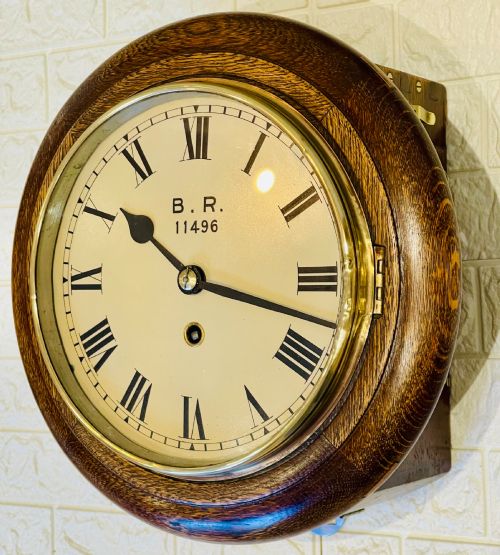
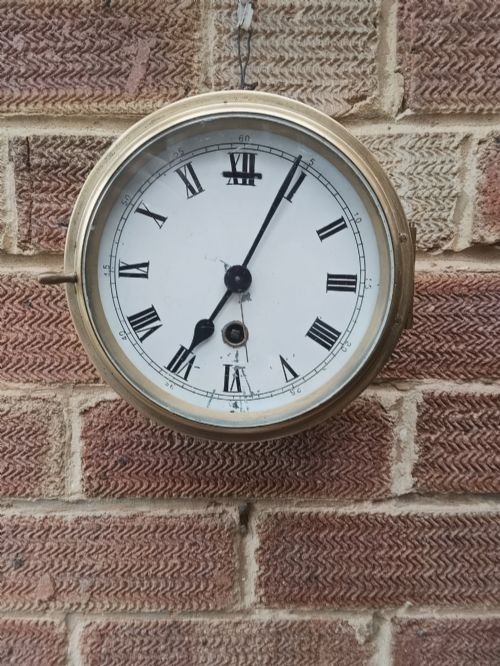
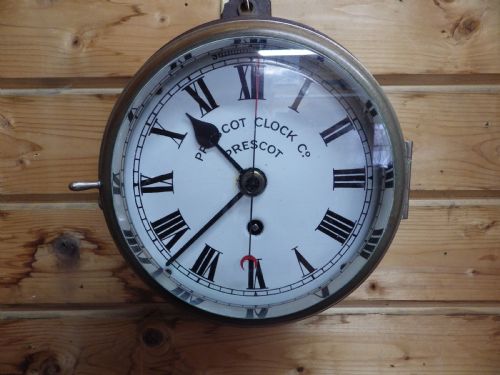


Heavy Brass Clock
A heavy brass clock brings genuine maritime history indoors, offering solid metal construction and reliable mechanical movements.

What these clocks are
When you search for a heavy brass clock, you are looking at robust marine and bulkhead timepieces built to withstand demanding conditions at sea. These pieces originate from various eras including the Victorian, Edwardian, and mid-twentieth-century periods, spanning wall clocks and nautical instruments.
The version you are most likely to meet on this page is a ship's bulkhead clock featuring a substantial brass case, enamel dial, and often a fusee movement. They range from military and maritime service instruments to specialised marine master clocks.
Makers recorded in our archives and current selections include established names such as Prescot Clock Co, Kelvin White & Hutton, and Mercer. Their origins span standard commercial marine production as well as official government and air ministry supply.
How they were made
These clocks combine heavy brass casings with glass face covers, steel components, and nickel-plated brass finishes. Dials are frequently finished in white enamel with clear markers for legible timekeeping in difficult light.
Movements rely on traditional mechanical techniques, notably chain fusee systems designed to maintain even tension and accuracy as the mainspring unwinds. Wooden mounting boards or structural elements occasionally accompany the metal housings.
Retail Price Guide 2026
Typical UK retail prices for heavy brass clock, calculated from the Sellingantiques database of over a million retail prices indexed since 2003. This retail price guide relies exclusively on Sellingantiques data; no external sources or auction records are used, so the figures do not describe the wider market.
Listings feature periods from the eighteen-fifties through to the nineteen-fifties, incorporating brass, glass, steel, and enamel materials.
What varies in quality
The standard of a heavy brass clock rests upon the sophistication of its internal movement, such as whether it houses a precision chain fusee or a standard striking mechanism. Heavier, thicker brass cases and signed dials by recognised makers elevate the piece above utilitarian examples.
Originality of components and the clarity of the enamel dial heavily influence the character of the clock. Pieces retained from official maritime or air ministry service often display higher baseline build standards suited to strict government contracts.
Prescot Clock Co·Kelvin White and Hutton·Mercer
The Heavy Brass Clock Glossary
- Bulkhead clock
- A sturdy timepiece designed to be mounted directly onto the bulkhead wall of a ship. These units feature secure mountings and heavy frames to resist constant vibration.
- Fusee movement
- A conical pulley mechanism connected to the mainspring by a chain. This clever device ensures constant driving power to the gear train as the spring loses tension.
- Enamel dial
- A metal face fused with powdered glass powder under high heat. This creates a durable, glossy white surface that resists discolouration over decades of use.
- Twin fusee
- A movement incorporating two separate fusee cones, typically dividing the timekeeping train from the striking train. This setup ensures both functions receive regulated, even power.
Frequently Asked Questions
What is a ship's bulkhead clock?
A ship's bulkhead clock is a heavy-duty timepiece manufactured specifically for mounting on marine vessels. Their robust brass housings protect the delicate internal gears from sea spray and constant motion.
These clocks were essential navigational tools on ships and government vessels, ensuring accurate timekeeping across long ocean voyages. Today, they serve as striking wall pieces for maritime enthusiasts.
How does a fusee movement work?
A fusee movement uses a conical pulley and a fine chain to regulate the power delivered from the mainspring. As the spring unwinds and loses strength, the chain pulls on a wider part of the cone to maintain consistent torque.
This mechanical innovation ensures the clock maintains steady accuracy throughout its running cycle. It represents a higher standard of clockmaking craftsmanship.
How do I date these brass clocks?
Dating these clocks involves examining the maker's signature, style of the enamel dial, and the complexity of the mechanical movement. Victorian and Edwardian examples often feature distinct fusee chains and heavy brass bezels.
Later mid-century pieces, such as those from the nineteen-forties or nineteen-fifties, frequently display specific military service markings or simplified movements. Comparing these details with historical records narrows down the era of manufacture.
Where were bulkhead clocks mounted?
Bulkhead clocks were traditionally mounted on the vertical partitions inside a ship's cabin, bridge, or chartroom. Their heavy brass construction allowed them to remain securely fastened despite rough seas and engine vibrations.
In modern settings, they make practical wall clocks for studies, kitchens, or hallways. Their durable materials ensure they suit daily domestic use.