
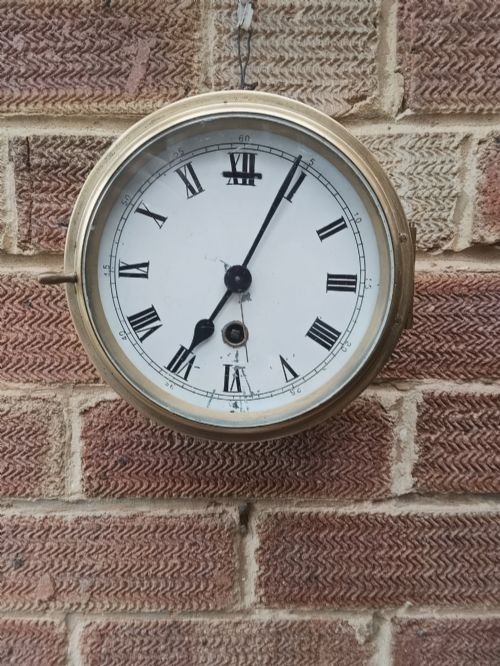
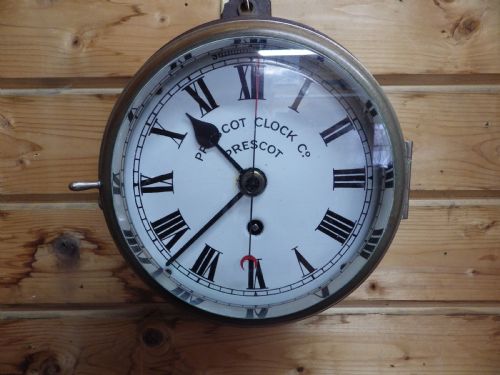


Marine Bulkhead Clock
These marine bulkhead clock pieces are heavy maritime timepieces built to endure the roll of a ship, offering lasting brass or chrome utility for the wall.
Marine Bulkhead Clock
A marine bulkhead clock is a heavy-duty wall timekeeper designed for use aboard vessels, engineered to withstand damp conditions and constant movement at sea.
The pieces on this page span several decades, ranging from nineteenth-century fusee movements to mid-century examples originating from workshops, naval services and civilian maritime makers.
Forms include straightforward brass wall clocks, engine room instruments, radio room clocks with coloured segments, and matched sets incorporating barometers.
How They Were Made
Construction relies heavily on robust metals, with solid brass cases, nickel-plated brass and chrome providing protection against corrosion in marine environments.
Dials frequently feature clear enamel or protected glass faces, allowing legibility in varying light conditions aboard a ship.
Many earlier examples utilise chain fusee movements to ensure steady tension and accurate timekeeping despite the motion of the vessel.
Listings feature periods spanning from the Victorian era through the Edwardian years and into the mid-twentieth century.
What Varies in Quality
Quality rests upon the calibre of the internal movement, where traditional chain fusee mechanisms demand finer workmanship than standard spring-driven alternatives.
The weight and finish of the outer metal case determine the tier of the piece, with heavy cast brass or thick chrome plating showing superior original intent.
Original military or official naval issue markings denote rigorous government standards, distinguishing specialised service clocks from standard commercial maritime hardware.
Prescot Clock Co·Kelvin White & Hutton London·Schatz of Germany·Smiths Empire·Smiths Astral·E & E Emanuel of Portsea
The Marine Bulkhead Clock Glossary
- Bulkhead
- A vertical partition dividing the hull of a ship into compartments, upon which these clocks are mounted.
- Fusee
- A conical pulley used with a cord or chain to maintain even power as the mainspring unwinds.
- Admiralty Pattern
- A standardised specification adopted by the British Admiralty for equipment supplied to the Royal Navy.
- Radio Room Clock
- A specialised timepiece featuring coloured segments on the dial to indicate silent periods for distress listening.
- Sestrel
- A notable British brand renowned for manufacturing high-quality maritime navigational instruments and clocks.
Marine Bulkhead Clock: Frequently Asked Questions
How do you mount a marine bulkhead clock?
These clocks are designed to attach directly to a wall or wooden panel through screw holes in the flange or hinged bezel ring.
Ensure the fixings can support the substantial weight of the brass case before hanging.
What is an eight-day movement?
An eight-day movement requires winding only once a week, making it practical for regular use aboard ships.
This longer power reserve was standard for reliable timekeeping at sea.
Why do some clocks have coloured dial segments?
Radio room clocks feature red and green sectors to mark silent periods for monitoring maritime distress frequencies.
Operators stopped transmitting during these intervals to listen for emergency calls.
How do I tell an Admiralty clock from a civilian one?
Naval issue pieces often display military broad arrow marks or specific pattern numbers on the dial or casing.
Civilian versions usually bear the name of the maker or retailer rather than government issue codes.