
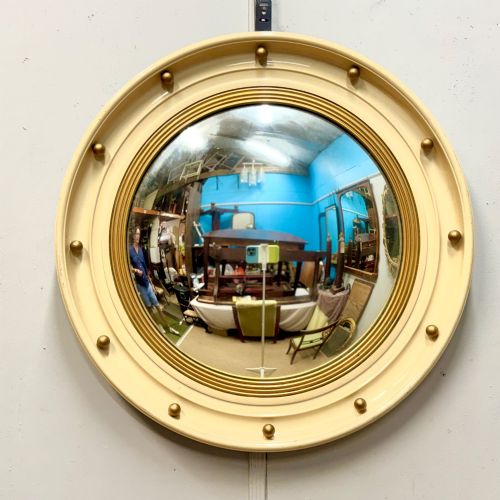
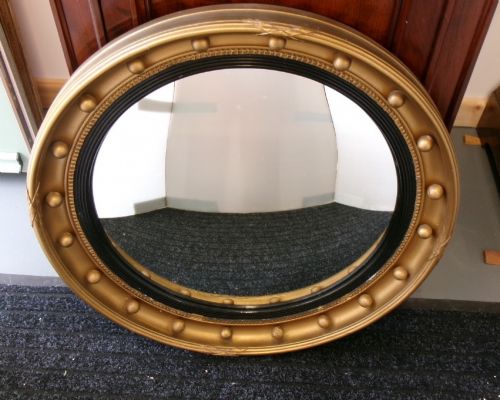


Gold Porthole Mirror
A gold porthole mirror brings a distinct curved reflection into a room, capturing light across a circular frame.
Gold Porthole Mirror
A gold porthole mirror typically takes the form of a round wall mirror featuring a convex glass lens that bends the reflection to capture a wider view of the room. These pieces appear across several periods, most notably originating in the Regency era before seeing revival forms through the Victorian period and into the twentieth century.
The versions most commonly met on this page span the nineteenth century, including grand Regency examples alongside later Victorian and 1900s interpretations. Their circular frames range from simple gilded wood mouldings to elaborate designs fitted with ebonised slips.
Makers and craftsmen designed these wall mirrors for halls and principal rooms, where their spherical glass plates served both a functional purpose and an ornamental role. They remain distinct from flat mirrors due to their curved surface and characteristic deep circular surrounds.
How they were made
Construction relies upon solid timber frames built up with gesso before receiving layers of gold leaf or paint to achieve a gilt finish. Ebonised wood slips often sit immediately against the glass to create a dark contrast within the frame.
The curved glass itself requires specialised blowing and cooling techniques to form an even convex surface without distortion. Metal framing also appears in later twentieth century pieces, shifting the material base away from traditional wood and gesso.
Listings span the nineteenth and twentieth centuries, featuring materials such as giltwood, ebonised wood, gesso and gilt metal.
What varies in quality
The crispness of the gesso moulding and the depth of the gilding set individual pieces apart, determining how well the frame catches light. Earlier Regency frames display finer detail in their carved elements compared to later revival pieces.
The clarity and condition of the convex glass plate also influence the overall character, as older hand-formed glass carries subtle variations that flat modern replacements lack.
The Gold Porthole Mirror Glossary
- Convex glass
- A curved glass plate that bulges outward to create a panoramic reflection of the interior space. This spherical form is the defining characteristic of a porthole mirror.
- Giltwood
- Timber that has been covered with a thin layer of gold leaf or gold paint. This material forms the primary structure for the majority of these circular frames.
- Ebonised slip
- A narrow dark inner border, often made of blackened wood, positioned between the mirror glass and the outer frame. It provides a visual contrast to the surrounding gold finish.
- Gesso
- A plaster-like mixture applied to wooden frames to provide a smooth surface for gilding. Skilled application allows for sharp decorative details.
- Girandole
- A branched candle sconce attached to the base of a wall mirror. These fixtures extend the reflective qualities of the glass by multiplying candlelight.
Gold Porthole Mirror: Frequently Asked Questions
Where should I hang a gold porthole mirror?
These mirrors suit spaces like hallways, entryways and dining rooms where their wide-angle reflection can open up the room.
Their circular shape works well centred above a fireplace mantel or console table to anchor the surrounding decor.
How do I clean the convex glass?
Dust the curved surface gently with a soft, dry cloth to avoid scratching the historical glass or disturbing the frame.
Apply a mild glass cleaner to a cloth rather than spraying directly onto the glass, ensuring liquid does not seep behind the edge.
What is the difference between Regency and Victorian pieces?
Regency mirrors date from the early nineteenth century and typically feature sharper carved details and traditional fire gilding techniques.
Victorian and later revival pieces often utilise simpler mouldings or heavier gesso application while retaining the classic circular silhouette.
Why do these mirrors have curved glass?
The curved glass creates a convex lens effect that reflects an entire room within a single circular frame.
Historically, this design allowed servants to monitor multiple doors or activities in a dining room from a single vantage point.