






Porthole Wall Mirror
A porthole wall mirror brings focused reflection and maritime character into a room, taking the shape of ship glass.
Porthole Wall Mirror
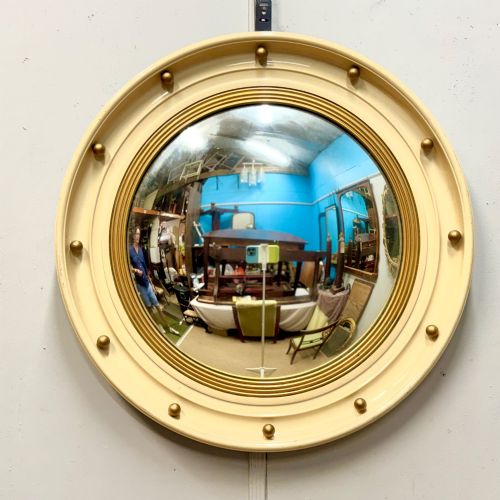
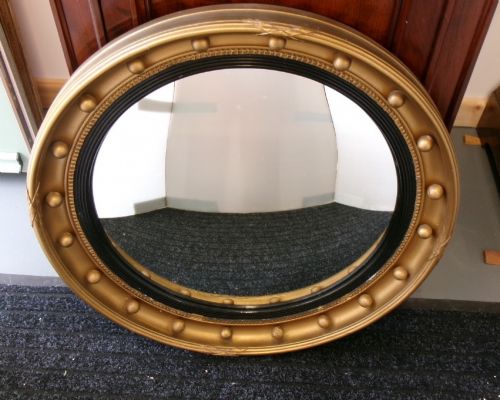
A porthole wall mirror takes its name from nautical round windows, presenting a circular glass plate housed within a stout frame. The form draws heavily on Regency and Victorian convex designs, often referred to as butler's mirrors.
Most examples found here span the nineteenth century, with Regency originals sitting alongside later Victorian interpretations and twentieth-century revivals. They appear most frequently as wall mirrors and hall mirrors designed to bounce light across compact spaces.
How they were made
Frames rely upon traditional timber construction, utilising wood, mahogany, or ebonised wood shaped into rigid circular profiles. Giltwood and gesso applications provide the characteristic metallic sheen, bonded directly to the wooden base.
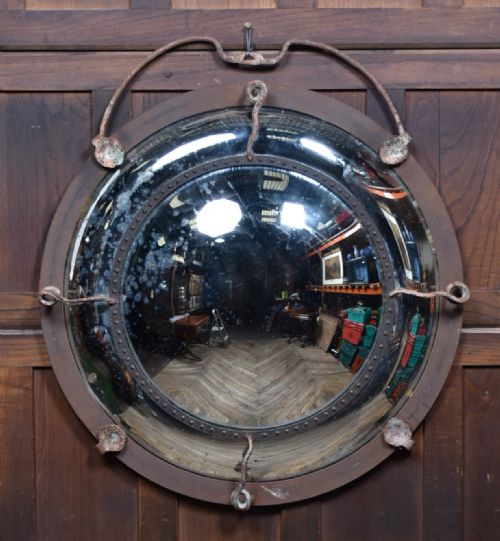
Convex glass plates demand specialised blowing and cooling techniques to achieve the curved surface that distorts the room in miniature. Brass bezels and fittings frequently secure the glass within its heavy timber or painted wood housing.
Porthole Wall Mirror Retail Price Guide 2026
Typical asking prices for porthole wall mirror among the pieces listed under this phrase on Sellingantiques today, from the lower quarter to the upper quarter. They describe what is for sale here now, not the wider market.
Butler's mirrors were supposedly placed opposite dining tables so servants could spot empty wine glasses without staring.
What varies in quality
The crispness of the gilt moulding and the depth of the carved wooden details dictate the visual weight of the piece. Finer frames maintain sharper definition in their gesso work, whereas lesser examples show softening in the ornamentation.
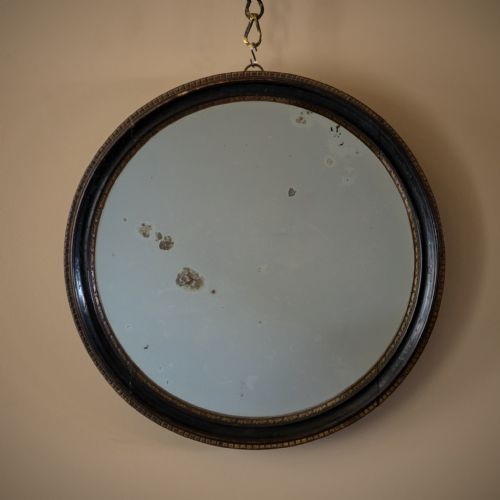
The clarity and integrity of the convex glass plate separate standard production from superior craftsmanship. Original mercury silvering displays natural ageing characteristics that differ significantly from uniform modern replacements.
The Porthole Wall Mirror Glossary
- Convex glass
- Curved glass that projects outward, creating a wide-angle reflection of the entire interior space.
- Giltwood
- Timber coated with a thin layer of gold leaf or gilt powder over a prepared gesso ground.
- Ebonised slip
- A dark, blackened inner moulding placed between the mirror plate and the main outer frame.
- Girandole
- A wall mirror featuring attached candle sconces designed to multiply the flickering light.
Porthole Wall Mirror: Frequently Asked Questions
Where should I hang a porthole mirror?
These circular frames suit hallways, above mantelpieces, or narrow wall spaces where a standard rectangular glass feels too heavy.
The curved reflection effectively opens up dark corners by gathering ambient light from multiple angles.
How do I date a convex mirror?
Look closely at the construction of the backboards, the composition of the gesso, and the silvering on the glass plate.
Nineteenth-century examples frequently exhibit hand-beaten brass mounts and dried pine or hardwood secondary timbers behind the frame.
Why is the reflection curved?
The optical design uses a spherical glass surface to pull a wide field of view into a compact circular frame.
This specific configuration allowed eighteenth and nineteenth-century servants to monitor entire rooms from a single vantage point.