


Georgian Reading Table
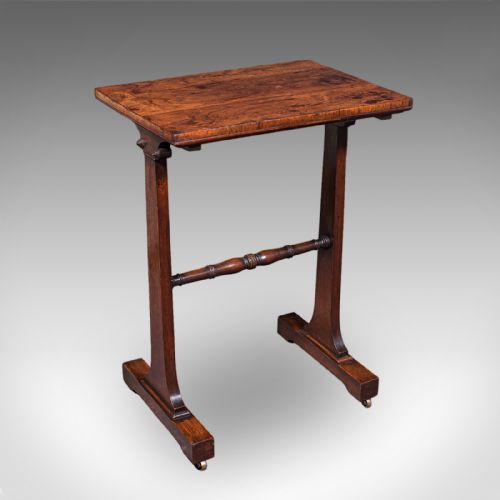
A georgian reading table combines adjustable book rests with fine cabinet-making, offering a practical workspace for study and letters.
Georgian Reading Table
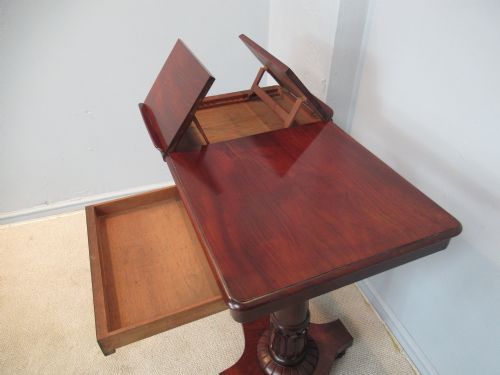
When you search for a georgian reading table, you encounter adjustable surfaces designed for books, music, and drafting. These pieces range from compact stands to larger desks with clever mechanical actions.
Mahogany forms the mainstay of these pieces, often featuring brass fittings and leather inserts. You frequently find variants with two tiers or tilting surfaces suited to the morning room or library.
The selections span the eighteenth and nineteenth centuries, including George III and Regency interpretations. Their versatile forms double as writing desks and occasional tables.
Materials and construction
Cabinet-makers relied heavily on figured mahogany and rosewood, sometimes accented with satinwood or ebony stringing. These timbers were chosen for their stability and rich grain.
Functional metalwork defined the adjustable elements, incorporating brass ratchets, hinges, and occasional bronze mounts. Leather inserts often lined the top surfaces for writing comfort.
Surviving examples bridge the Georgian, Regency, and early Victorian eras through changing interpretations of the form.
What separates the best examples
Quality rests in the precision of the adjustable mechanism and the smoothness of its operation. A superior piece moves without binding and holds its angle securely.
The choice of timber grain and the crispness of edge mouldings dictate visual merit. Finely figured mahogany and well-fitted brass components elevate an example above standard utility items.
Marsh & Tatham
The Georgian Reading Table Glossary
- Reading table
- A specialised table featuring an adjustable or tilting top designed to hold books or folios at a comfortable angle. These often include pull-out candle slides or shelves.
- Ratchet support
- A notched wooden or metal bracket fitted beneath the reading surface. It allows the user to alter the pitch of the desk.
- Architect's desk
- A multi-functional piece with a rising central section and storage for papers and instruments. They frequently incorporate extending ledges.
- Regency
- A design period spanning the early nineteenth century defined by Neoclassical influences and dark exotic woods. Pieces often feature bold brass mounts and classical motifs.
- Two-tier table
- A design incorporating an upper surface supported by columns above a lower shelf or platform. This configuration provided additional space for books and papers in libraries.
Georgian Reading Table: Frequently Asked Questions
How do I adjust the reading stand?
Most pieces utilise a wooden or brass ratchet mechanism beneath the surface. You simply lift the reading flap to the desired notch.
Ensure the support engages securely before placing heavy books or folios on the ledge.
Are these tables suitable for modern laptops?
The adjustable surfaces accommodate modern technology well, provided the weight remains within reason. Many variants offer sufficient surface area for writing and device use.
Protect vulnerable mahogany and leather surfaces with a pad if placing hot items or metals directly on the wood.
What is the difference between a reading table and an architect's desk?
Reading tables focus primarily on an adjustable tilting surface for books and music sheets. Architect's desks incorporate larger lifting compartments and drawer arrangements suited to drafting.
Both forms belong to the same broader family of metamorphic furniture developed for study rooms.
How should I care for the leather top?
Leather inserts require occasional conditioning with a neutral wax or specialised balm to prevent cracking. Avoid exposure to direct sunlight and excessive heat.
Dust the surrounding mahogany regularly with a soft cloth to maintain the polish.