




Georgian Mahogany Stationery Box
A georgian mahogany stationery box brings the clean architectural lines of the late eighteenth and early nineteenth centuries directly to the modern desk.
Georgian Mahogany Stationery Box
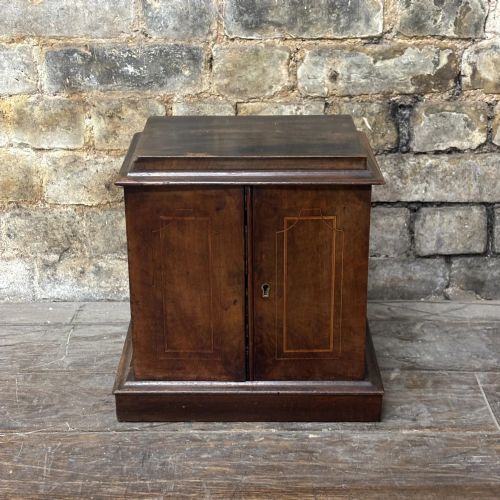
The georgian mahogany stationery box category encompasses several overlapping forms originating in the eighteenth and nineteenth centuries, including dedicated letter holders, post boxes, and knife boxes adapted for desk use.
Buyers browsing this selection will encounter pieces spanning the Georgian, Regency, and Edwardian eras, alongside related writing slopes and campaign boxes.
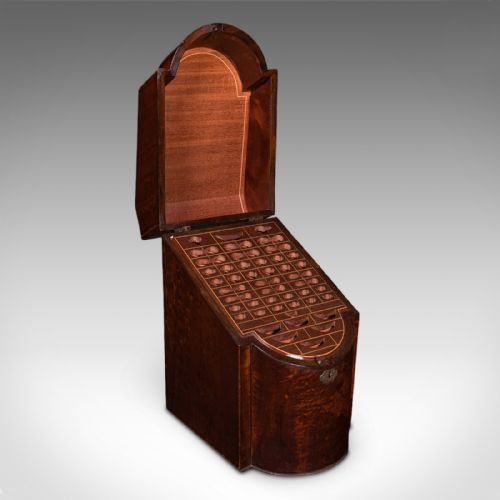
Many of these containers trace their origins back to eighteenth-century cutlery boxes, subsequently repurposed to hold correspondence and writing paper as domestic habits shifted.
Materials and construction
Makers built these pieces primarily from solid mahogany, frequently selecting figured timber for principal surfaces and incorporating contrasting stringing or wood inlay in boxwood and satinwood.
Internal partitions and fittings occasionally utilise supplementary bone or secondary woods to organise compartments for letters and writing implements.
Current listings feature pieces spanning the Georgian, Regency, and Edwardian periods, constructed primarily from mahogany with brass and satinwood inlay.
Judging quality
Quality rests upon the selection of the mahogany timber and the crispness of any inlaid decoration, distinguishing finely figured George III examples from simpler later pieces.
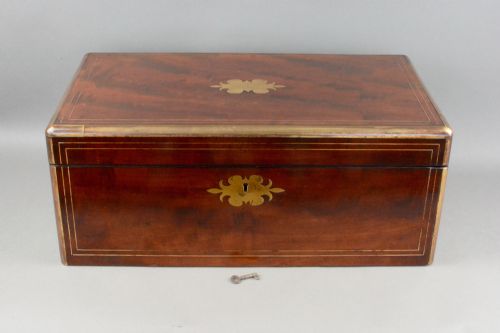
The integration of brass fittings, from flush carrying handles to fitted locks, demonstrates the original workshop's standard of execution.
Proportion and form dictate the piece's standing, with serpentine fronts and substantial brass bound construction marking out superior examples.
The Georgian Mahogany Stationery Box Glossary
- Mahogany
- A durable tropical hardwood prized for its rich reddish-brown tone and stability. It serves as the primary structural material for the vast majority of these boxes.
- Serpentine
- A gently undulating curved shape resembling a snake's path, often seen on the front elevation of finer Georgian boxes. This profile requires skilled woodworking.
- Writing slope
- A portable box with a hinged sloping lid that opens to reveal a desk surface and storage compartments. Several examples in this category share lineage with stationery boxes.
- Campaign box
- Portable furniture designed for military officers on the move, typically reinforced with brass corners and recessed handles. These pieces prioritise rugged portability.
- Inlay
- A decorative technique where contrasting materials such as boxwood or satinwood are set into the mahogany surface. This creates geometric or botanical patterns.
Georgian Mahogany Stationery Box: Frequently Asked Questions
What were stationery boxes originally used for?
These boxes served to organise correspondence, writing paper, and envelopes on domestic desks before the advent of modern postal systems. Many started life as knife boxes before finding a second purpose holding letters.
Over time, changing writing habits transformed how people stored paper goods, leading to dedicated cabinets and letter holders by the nineteenth century.
How do I distinguish a Georgian box from a later copy?
Examine the secondary woods inside the box, the construction of the dovetail joints, and the wear patterns on the mahogany surfaces. Genuine Georgian pieces display hand-cut joinery and period-appropriate hardware.
Later Victorian and Edwardian reproductions often utilise machine-swn elements and different interior arrangements that reflect the manufacturing standards of their own decades.
Can I still use an antique stationery box today?
These boxes function exceptionally well on modern desks for holding contemporary stationery, letters, or small office supplies. Their internal partitions remain practical for organising modern paper sizes.
Placing them out of direct sunlight and away from heat sources protects the polished mahogany finish and prevents the wood from drying out.
Why do some stationery boxes look like knife boxes?
Many eighteenth-century knife boxes possessed sloping lids and tall profiles that lent themselves perfectly to holding upright letters and stationery. Makers and owners frequently repurposed these dining room accessories for the study.
This crossover explains why several items listed under stationery searches retain the distinctive silhouette of cutlery storage.