

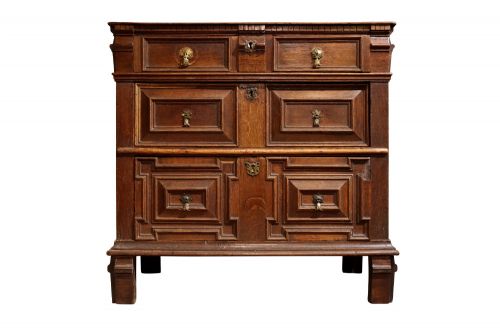


Geometric Moulded Cabinet
A geometric moulded cabinet or chest brings heavy seventeenth-century texture to a room, driven by panelled fronts and rich timber contrast.
Geometric Moulded Cabinet
A geometric moulded cabinet or related chest of drawers centres on architectural raised mouldings applied to drawer fronts and doors. These pieces span seventeenth-century origins, later revivals, and subsequent periods including the eighteenth and nineteenth centuries.
The pieces appearing here include oak chests, cabinets on stands, dressers, and writing bureaus. Many examples draw directly from seventeenth-century Jacobean and Charles II aesthetics, while others date from later revival phases in the early twentieth century.
Oak forms the primary structure for the early examples, accompanied by walnut and fruitwood. Buyers frequently encounter seventeenth-century joined timber alongside dark oak pieces built during the nineteen-twenties and nineteen-thirties.
How these pieces were made
Joiners constructed the foundational carcases using solid oak and walnut, employing traditional frame-and-panel techniques. Drawer fronts received applied mitred moulding strips to create intricate geometric panels and bossed projections.
Craftsmen enriched surfaces using fruitwood inlay, snakewood, and occasional mother-of-pearl details. Timber surfaces were finished to highlight the natural grain of the wood, paired with brass hardware.
The forms represented span chests of drawers, bureau bookcases, writing bureaus, and cabinets on stands.
What varies in quality
The integrity of the applied geometric mouldings dictates much of the visual success of the piece. Crisp mitres and intact raised panels separate superior joinery from simpler interpretations.
The choice of secondary timbers and decorative elements introduces significant variation. Pieces incorporating snakewood, fruitwood inlay, and mother-of-pearl reflect higher ambition than plain surfaces.
The Geometric Moulded Cabinet Glossary
- Geometric moulding
- Raised wooden strips applied in repeating patterns to create architectural panels. This technique defines the facade of seventeenth-century case furniture.
- Jacobean style
- A heavy, panelled aesthetic originating in the early seventeenth century and revived later. It relies on dark oak and deep relief carving.
- Snakewood
- A dense, heavily figured exotic timber utilised for decorative banding and contrast. Its distinct markings enhance high-status cabinetry.
- Bureau bookcase
- A writing desk with a sloping fall-front combined with shelving above. These forms often incorporate panelled doors and fitted internal compartments.
Geometric Moulded Cabinet: Frequently Asked Questions
How do I date a geometric chest?
Examine the construction methods, timber choice, and secondary woods used in the drawers and backboards. Seventeenth-century pieces display hand-riven boards and traditional joinery rather than machine-cut elements.
Revival pieces from the twentieth century often use standardised fixings and darker uniform finishes. Comparing the moulding profiles to verified period examples also clarifies the age.
Where should I place this cabinet?
These substantial oak and walnut pieces suit hallways, living rooms, or studies where their dark timber and tactile facades provide grounding contrast. Ensure the room has stable humidity to protect old joined timber.
Keep them away from direct heat sources to prevent the wood and applied mouldings from shrinking or splitting.
Are Jacobean revival pieces authentic antiques?
Revival pieces manufactured during the early twentieth century are genuine antiques in their own right, reflecting the historicism of that era. They reproduce seventeenth-century forms using period woodworking methods.
Distinguishing between a seventeenth-century original and a nineteen-twenties interpretation depends on wear patterns, material oxidation, and structural assembly.
What maintenance do these timbers need?
Apply traditional beeswax periodically to nourish the oak, walnut, or fruitwood surfaces and maintain a soft sheen. Avoid modern silicone sprays that build up and attract dust.
Dust regularly with a soft, dry cloth to protect the intricate crevices of the geometric mouldings from grime accumulation.