
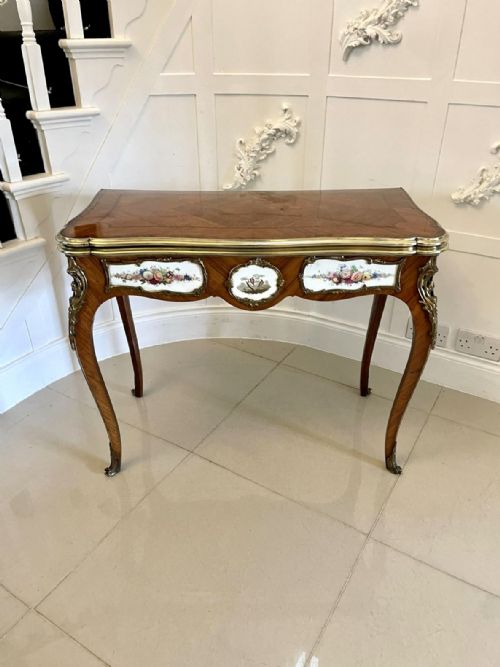
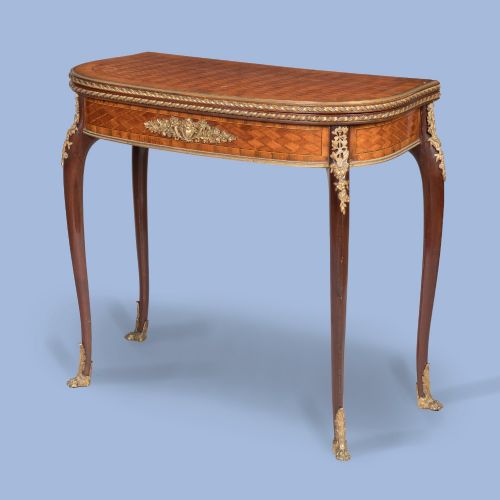


French Parquetry Games Table
A french parquetry games table offers intricate wood mosaics and clever folding tops designed for nineteenth-century card play.
French Parquetry Games Table
A french parquetry games table is a multifunctional nineteenth-century furniture form engineered for domestic entertainment. These pieces typically function as side or console tables until their tops fold or swivel open to reveal a baize-lined playing surface.
The examples found here span the 1850s to the 1890s, heavily influenced by Louis XV and Louis XVI revival aesthetics. They range from demi-lune shapes to circular bouillotte tables and square envelope formats.
Makers working in London and Paris constructed these tables from timber veneers arranged in geometric or floral wood mosaics. Ormolu and gilt bronze mounts frequently accent the corners, borders, and legs of the more ambitious pieces.
How they were made
Cabinetmakers built these tables using timber veneer over a supportive carcase of secondary woods. Kingwood, rosewood, walnut, and mahogany form the foundation of the parquetry patterns, supplemented by brass stringing.
Gilt bronze and ormolu mounts were cast and chased separately before being screwed onto the wooden frames. Hinges and pivot mechanisms required precise metalwork to ensure the folding and rotating tops operated smoothly.
The listings on this page span the mid to late nineteenth century, concentrating heavily on Louis XV and Louis XVI revival styles.
What varies in quality
The precision of the veneer cutting dictates the crispness of the parquetry design across the top. Finer examples display tight, complex geometric or floral compositions with minimal filler between individual wood tiles.
The weight and chasing of the ormolu mounts separate standard production from master workshop output. Thicker bronze mounts with deeply chased details indicate superior craftsmanship compared to thin, cast brass alternatives.
G T Morant·François Linke·Maison Mottheau·Joseph-Emmanuel Zwiener
The French Parquetry Games Table Glossary
- Parquetry
- A geometric mosaic of wood veneers used to decorate furniture surfaces. Cabinetmakers arrange contrasting timbers to create patterns.
- Ormolu
- Gilt bronze mounts applied to furniture for decorative accent. This technique involves gilding a bronze base with gold leaf or mercury amalgam.
- Kingwood
- A dense, heavily figured timber native to Brazil utilised in fine cabinetmaking. Its dark brown colour and distinctive grain made it a favourite for nineteenth-century veneers.
- Bouillotte table
- A small circular occasional table often featuring a raised gallery edge around the top. They typically date from the late nineteenth century.
- Demi-lune
- A half-moon shape common in console and card tables designed to sit flush against a wall. These pieces often feature folding tops supported by a swing leg.
French Parquetry Games Table: Frequently Asked Questions
How do these folding tables work?
The top surfaces are hinged, pivoted, or designed in an envelope format to unfold and reveal a concealed playing well underneath. This mechanism allows a compact console or side table to transform into a stable surface for cards.
Supporting legs often swing out simultaneously to bear the weight of the opened leaf. The internal compartments frequently store counters or cards when the table is closed.
What is parquetry?
Parquetry is a technique where small geometric pieces of coloured veneer are fitted together to form a decorative mosaic. Artisans cut timbers like kingwood, rosewood, and walnut to create interlocking patterns across the table top.
This method differs from marquetry, which typically depicts pictorial scenes or floral sprays rather than repeating geometric shapes.
Where were these tables used?
These tables stood in the salons and drawing rooms of nineteenth-century residences as decorative furniture pieces during the day. They moved to the centre of the room when guests gathered for evening card games.
Their dual nature made them practical for fashionable homes where floor space was utilised for multiple daily activities.
How do I date a nineteenth-century piece?
Dating relies on stylistic clues, construction methods, and the specific revival movements evident in the design. Pieces from the 1850s often display robust Louis XV curves, while 1890s examples lean towards refined Louis XVI symmetry.
Attribution is sometimes aided by maker stamps on the bronze mounts or timber carcase, though many high-quality tables remain unsigned.