




Gilt Bronze Games Table
A gilt bronze games table brings French revival elegance into a room, offering a functional surface that folds open for play.
Gilt Bronze Games Table
When you search for a gilt bronze games table, you encounter nineteenth-century French and Victorian pieces designed for both display and card playing. The selection on this page centres primarily on nineteenth-century examples, including card tables and demi-lune games tables.
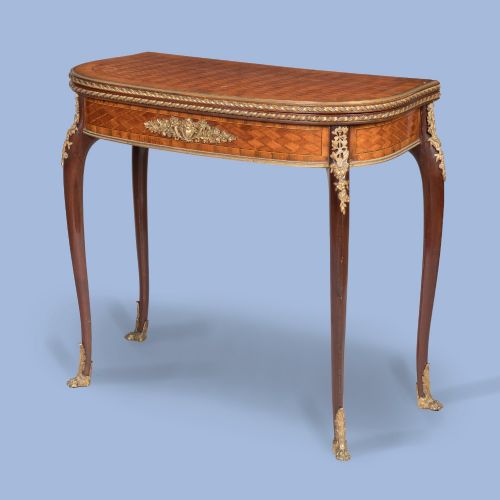
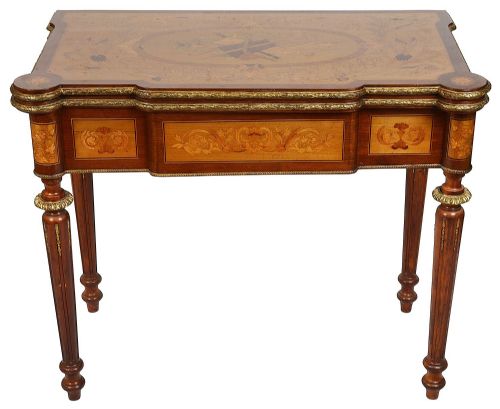
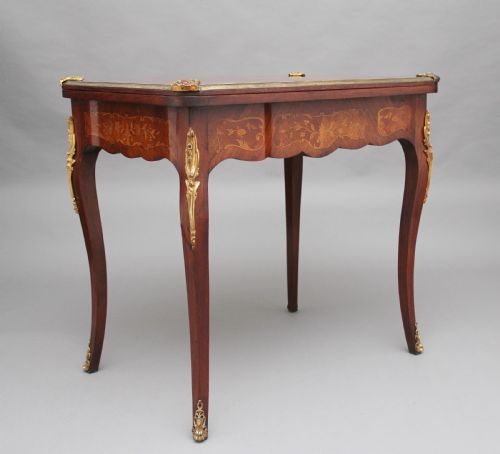
You are most likely to meet pieces adhering to the Louis XVI style and Louis XV revival, often featuring intricate parquetry or marquetry. These tables frequently take the form of fold-over card tables or console tables that transform into playing surfaces.
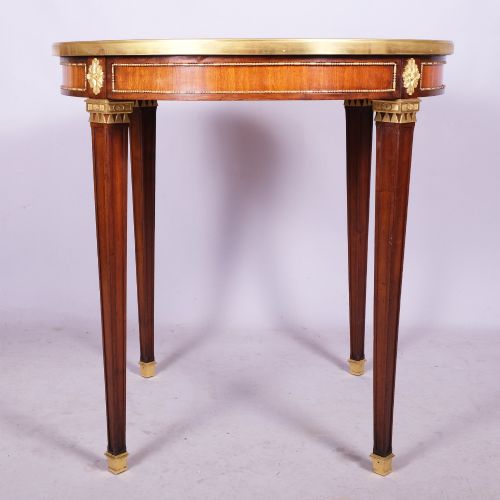
Origins stretch across French workshops and Victorian English interpretations, combining utilitarian card playing with decorative arts. The forms include bouillotte tables with marble tops alongside richly inlaid folding designs.
How they were made
Cabinetmakers constructed these tables using a hardwood carcass of kingwood, walnut, rosewood, or mahogany as the structural base. Surfaces were then adorned with elaborate parquetry and marquetry geometric or floral patterns.
Gilt bronze and ormolu mounts were cast and applied to borders, legs, and aprons to accentuate the architectural lines. Selected pieces incorporated inset marble tops bordered by brass or gilt bronze galleries.
Listings feature nineteenth-century pieces utilising kingwood, walnut, rosewood, and mahogany alongside gilt bronze and ormolu mounts.
What varies in quality
The distinction between standard production and top-tier pieces lies in the crispness of the gilt bronze chasing and the complexity of the wood veneers. Superior execution shows in the precision of the marquetry and the smooth engineering of the folding mechanisms.
Attribution to notable makers or adherence to specific revival styles elevates a piece above ordinary manufacturing. The integration of high-grade materials like finely grained kingwood and heavy, well-cast ormolu defines the upper range.
François Linke·Joseph-Emmanuel Zwiener·Gillows
The Gilt Bronze Games Table Glossary
- Ormolu
- Gilded bronze used for decorative mounts on furniture, highly fashionable in nineteenth-century French cabinetmaking.
- Parquetry
- Geometric wood inlay forming patterns such as cubes or chequers across the table top.
- Marquetry
- Pictorial wood veneer work depicting floral or scroll designs using contrasting timbers.
- Kingwood
- A dense, richly figured Brazilian timber prized for fine nineteenth-century cabinetwork.
- Bouillotte table
- A small round table with a raised gallery edge, often topped with marble and used for card games.
Gilt Bronze Games Table: Frequently Asked Questions
What is a gilt bronze games table?
A gilt bronze games table is a nineteenth-century entertaining piece, usually featuring a fold-over top for card playing and decorative metal mounts.
These tables were designed to sit against a wall as console or side tables before opening up for evening card games.
How do you use a fold-over games table?
The top leaf rotates and folds out to double the surface area, often revealing a baize or leather playing surface underneath.
When closed, the table functions as a slim console or side piece in a drawing room or hallway.
How do you date a nineteenth-century games table?
Dating relies on identifying stylistic markers such as Louis XVI revival symmetry or Victorian rococo curves, alongside timber choices like kingwood or walnut.
Construction methods and the weight and chasing of the ormolu mounts also provide clues to the exact decade of manufacture.
What distinguishes French style from Victorian pieces?
French nineteenth-century tables often lean heavily into Louis XV and Louis XVI revival aesthetics with precise parquetry and refined ormolu. Victorian interpretations can incorporate heavier walnut frames and broader floral marquetry.