


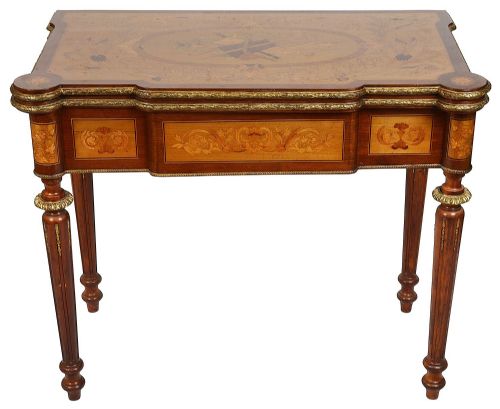


Louis XVI Games Table
A louis xvi games table brings refined French craftsmanship into a room, offering fold-over surfaces and intricate parquetry designed for evening entertainment.
Louis XVI Games Table
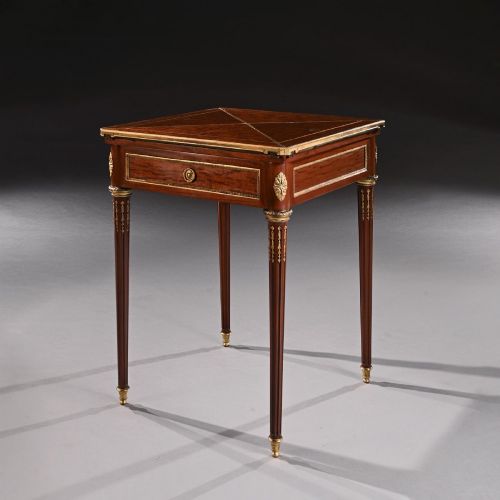
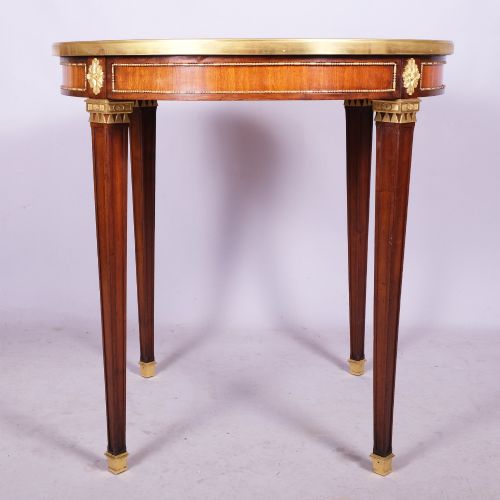
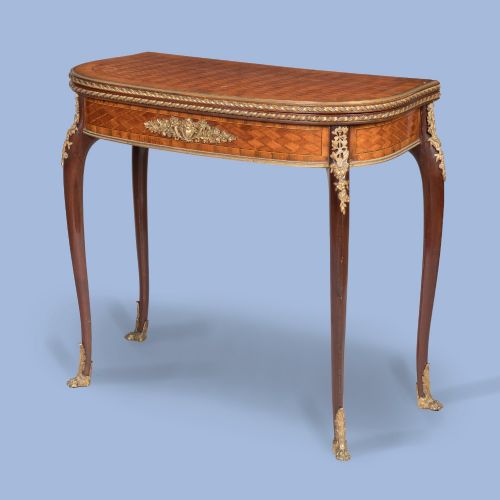
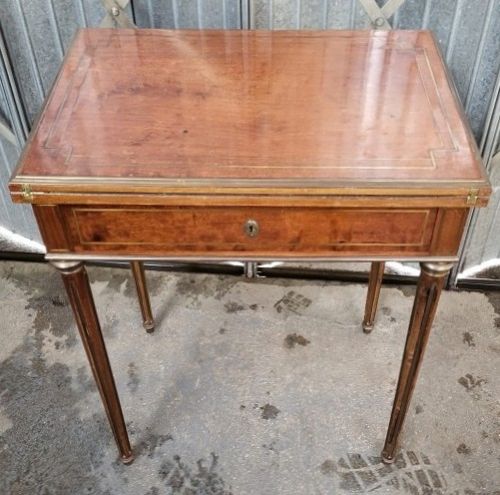
A louis xvi games table is typically encountered as a card or console table dating from the nineteenth century, reflecting revivalist tastes in France and Britain. These pieces often feature fold-over tops that reveal baize-lined surfaces, alongside circular bouillotte forms topped with marble and surrounded by brass galleries.
The construction embraces styles such as Louis XVI Revival and French Rococo Revival, showing a strong preference for symmetrical lines contrasted with elaborate wood veneers. Makers and workshops of the period utilised walnut, mahogany, and exotic woods to create geometric parquetry and pictorial marquetry.
Many examples incorporate bronze and ormolu mounts that accent the legs and apron, bridging the gap between decorative console furniture and functional gaming equipment.
How they were made
Cabinetmakers constructed the carcase using dense timbers like walnut and mahogany, onto which intricate parquetry and marquetry veneers of kingwood and rosewood were carefully glued. This surface work often forms geometric cubes or floral motifs across the folding top.
Cast ormolu and gilt bronze mounts were meticulously chased and fitted to the corners, legs, and borders to highlight the structural lines. Marble slabs were selected for circular bouillotte tables, then inset into brass galleries with exact precision.
Listings feature nineteenth-century revival pieces incorporating walnut, mahogany, kingwood, rosewood, marble, and ormolu.
What varies in quality
The distinction between standard production and top-tier pieces lies in the crispness of the gilt bronze or ormolu mounts and the complexity of the wood inlay. Superior workshops employed deep-chasing techniques on the metalwork and selected highly figured exotic veneers for the parquetry.
Ingenuity of the mechanical action also marks out superior examples, particularly in metamorphic side tables and envelope card tables where the leaves unfold smoothly together. The integration of the joints and the weight of the timber reflect the standard of the maker's workshop.
Antoine Lampre·François Linke·Maison Mottheau
The Louis XVI Games Table Glossary
- Ormolu
- Gilt bronze applied as a decorative mount to furniture. This technique involves gilding a mercury and bronze amalgam.
- Parquetry
- Geometric patterns formed by fitting veneer pieces together on a tabletop. It creates a striking tiled visual effect.
- Marquetry
- Pictorial or decorative veneer work using various coloured woods to depict foliage or scenes. Artisans cut these shapes from thin sheets of timber.
- Bouillotte table
- A small circular card table featuring a raised gallery edge around a marble top. It takes its name from an eighteenth-century card game.
- Envelop table
- A card table with four triangular flaps that swivel open to reveal the playing surface. The folding mechanism requires precise joinery.
Louis XVI Games Table: Frequently Asked Questions
How do I use a louis xvi games table?
These tables are designed with folding or pivoting tops that open to reveal baize-lined surfaces for card games and writing. When closed, they function as console or side tables against a wall.
To protect the timber and veneer, place them away from direct sunlight and radiators. Use coasters to shield the polish from drinks.
What is a bouillotte table?
A bouillotte table is a small, circular card table featuring an inset marble top surrounded by a pierced brass gallery. They were originally used for playing a French card game called bouillotte.
These tables frequently stand on slender tapered legs and often include small pull-out candle slides beneath the rim.
How do I identify parquetry?
Parquetry consists of small geometric pieces of veneer arranged in repeating patterns such as cubes, lozenges, or squares. It differs from marquetry, which depicts pictorial scenes or floral motifs.
On these tables, parquetry is typically showcased on the fold-over top to provide a decorative surface when closed.