




Gilt Bronze Card Table
A gilt bronze card table brings nineteenth-century French revival elegance and folding versatility into a drawing room.
Gilt Bronze Card Table
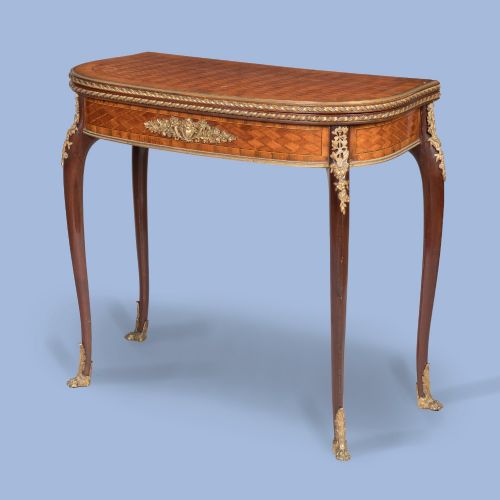
A gilt bronze card table is typically encountered as a nineteenth-century French games table designed with a fold-over top. The pieces appearing here span the Victorian era and the late nineteenth century, predominantly rendered in Louis XVI and Louis XV revival styles.
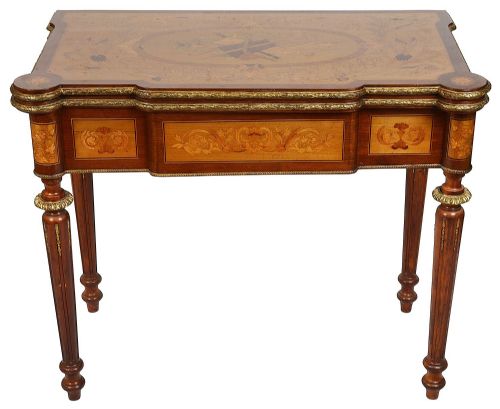
Makers and workshops of the period utilised forms such as demi-lune games tables and rectangular card tables alongside related console tables and centrepiece trays. Kingwood, walnut, and mahogany form the carcasses for parquetry and marquetry inlay work.
The form exists to provide a dual-purpose surface that functions as a side table when closed and opens to reveal a baize-lined playing surface. Examples range from standard parlour pieces to exhibition-quality works attributed to prominent makers.
Materials and Construction
Cabinetmakers constructed the frames using hardwoods like kingwood, walnut, and mahogany, often applying intricate parquetry and floral marquetry geometric patterns to the tops and sides. Surface veneers were carefully selected to create visual contrast across the folding leaves.
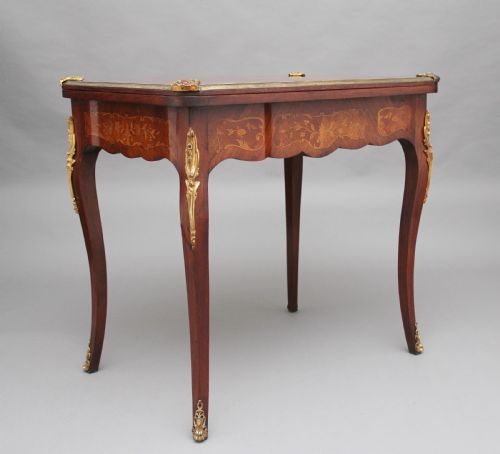
Ormolu and gilt bronze mounts were cast, chased, and fire-gilded before being fixed to the corners, apron, and legs to accentuate the contour of the table. Some pieces incorporate champleve enamel and onyx panels within the mounts.
The folding mechanism relies on hinged leaves that swivel or flip to reveal the games surface underneath, supported by pivoting rear legs or concertina frames.
Some nineteenth-century card tables hid secret compartments beneath the baize for stashing coin counters and ivory gaming tokens away from prying eyes.
Markers of Quality
The distinction between standard production and top-tier pieces lies in the crispness of the gilt bronze chasing and the complexity of the marquetry. Superior tables display deeply hand-chased ormolu mounts rather than shallow, mass-produced castings.
The selection and alignment of timber veneers dictate visual depth, where finer items use quartersawn kingwood and walnut arranged in symmetrical geometric patterns. Attribution to known workshops like François Linke or Gillows elevates a piece through documented craftsmanship and superior joinery.
François Linke·Joseph-Emmanuel Zwiener·Gillows
The Gilt Bronze Card Table Glossary
- Ormolu
- Gilt bronze mounted as decorative hardware on furniture. The technique involves applying a mercury and gold amalgam to cast bronze before heating.
- Parquetry
- Geometric wood veneer patterns arranged to form tessellated designs on tabletops. This technique contrasts with pictorial marquetry.
- Marquetry
- Pictorial wood veneer inlay depicting floral or scrollwork motifs. Cabinetmakers pieced different coloured woods together before gluing them to the carcass.
- Champleve
- Enamelling technique where troughs are dug into metal and filled with vitreous paste before firing. This coloured detail appears on mounts and trays.
- Bouillotte
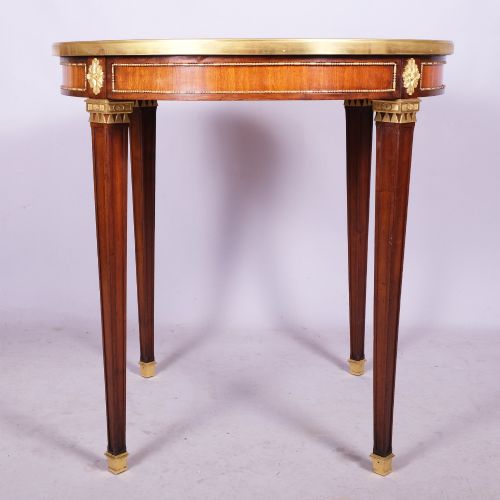
- Small round table with a raised gallery edge, traditionally used for card games. Examples frequently feature marble tops and brass or ormolu galleries.
Gilt Bronze Card Table: Frequently Asked Questions
What is a gilt bronze card table?
A gilt bronze card table is a nineteenth-century folding table featuring decorative gilt bronze or ormolu mounts. They were designed for parlour games and display during the Victorian and Belle Epoque periods.
These pieces combine functional folding mechanisms with decorative veneered timbers like kingwood and walnut. They serve as decorative console tables when closed.
How do you open a folding card table?
The top leaf rotates on a pivot or hinges open like a book to reveal a lined playing surface. A rear leg swings out from the frame to support the opened leaf.
Care must be taken with the hinges and pivoting leg mechanism to avoid straining the veneer or the gilt bronze mounts.
How do I care for kingwood and ormolu?
Kingwood veneer requires protection from direct sunlight and excessive humidity to prevent fading and splitting. Dust regularly with a soft, dry cloth.
Ormolu mounts should be cleaned gently without abrasive metal polishes that can strip the original fire gilding. Maintain a stable indoor climate.