


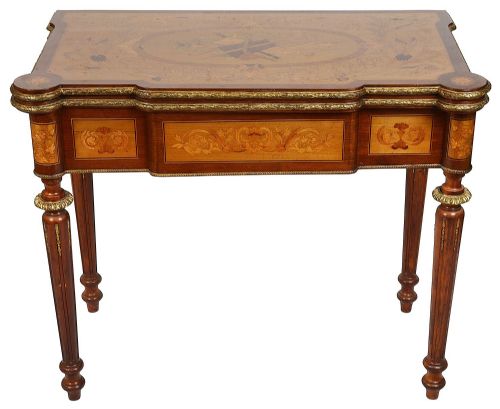


Louis XVI Card Table
A louis xvi card table brings sophisticated French elegance into a room, offering clever folding mechanisms and intricate marquetry for evening entertainment.
Louis XVI Card Table
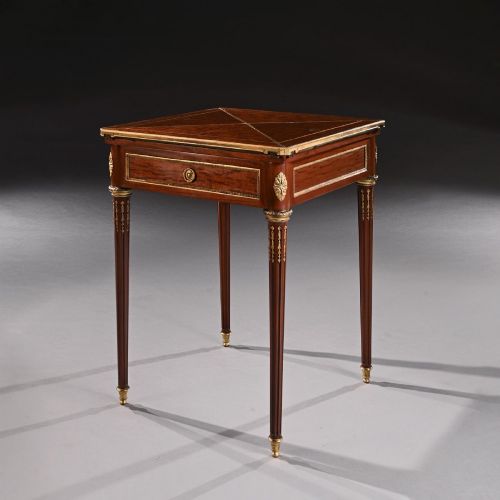
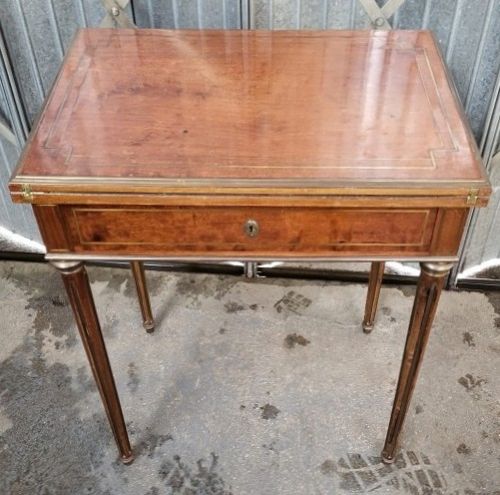
A louis xvi card table is a specialised piece of furniture designed for parlour games, featuring folding or rotating tops supported by slender legs. The versions met on this page originate predominantly from the nineteenth century, showcasing revival aesthetics inspired by earlier French royal taste.
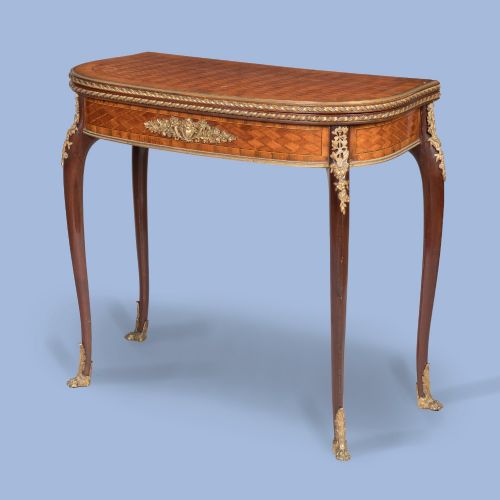
Makers and workshops of this period produced these tables in several distinct forms, including envelope designs, demilune shapes, and metamorphic side tables. These pieces function equally well as console tables when closed, adapting easily to modern living spaces.
Materials and construction
Cabinetmakers constructed these tables using a sturdy carcase of walnut or mahogany, overlaid with exotic woods arranged in geometric parquetry and pictorial marquetry patterns. Kingwood and rosewood frequently feature in these decorative veneer compositions, creating striking visual contrasts.
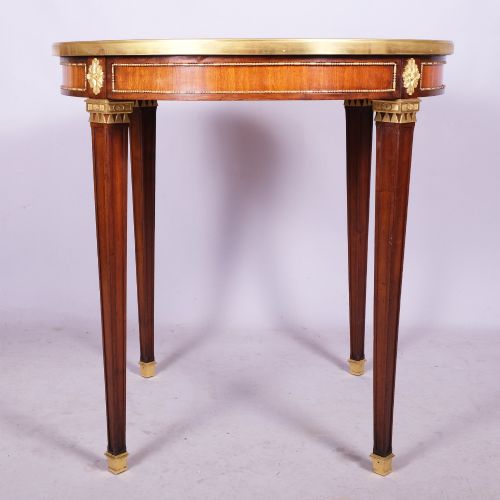
Ornate cast or chased ormolu and brass mounts highlight the structural lines and protect vulnerable corners, while inset marble occasionally forms the upper surface of related bouillotte tables. Skilled artisans combined precise joinery with lavish metal ornamentation to achieve the desired neoclassical elegance.
Louis XVI Card Table Retail Price Guide 2026
Typical asking prices for louis xvi card table among the pieces listed under this phrase on Sellingantiques today, from the lower quarter to the upper quarter. They describe what is for sale here now, not the wider market.
The listings combine nineteenth-century French revival pieces with walnut, mahogany, and exotic wood veneers finished with ormolu mounts.
Assessing quality and execution
The distinction between standard production and exhibition quality lies in the crispness of the gilt bronze mounts and the precision of the wood inlay. Superior examples display seamless parquetry where every grain aligns purposefully across the folding leaves.
Provenance and attribution to notable Parisian makers elevate the standing of a piece, as seen in works associated with François Linke or Antoine Lampre. The fluidity of the mechanical folding action and the stability of the timber frame further separate exceptional pieces from ordinary ones.
Antoine Lampre·François Linke·Maison Mottheau
The Louis XVI Card Table Glossary
- Ormolu
- Gilded bronze used for decorative mounts and accents on furniture. This material was cast and hand-chased to produce crisp, luxurious details.
- Parquetry
- Geometric patterns formed by fitting small wooden veneers together. It creates repeating motifs across table tops and friezes.
- Marquetry
- Pictorial or ornamental inlay work using various coloured woods. Artisans cut delicate veneer slices to picture floral or scroll designs.
- Demilune
- Half-moon shape, characteristic of tables designed to sit flush against a wall. These pieces often feature hinged leaves that unfold to form a full circle or square.
- Envelope table
- A card table with a clever folding top that opens like an envelope. Four triangular flaps pivot outward to reveal a baize-lined playing surface.
Louis XVI Card Table: Frequently Asked Questions
How do you open a louis xvi card table?
Most models feature a pivoting or folding top that swings open on concealed hinges to double the surface area for gaming. Envelope versions utilise a clever mechanism where four triangular flaps fold outward simultaneously.
Underneath the top, many designs incorporate a hidden shallow well or compartment originally intended for storing cards, counters, and small gaming accessories.
What is the difference between a bouillotte table and a card table?
A bouillotte table is a small occasional table traditionally featuring an elevated brass gallery edge and frequently an inset marble top. They were originally designed for a specific French card game.
Standard card tables on this page focus on folding or rotating tops that transform a console into a dedicated gaming surface lined with felt or leather.
Are these tables from the eighteenth century?
The vast majority of the pieces available date from the nineteenth century, specifically spanning the Victorian era up to around nineteen hundred. They are revival pieces created during periods of intense interest in classic French styles.
Cabinetmakers of the eighteen-eighties and nineties deliberately emulated the earlier eighteenth-century royal aesthetics using advanced nineteenth-century workshop techniques.