
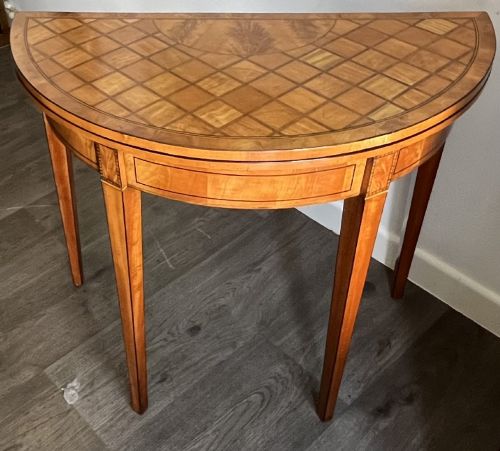
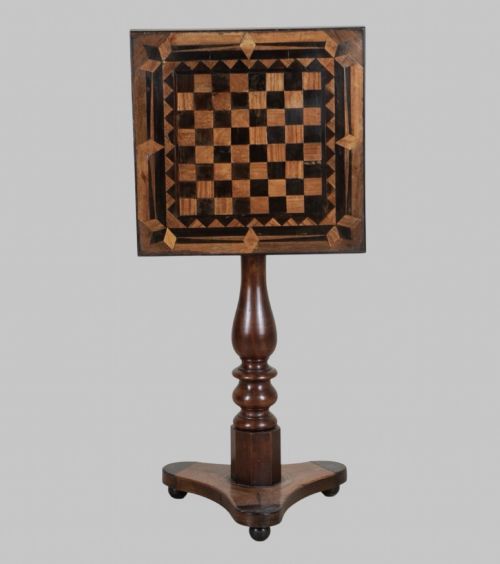
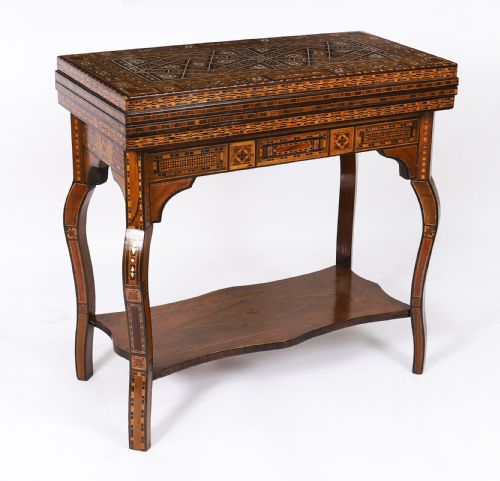
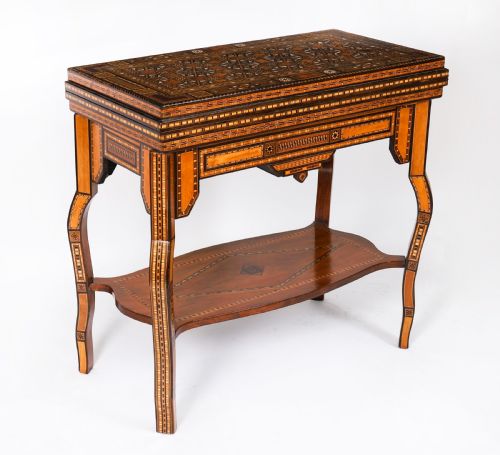



Parquetry Gaming Table
A parquetry gaming table brings geometric wood patterns and centuries of social play into a room.
Parquetry Gaming Table
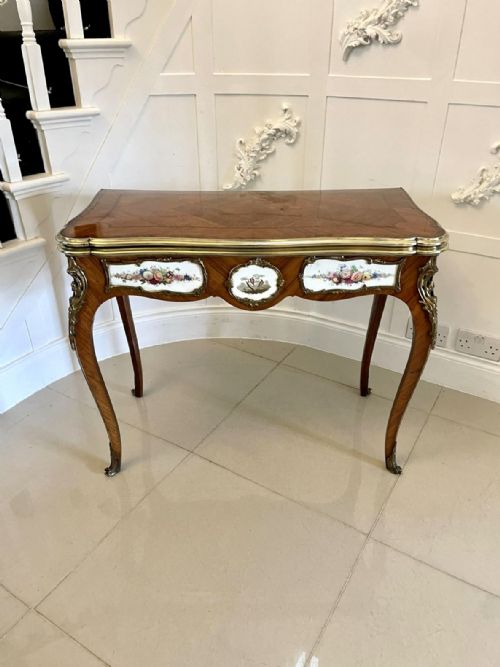
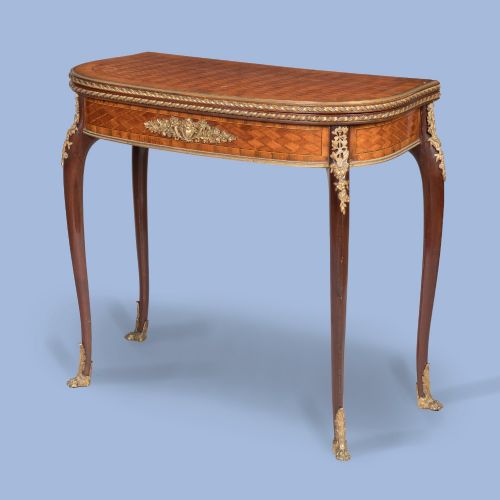
A parquetry gaming table is a dual-purpose piece designed for entertainment and display, appearing here in forms ranging from card tables and side tables to occasional tables. These pieces span the eighteenth century, the Georgian era, the nineteenth century, and the twentieth century, alongside specific revival movements.
The versions most commonly met on this page include French examples in the Louis XV and Louis XVI styles, alongside Georgian and Victorian pieces. They arrive with wooden surfaces arranged for cards, chess, and backgammon, often opening or pivoting to reveal storage or felt-lined playing areas.
Makers and designers of these tables utilised distinct regional vocabularies, stretching from European cabinet work to Levantine and Syrian Ottoman traditions. The resulting objects function as versatile furniture that shifts easily between formal display and active use.
What varies in quality
Quality rests upon the precision of the wood mosaic and the stability of the timber joints through decades of opening and pivoting. Finer tables display meticulous alignment in their geometric patterns and seamless integration of contrasting veneers.
The grade of the secondary mounts and the crispness of the ormolu detailing distinguish standard production from exceptional cabinet work. Superior pieces maintain smooth mechanical action in their folding tops and retain their original surface patination without excessive restoration.
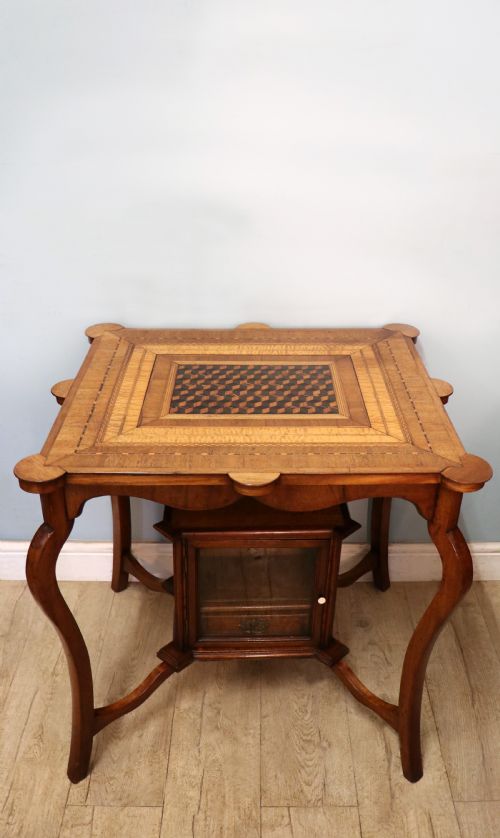
Several tables manage to conceal chess, backgammon, cards, and a smokers' cabinet all within the footprint of a single parlour table.
G T Morant·François Linke·Maison Mottheau·Joseph-Emmanuel Zwiener
The Parquetry Gaming Table Glossary
- Parquetry
- A geometric mosaic of wood veneers arranged in patterns such as cubes, chequers, or lozenges to ornament a surface. It forms the primary decorative skin of these gaming tops.
- Ormolu
- Gilt-bronze mounts applied to furniture edges and legs for architectural emphasis and protection. This technique requires meticulous casting and mercury gilding in period pieces.
- Demi-lune
- Half-moon or semicircular in plan, describing tables designed to sit flush against a wall before opening for play. This shape is common in French and English card tables.
- Bouillotte table
- A small circular occasional table with a raised gallery edge, traditionally used for the French card game of the same name. These often feature marble tops and candle slides.
Parquetry Gaming Table: Frequently Asked Questions
How were gaming tables used?
These tables served as everyday furniture until guests gathered for cards, chess, or backgammon after dinner. The tops typically folded, pivoted, or lifted off to reveal specialised playing surfaces.
Between gaming sessions, the tables functioned as side, console, or occasional furniture in reception rooms and parlours. Their dual nature allowed households to combine social entertainment with formal interior display.
How do I tell French styles apart?
Louis XV style pieces, often described through revival periods, feature asymmetric curves, cabriole legs, and flowing ormolu mounts. The lines are organic and rounded.
Louis XVI style tables show a return to classical symmetry, straight tapering legs, and geometric ormolu framing. The silhouettes rely on right angles and restrained proportions.
What games were played on them?
Many surviving tables feature multi-purpose tops inlaid for chess, draughts, and backgammon, often reversible or sliding to reveal baize-lined card surfaces underneath. These accommodated the varied evening pastimes of Georgian and Victorian households.
Specialist tables might focus solely on card games like whist or bouillotte, providing shallow wells for counters and candlesticks at the corners.
How do I care for parquetry surfaces?
Keep these tables away from direct sunlight and steady heat sources to prevent the intricate wood veneers from shrinking and lifting. Maintaining stable room humidity protects the underlying timber construction.
Dust gently with a dry, soft cloth and apply traditional wax polish sparingly when the wood appears dry. Avoid commercial liquid cleaners that can damage historic polishes.