
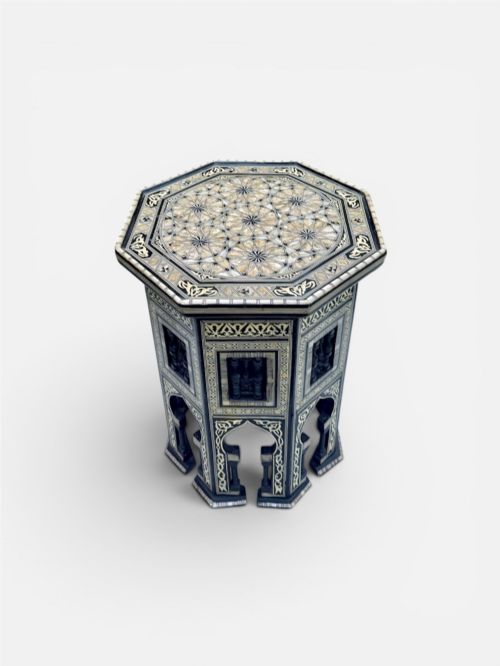

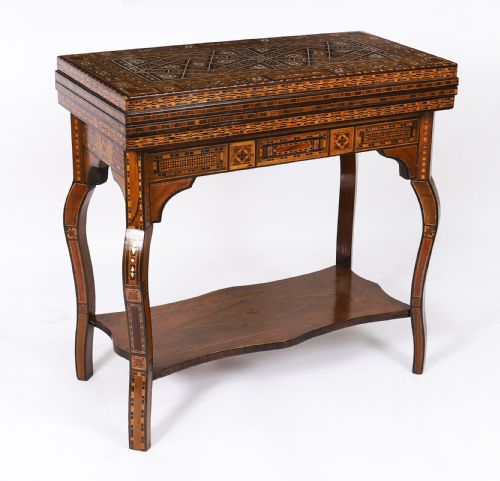
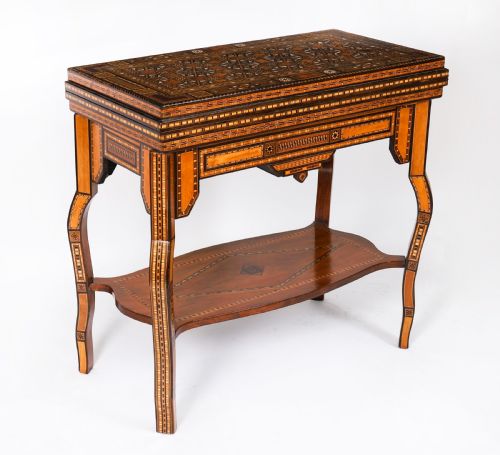
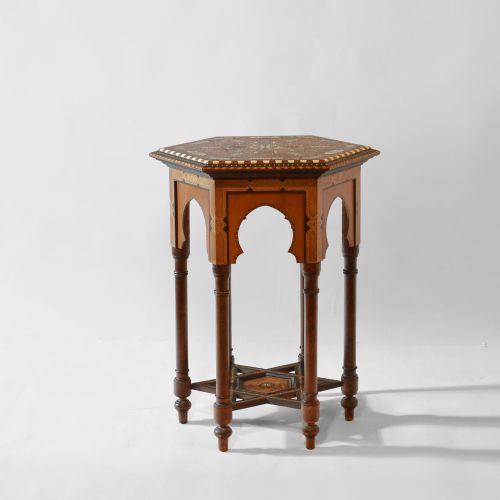


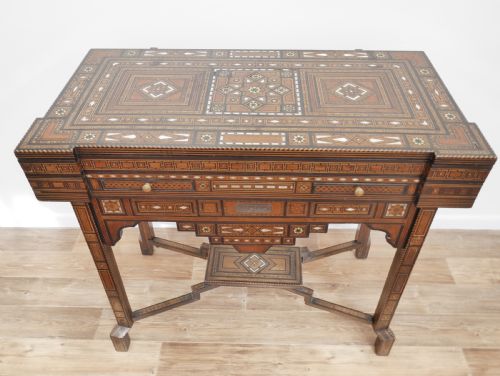

Syrian Marquetry Table
These Syrian marquetry tables bring intricate bone, mother-of-pearl, and varied wood inlays into your home.
Syrian Marquetry Table
When you search for a syrian marquetry table, you encounter intricate pieces originating primarily from Damascus during the nineteenth and early twentieth centuries. The selection ranges from octagonal and hexagonal side tables to complex games tables equipped for chess and backgammon.
Most examples you meet on this page feature geometric mosaic patterns constructed from contrasting timbers, bone, and mother-of-pearl. Occasional tables and metamorphic writing desks also appear, reflecting the rich decorative traditions of the Levant and the Ottoman Empire.
How they were made
Craftsmen built these pieces using walnut, fruitwood, ebony, and ebonised wood as a structural base for detailed geometric surface work. Individual pieces of bone and mother-of-pearl were meticulously cut and fitted alongside contrasting wood veneers to form elaborate interlocking patterns.
Makers utilised precise woodworking techniques to assemble multi-sided tabletops, chests, and folding games surfaces. The combination of natural shell, bone, and diverse timbers created the signature textured appearance characteristic of Syrian and Damascus craftsmanship.
Materials recur in combinations of walnut, fruitwood, bone, and mother-of-pearl, applied across forms including side tables, chests, and writing desks.
What varies in quality
The distinction between standard examples and the finest pieces lies in the precision and density of the inlay work. Superior items display tightly fitted mosaic sections with minimal filler, using generous quantities of mother-of-pearl and bone alongside select hardwoods like walnut.
Execution of the geometric symmetry and the condition of the delicate surface marquetry dictate the overall standing of each piece. Tables featuring integrated gaming boards with complex multi-material borders generally represent higher levels of artisan skill.
Liberty & Co.
The Syrian Marquetry Table Glossary
- Marquetry
- Decorative veneer work applied to a wooden structure to form geometric or pictorial patterns. This technique uses contrasting materials to create detailed surface designs.
- Mother-of-pearl
- The iridescent inner layer of mollusc shells used extensively for contrasting inlay work. Artisans cut this material into thin geometric shapes to catch the light on table surfaces.
- Moorish Revival
- An architectural and decorative style popular in the nineteenth century that reinterpreted Islamic design elements. Pieces in this category often feature complex arched motifs and dense surface ornamentation.
- Metamorphic
- Describing furniture designed to transform its function, such as a table that converts into a writing desk or games surface. These pieces incorporate clever concealed mechanisms.
- Octagonal
- Having eight sides and angles, forming a distinct shape common in Middle Eastern occasional tables. This geometry allows for balanced radial patterns in the tabletop inlay.
Syrian Marquetry Table: Frequently Asked Questions
What is a syrian marquetry table?
A syrian marquetry table is an intricately decorated piece of furniture featuring geometric wood veneers, bone, and mother-of-pearl inlay. Originating largely from Damascus during the nineteenth and early twentieth centuries, these tables often take octagonal or hexagonal forms.
They serve as decorative side tables, occasional stands, or multi-functional games tables designed for chess and backgammon. The rich use of contrasting materials gives each piece a distinctive mosaic appearance.
How do I use a games table?
These antique games tables function as standard occasional surfaces while concealing boards for chess, card games, or backgammon. You can place them in a living space as a focal point that offers interactive utility.
When hosting guests, the specialised tabletops provide an authentic setting for traditional board games. Their compact proportions make them adaptable for placement beside seating areas.
How do I clean mother-of-pearl inlay?
Maintenance requires gentle dusting with a dry, soft cloth to prevent dirt accumulation within the intricate crevices of the wood and shell mosaic. Avoid using harsh chemical cleaners, abrasive pads, or excessive moisture that might loosen the delicate bone and veneer components.
Conditioning the surrounding wood with appropriate natural wax helps preserve the timber without damaging the shell elements. Regular, careful upkeep ensures the multi-material surface remains stable over time.
How do I date an ottoman table?
Dating relies on examining the construction methods, timber selection, and stylistic markers associated with late nineteenth and early twentieth-century Levantine production. Pieces from this era often show specific regional motifs linked to Damascus workshops active between eighteen-eighty and nineteen-thirty.
Comparing the complexity of the bone and mother-of-pearl patterns against documented archive examples helps narrow down the period. The specific combination of ebonised wood, fruitwood, and walnut also provides clues regarding the decade of manufacture.