




French Ormolu Cassolettes
French ormolu cassolettes are reversible decorative urns that transform from vases to incense burners, bringing neoclassical elegance to any mantelpiece.
French Ormolu Cassolettes
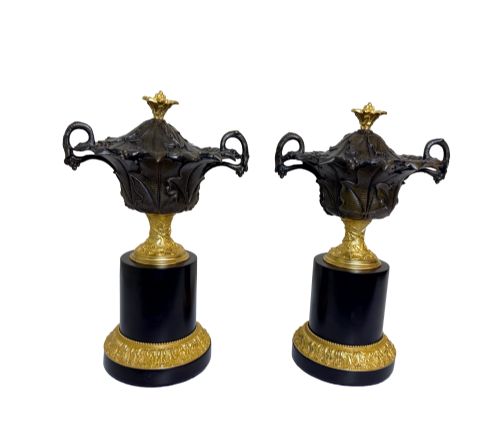
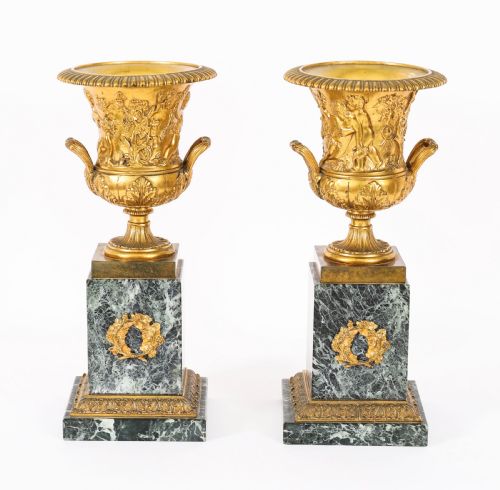
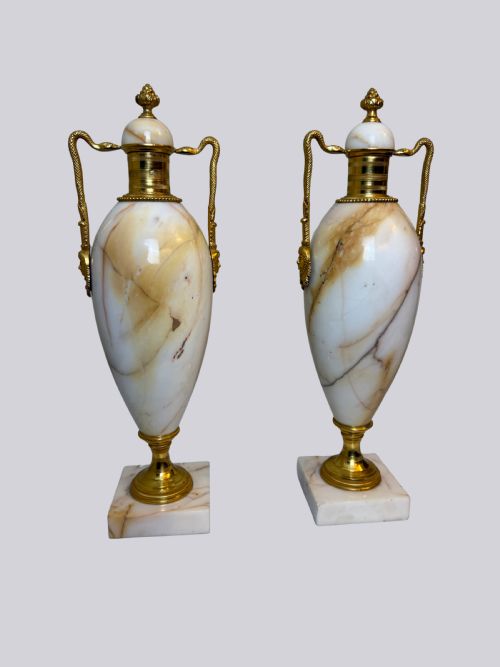
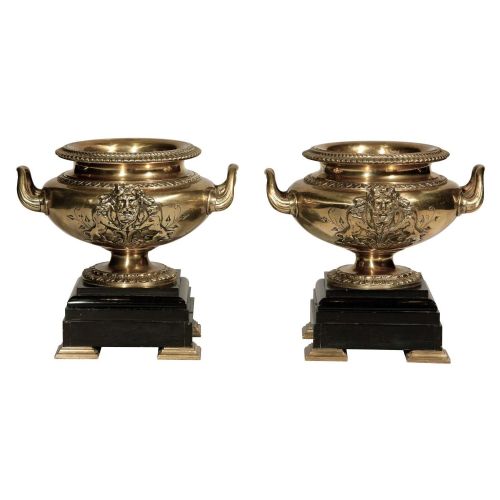
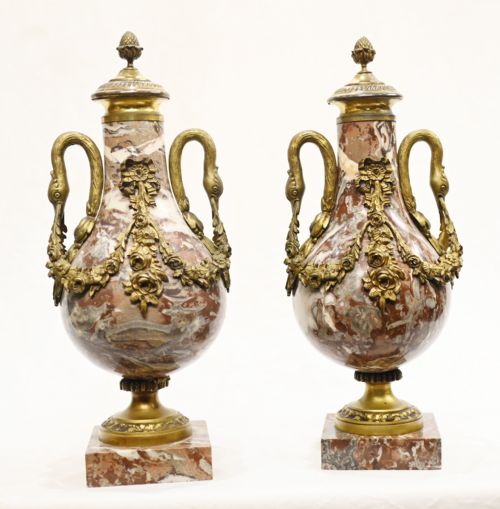
French ormolu cassolettes are ornamental vessels designed with a reversible lid that exposes either a solid vase top or an incense-burning insert. The pieces on this page span the nineteenth century, including Victorian and Napoleon III periods, reflecting a sustained demand for classical French interior ornamentation.
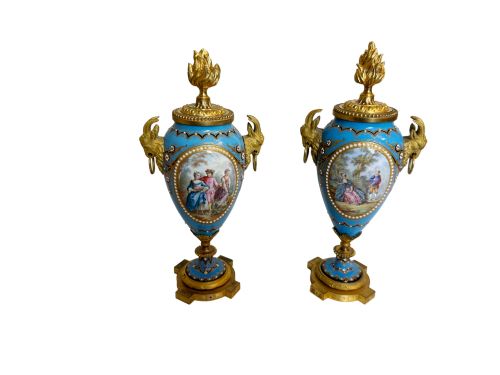
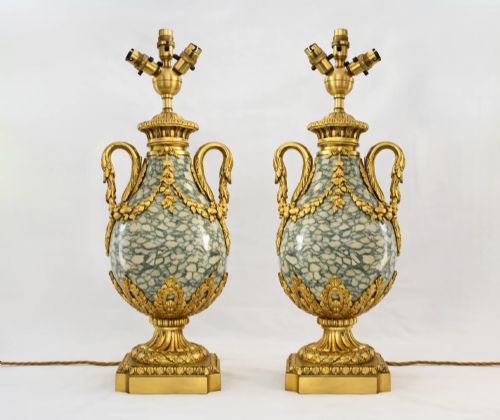
The dominant forms seen here are pairs of decorative urns, vases, and occasional table lamps or clock garniture sets. These items derive heavily from Louis XVI and French Empire styles, drawing on neoclassical design vocabulary intended to evoke ancient Rome and Greece.
Most examples combine turned stone bodies with gilt metal mounts, presenting a symmetrical silhouette suited for placement on mantelpieces, pedestals, and side tables. Buyers seeking these objects will encounter both dedicated cassolettes and related ornamental urns sharing the same structural vocabulary.
How They Were Made
The construction of these pieces relies on the pairing of cast bronze metals with carved and turned mineral bodies. Gilt bronze and ormolu provide the shimmering mounts, handles, and bases, while patinated bronze and silvered elements offer tonal contrast.
Stones such as white, green, rouge, and giallo di siena marble, alongside white and green onyx and quartz, form the main body of the vessels. These geological materials are shaped on lathes and fitted precisely with metal collars, rims, and finials.
Enamel, porcelain, including Sevres and Majolica types, and champleve techniques are integrated into the metal and stone framework for added colour and surface detail. The reversible lid mechanism is engineered to fit flush in both orientations, demonstrating precise metalwork.
French Ormolu Cassolettes Retail Price Guide 2026
Typical asking prices for french ormolu cassolettes among the pieces listed under this phrase on Sellingantiques today, from the lower quarter to the upper quarter. They describe what is for sale here now, not the wider market.
Many a nineteenth-century drawing room smelled faintly of burnt spices because guests could not resist flipping the lids to test the burners.
What Varies In Quality
Quality in these objects rests primarily on the crispness of the bronze chasing and the depth of the mercury gilding or ormolu finish. Finer examples display sharp leaf tips, distinct bead reels, and deeply modelled mounts that show no soft edges from worn casting moulds.
The selection and turning of the stone body create another tier of distinction, with unblemished marble or richly figured onyx commanding attention over more uniform materials. Well-matched stone pairs, where the natural veining mirrors across both vessels, indicate greater care in initial material selection.
The integration between metal and stone marks the standard of the workshop, distinguishing robust, seamless construction from loose or poorly aligned mounts. Superior pieces maintain structural balance and proportion between the heavy metal bases and the central mineral vessel.
The French Ormolu Cassolettes Glossary
- Cassolette
- A decorative vessel with a reversible lid that serves as either a vase or an incense burner. This dual function defines the primary category of object on this page.
- Ormolu
- Gilt bronze produced by applying a mercury and gold amalgam to a bronze base and heating it to drive off the mercury. This technique yields a durable, rich golden surface characteristic of fine nineteenth-century French mounts.
- Grand Tour
- A cultural journey through Europe undertaken by nineteenth-century elites, acquiring portable antiquities and decorative art. Pieces bearing this association often reflect classical tastes gathered during travel.
- Garniture
- A set of matching decorative objects, typically a clock flanked by matching urns or cassolettes. These sets were designed to sit harmoniously on a mantelpiece as a cohesive decorative unit.
- Champleve
- An enamelling technique where troughs or cells are hollowed out of a metal surface and filled with vitreous enamel powder before firing. It adds vibrant colour details to ormolu mounts and vases.
French Ormolu Cassolettes: Frequently Asked Questions
What is a cassolette?
A cassolette is a decorative vessel featuring a removable, double-sided lid. One side presents a closed vase top, while the reverse reveals a pierced burner for incense.
This clever design allowed nineteenth-century homeowners to switch the function of the object depending on the room's requirements or social occasion.
How do I date these pieces?
Dating relies on examining the material choices, casting quality, and stylistic revival cues. Nineteenth-century examples often blend Louis XVI neoclassical restraint with Victorian manufacturing methods.
Details such as the composition of the ormolu, the type of marble, and the presence of converted lamp fittings provide reliable chronological markers.
Where should I display them?
These pieces suit prominent flat surfaces such as mantelpieces, sideboards, or dedicated console tables. Because they were created as decorative focal points, they perform best when given adequate clearance to display their gilding and stone veining.
Pairs look particularly striking when flanking a clock or positioned symmetrically beneath a mirror.
Can I still burn incense in them?
While the lidded inserts were originally manufactured for burning aromatics, modern owners generally use them purely as decorative objects. The delicate nature of nineteenth-century gilding and antique stone makes regular use as a burner inadvisable.
Keeping them dry preserves both the internal metalwork and the exterior marble finishes.