




English Spring Clock
An English spring clock uses a coiled mainspring rather than falling weights to drive the mechanism, offering precise timekeeping in a portable wooden case.
English Spring Clock
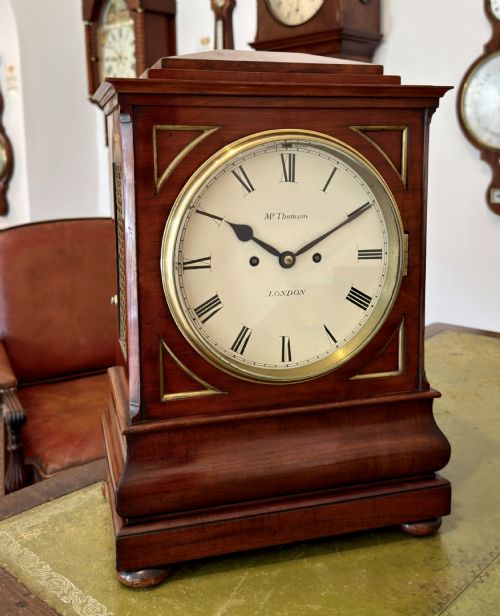
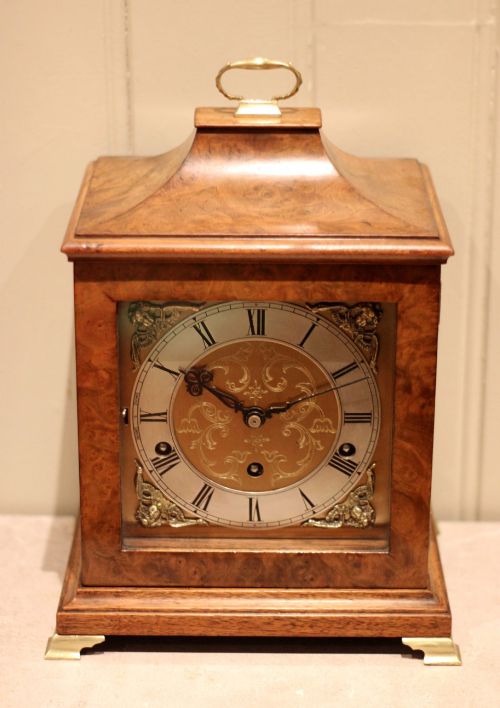
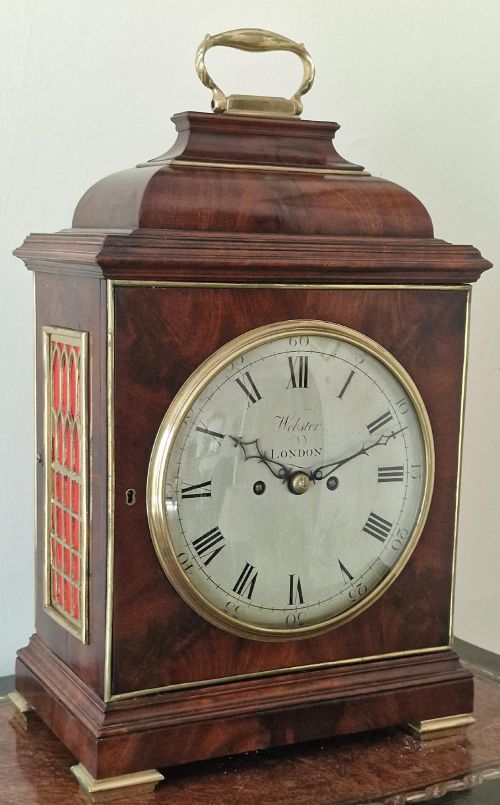
An English spring clock sits on a bracket, mantel, or table, designed to be moved easily between rooms without losing its set time. You will most frequently encounter mahogany and rosewood specimens from the Georgian and Victorian periods on this page.
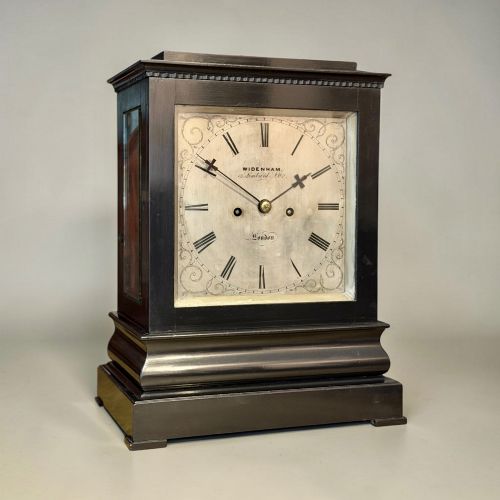
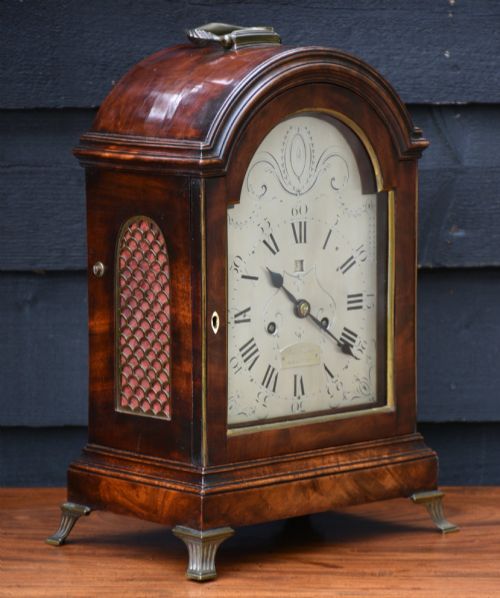
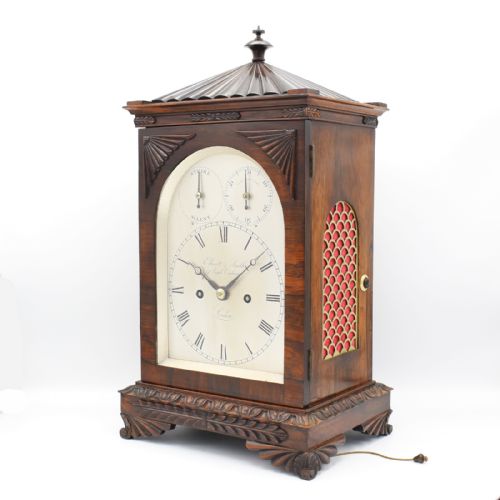
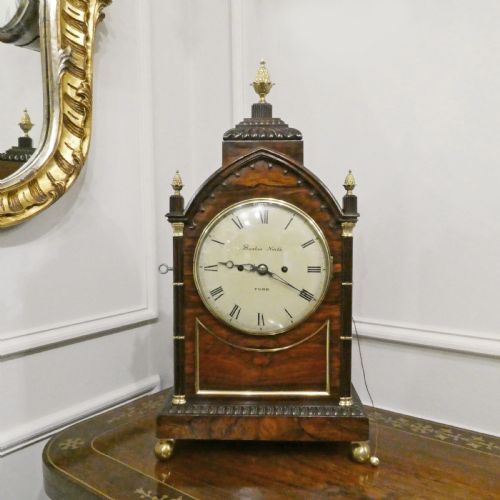
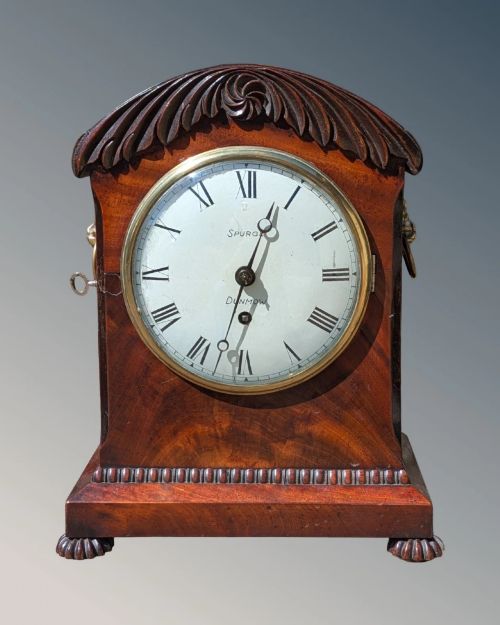
Makers housed these movements in compact wooden housings featuring brass dial details, glass viewing panels, and occasionally ebonised finishes. The overarching form evolved from the seventeenth-century basket top to later bell-top and architectural library clock designs.
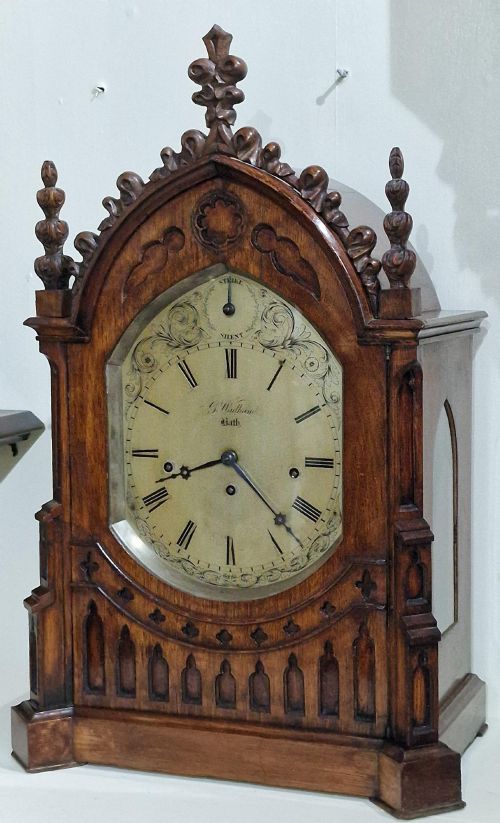
Regional makers from Bath, York, and Reading join notable London horologists in the available selection, demonstrating how widely spread precision clockmaking became across Britain. Each piece reflects the aesthetic preferences of its era, moving from simple mahogany boxes to elaborate Regency and Gothic revivals.
Materials and Movements
Cases utilise dense hardwoods like mahogany, rosewood, and ebony, often polished to a deep lustre and fitted with cast brass mounts, handles, and pierced frets for sound. Ebonised wood provides a sharp, dark finish favoured in the seventeenth century, while later Victorian versions lean towards rich burr walnut and heavy mahogany.
Mechanisms rely on brass plates and wheels driven by a steel spring housed within a barrel, frequently governed by a fusee chain to equalise the power output as the spring unwinds. Dials combine engraved silvered metal chapter rings with polished brass spandrels, protected behind glazed hinged doors.
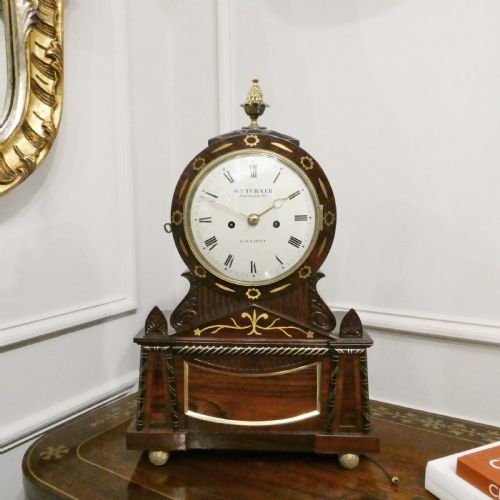
One London maker built an Egyptian revival spring clock complete with strange architectural styling to satisfy Georgian tastes.
Evaluating Construction and Craft
The refinement of the movement engraving and the precision of the gear train separate standard production from master work. Hand-engraved backplates signed by prominent makers indicate a higher tier of workshop output.
Cabinetwork quality shows in the choice of timber figuring, the crispness of brass inlay, and the retention of original glass and fittings. Originality of the dial and movement components dictates the integrity of the piece.
Thomson of London·Widenham of London·George Wadham Bath·Mappin and Webb·Ellicott and Smith·Barber and North of York·Turner of London·L Vick of Stroud·Spurge Dunmow·Jonathon Lowndes·Seller of Reading·Thomas Moss·John Witherston of Hereford·John Pepys London·William Speakman London·Cording of London·Piggin Norwich·Phillips Brothers·Geo Carter Hackney·J Kingerley Manchester·Paul Philip Barraud·Hyde of Salisbury·Richard Rooker·Brockbanks of London·Funnell of Brighton
The English Spring Clock Glossary
- Fusee
- A conical pulley used in spring-driven clocks to maintain even power as the mainspring unwinds. This ensures consistent timekeeping throughout the duration of the wind.
- Bracket clock
- A portable timekeeper originally designed to sit upon a matching wall bracket. They typically feature carrying handles on top and striking or chiming mechanisms.
- Verge escapement
- An early type of clock escapement that controls the drop of the teeth on a crown wheel. It regulates the motion of the clock using a balance wheel or pendulum.
- Silvered metal
- A brass dial plate treated with a silver compound to create a bright, contrasting background for black engraved numerals. It catches ambient light well in dimly lit rooms.
- Double fusee
- A movement incorporating two separate fusee cones, one powering the going train and the other driving the striking or chiming train. This setup ensures both functions receive regulated power.
English Spring Clock: Frequently Asked Questions
How do I wind my spring clock?
Insert the appropriate winding key into the dial holes and turn gently clockwise until you feel resistance. Do not overwind, as this can damage the mainspring.
Ensure you support the case if it is a portable model, and keep the key stored in a safe place away from the mechanism.
Why does my clock run fast or slow?
Changes in temperature and the natural settling of the mechanical parts affect the rate over time. Adjustment is usually handled via a small regulating square on the dial.
Small adjustments made over several days will bring the timekeeping back to accuracy without disrupting the escapement.
Can these clocks run on a wall bracket?
Many examples are built specifically to sit on matching wooden wall brackets, allowing the sound of the bell to resonate. The bracket must be firmly secured to a stud wall to bear the weight.
Table placement on a level surface works just as well if a wall fixing is not available.
What is the difference between a timepiece and a clock?
A timepiece simply tells the time without any striking or chiming mechanism. A clock includes additional gear trains to sound the hours or quarters on bells.
Both utilise the same spring and fusee principles for driving the hands.